


Never toss a disposable vape in your curbside trash or recycling bin. Its lithium-ion battery and leftover nicotine make it a fire and toxicity risk for waste workers, so the right move is a Household Hazardous Waste (HHW) facility or authorized battery recycler. Call ahead first to confirm they take vapes and check any drop-off limits.
TL;DR:
- Household hazardous waste facilities are the safest and most reliable option for recycling disposable vapes, often at no cost, but calling ahead is essential.
- Proper preparation involves leaving devices sealed if non-removable or taping and storing batteries separately in non-metal containers, to prevent hazards during transport.
- Never dispose of vapes or loose lithium batteries in curbside trash or recycling because crushed batteries can spark fires inside compactors or waste trucks.
- For those without nearby HHW sites, options include battery-only recyclers, mail-back kits, or community collection events, always following strict safety and shipping rules.
- Using longer-lasting vape devices reduces hazardous waste, and consumers should verify local disposal rules beforehand to ensure safe and compliant recycling practices.
Table of Contents
- Where Can You Take Disposable Vapes for Recycling?
- How Do You Prepare a Disposable Vape for Drop-Off?
- What Should You Never Do With a Used Vape?
- What If There’s No HHW Site Near You?
- How Should You Store and Transport Multiple Devices?
- Why Does Proper HHW Handling Actually Matter?
- A Retailer’s Quick Note on Safe Disposal
- A Lower-Waste Way to Vape Without Changing Habits
- Where to Verify Local Disposal Rules
- Sources
- FAQ
Where Can You Take Disposable Vapes for Recycling?
Household hazardous waste sites are the primary route for disposable vape recycling, and most municipal programs accept them at no charge to residents. These sites are built to handle exactly this kind of mixed hazard: a lithium battery paired with a chemical residue. Retail take-back programs exist in some areas too, but they’re inconsistent from one chain or city to the next, so don’t assume your local shop participates without asking first.
If you’ve already popped the battery loose, a standalone battery recycler or a mail-back battery kit can handle that piece separately.
Here’s how the main options break down:
- HHW facilities and events: the standard, EPA-recommended path; usually free; call to confirm hours and device limits.
- Retailer or municipal take-back programs: available in some regions, not standardized; phone or check the store’s website before making a trip.
- Battery-only recyclers: accept removed lithium cells, following EPA’s battery collection guidance on terminal taping and safe containers.
- Mail-back battery kits: a fallback for people without nearby HHW access, discussed in more detail below.
How Do You Prepare a Disposable Vape for Drop-Off?
Preparation is where most people either get it right or accidentally create a hazard in their own car. A disposable vape isn’t a gadget you take apart for fun, and the New Hampshire Department of Environmental Services specifically warns against disassembling devices that weren’t designed to open.
Follow these steps before you leave the house:
- Leave sealed, non-removable devices exactly as they are. Do not pry them open.
- If the battery is removable, tape both terminals with electrical or packing tape.
- Place each taped battery in its own small bag or rigid container, separate from other batteries.
- Pack everything in a plastic bin, not a metal one, and keep devices upright.
- Store the container somewhere cool during transport. Never leave it in a hot car.
- Call the HHW site ahead of time to confirm packaging rules and any per-visit device caps.
Pro Tip: Keep a small dedicated box in a closet for used devices as you finish them, so you’re never scrambling to find and tape loose batteries the morning of your HHW appointment.
What Should You Never Do With a Used Vape?
Some habits feel harmless but actually cause real damage at the waste stream level. Curbside trash and recycling trucks use compactors, and a crushed lithium battery inside one of those machines can spark a fire that damages the whole load, or the truck itself.
Avoid these entirely:
- Never put vapes or loose lithium batteries in curbside trash or recycling bins.
- Never crush, puncture, or try to burn a device to “empty it out.”
- Never pour leftover nicotine e-liquid down a sink or toilet, and don’t try to neutralize it with household chemicals.
- Never attempt to dismantle a device that has an embedded, non-removable battery.
The EPA’s guidance on e-cigarette disposal is blunt about this: damaged batteries are the leading cause of fires linked to improperly discarded vapes, and that risk shows up immediately, not years down the road.
What If There’s No HHW Site Near You?
Plenty of readers live somewhere without a convenient HHW facility, and that’s genuinely frustrating when you’re trying to do the right thing. A few fallback options still work.
- Battery-only recyclers take lithium cells you’ve already removed and taped, following the same terminal-taping and container rules EPA lays out for household collection.
- Mail-back kits are sold specifically for battery and e-cigarette waste, but they come with strict carrier rules. Follow the kit’s instructions exactly. Shipping a loose lithium battery outside an approved kit can violate hazardous-material shipping regulations.
- Community collection events pop up periodically through counties or environmental groups, and some retailer take-backs accept devices too, but always verify scope first. Many programs explicitly exclude cannabis or THC vape devices, which route through separate guidance.
How Should You Store and Transport Multiple Devices?
If you vape regularly, used devices tend to pile up before you get around to disposing of them. That’s a mistake worth avoiding.
- Keep devices in a cool, dry spot away from anything flammable, and out of reach of kids and pets.
- Check whether your local HHW site limits how many devices you can drop off per visit or requires an appointment, then plan your trip around that.
- Don’t stockpile for months. Batteries degrade with age, and an aging lithium cell is more prone to leaking or overheating than a fresh one.
A shoebox of forty dead vapes sitting in a garage for a year is a bigger fire risk than the same forty devices dropped off in four separate trips.
Why Does Proper HHW Handling Actually Matter?
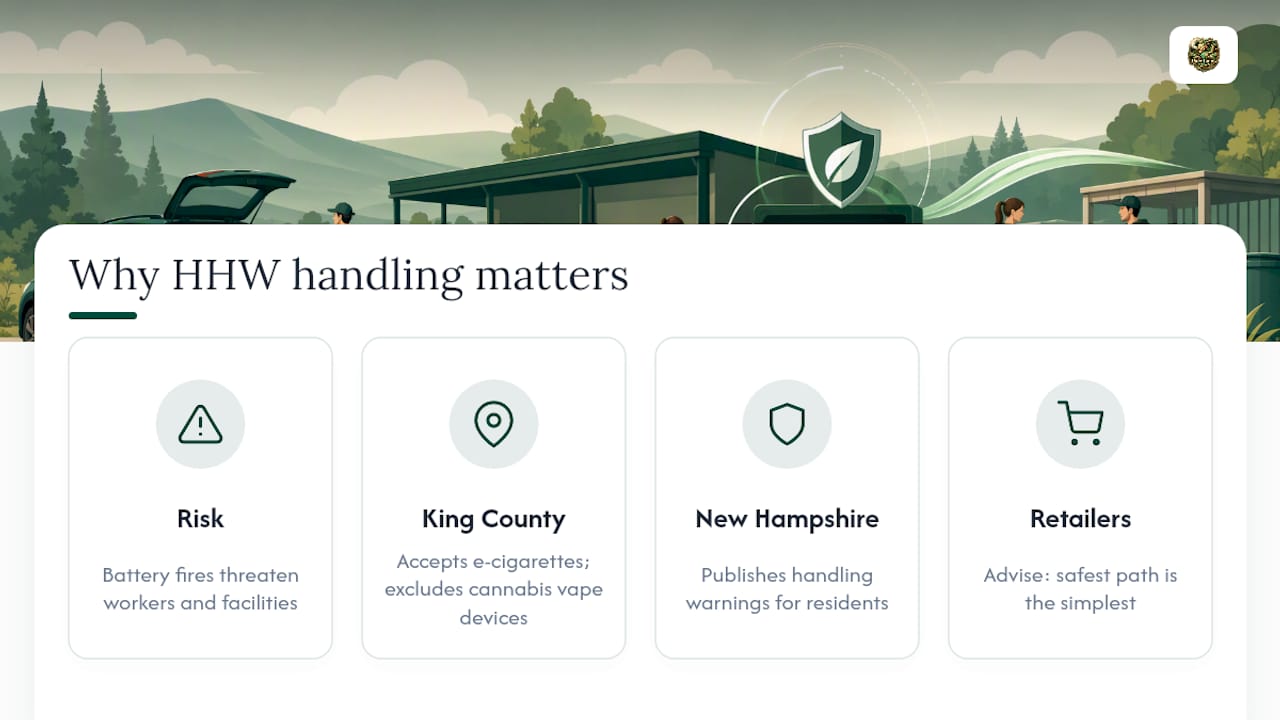
The EPA doesn’t recommend HHW routing as a bureaucratic formality. Its guidance exists because damaged lithium batteries cause fires that threaten sanitation workers and recycling facilities directly, not just the environment in some abstract long-term sense. Municipal programs back this up with real operating rules. King County, Washington, for example, accepts e-cigarettes at its HHW sites but excludes cannabis vape devices, and New Hampshire’s environmental agency publishes similar handling warnings for residents.
Some vape retailers have spent years writing buyer and safety guides for people navigating device choices and end-of-life questions, and that retailer-level view keeps coming back to the same point: the safest path is also the simplest one.
A Retailer’s Quick Note on Safe Disposal
Writing guides on device performance and battery handling for this long teaches you one thing fast: people want a simple answer, not a policy lecture. Retailers generally point customers toward HHW because it’s the route built to handle nicotine and lithium together safely. Some stores can support local collection efforts, but that varies by location and agreement. Whatever you do, follow your municipality’s specific rules and ask before you assume a site takes vapes.
— James
A Lower-Waste Way to Vape Without Changing Habits
Every disposable you use is eventually a disposal event, so fewer devices per month means fewer trips to the HHW site and fewer batteries entering the waste stream in the first place. That math is exactly why longer-life devices are worth a look if you’re trying to cut down on hazardous waste without giving up vaping altogether.
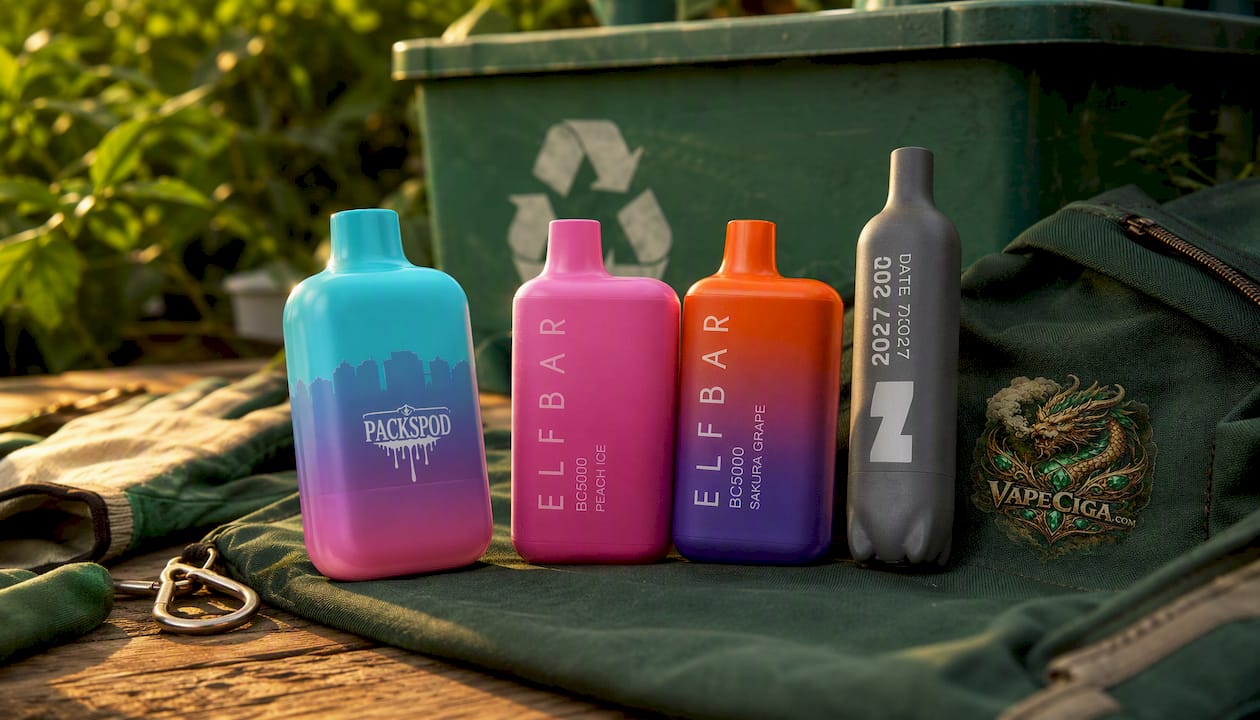
VapeCiga carries several higher-capacity options built around this idea. The Packspod 5000 and BC5000 both offer significantly more puffs per device than standard disposables, and the 2027 Date 7 2000 rounds out the lineup for shoppers who want a longer-lasting alternative to replace more often than they’d like. If you do pick one up, the same disposal rule still applies once it’s spent: take it to an HHW site or authorized recycler, never the trash. Browse the current lineup at VapeCiga and pick the device that matches how much you actually vape in a week.
Where to Verify Local Disposal Rules
Before you make a trip, confirm the details directly with an official source. The EPA’s e-cigarette disposal page covers national guidance, while pages like King County’s HHW program show how local rules and exclusions work in practice. Always call your nearest site before visiting.
Sources
- How to safely dispose of e-cigarettes: Information for individuals | US EPA
- E-cigarettes and vape devices - King County, Washington
- E-Cigarettes and vape devices | New Hampshire Department of Environmental Services
FAQ
Does Home Depot Take Vapes for Recycling?
Home Depot’s in-store battery recycling bins are generally meant for standard rechargeable batteries, not sealed disposable vapes with embedded lithium cells. Check with your nearest location or route the device through an HHW facility instead.
Can You Use a Disposable Vape That’s a Couple Years Old?
An unused disposable vape that’s been sitting for a year or two will likely have a degraded battery and stale e-liquid, and its performance and safety both decline with age. If it hasn’t been used, dispose of it through HHW rather than trying to vape it.
Can You Get Money for Recycling Vapes?
Most HHW and battery-recycling programs don’t pay for disposable vapes; they’re a free public service, not a scrap-metal exchange. A handful of retailer take-back promotions occasionally offer store credit, but that’s not standard or guaranteed.
What Can You Do With Old Disposable Vapes Besides Throwing Them Away?
Once a device is dead, an HHW facility or battery recycler is the only appropriate destination. Some people repurpose the outer shells for small-parts storage after batteries are safely removed by a professional recycler, but the internal components always need proper hazardous-waste handling.