


Mouth to lung vape tanks are devices engineered to replicate the draw of a cigarette, pulling vapor into the mouth first before inhaling into the lungs. This style of vaping, known in the industry as MTL (mouth to lung), uses coils above 1.0 ohm and operates between 10–18W, producing a tight, controlled draw with concentrated flavor. MTL tanks are the top choice for smokers transitioning to vaping because they feel familiar, use e-liquid efficiently, and deliver a satisfying throat hit without requiring high wattage or large clouds. VapeCiga stocks a full range of MTL-compatible gear for vapers at every level.
What makes mouth to lung vape tanks different from direct lung tanks?
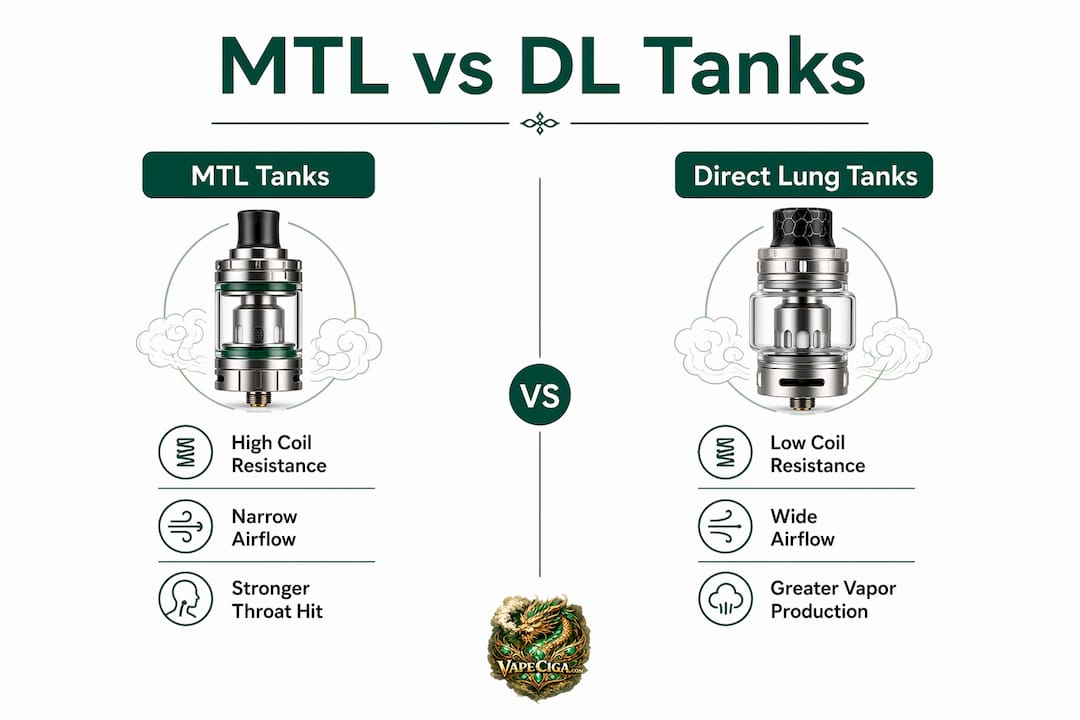
The core difference between MTL and direct lung (DL) tanks is coil resistance and airflow design. Coil resistance above 1.0 ohm signals an MTL setup, favoring lower wattage and a tighter draw. Resistance below 1.0 ohm suits sub-ohm DL vaping, where vapor floods the lungs directly and cloud production is the priority.
Airflow design is where the real separation happens. MTL tanks use narrow airflow holes, a smaller chimney, and a narrower drip tip. Draw style, dictated by airflow and drip tip shape, cannot be replicated by simply tightening the airflow on a DL tank. The geometry of the tank itself determines the experience.
The practical impact shows up in three areas: vapor production, throat hit, and e-liquid consumption. MTL tanks produce less visible vapor but deliver a sharper, more focused throat hit. They also consume far less e-liquid per session. That combination makes them economical and discreet.
| Feature | MTL tanks | Direct lung (DL) tanks |
|---|---|---|
| Coil resistance | Above 1.0 ohm | Below 1.0 ohm (sub-ohm) |
| Wattage range | 10–18W | 40–100W+ |
| Airflow | Tight, restricted | Wide, open |
| Vapor production | Low to moderate | High |
| Throat hit | Strong, focused | Mild, diffuse |
| E-liquid use | Low | High |
MTL tanks are also significantly better for coil longevity. Running at 10–18W puts far less thermal stress on the coil material compared to sub-ohm setups. Vapers who prioritize flavor accuracy and economy consistently favor MTL hardware.
What e-liquids work best with MTL vape tanks?
The right e-liquid makes or breaks the MTL experience. MTL tanks pair best with 50/50 PG/VG or high-PG e-liquids because thinner viscosity wicks faster through tight coil cotton. High-VG liquids (70/30 or 80/20) are too thick for most MTL coils and cause dry hits or clogging.
Nicotine salts are the strongest match for MTL vaping. Salt nic formulas deliver higher nicotine concentrations, typically 25mg or 50mg, with a smoother throat hit than freebase nicotine at the same level. That smoothness matters because MTL draws are slower and more deliberate, giving nicotine more time to absorb.
The best e-liquid categories for MTL tanks include:
-
Nicotine salt formulas at 25mg or 50mg for strong satisfaction without harshness. Options like Coastal Clouds TFN Salt Nic or VGOD SaltNic are built for this style.
-
50/50 PG/VG freebase liquids at 3mg or 6mg for vapers who prefer a lighter nicotine hit with more throat sensation.
-
Tobacco and menthol flavors because the tight draw and concentrated flavor delivery of MTL tanks amplify these profiles naturally. Tobacco Monster Salt Nic is a strong example of a bold tobacco salt nic designed for this style.
-
Fruit and mint profiles in salt nic form, such as MINTS Vape Co SALT or Juice Head Salts, which shine through the focused flavor delivery of MTL coils.
Avoid max-VG cloud-chasing liquids entirely. They will gunk up your coil within a day and produce a muted, unsatisfying flavor even if the coil survives.
How to choose and set up an MTL tank for the best performance
Choosing the right MTL tank starts with airflow control. Slight adjustments to airflow can shift the draw from a tight cigarette-like pull to a looser, airier feel called Restricted Direct Lung (RDL). Most quality MTL tanks include a rotary airflow ring with multiple hole sizes. Start with the smallest opening and open it gradually until the draw feels right for you.
Top airflow vs. bottom airflow
Top-airflow MTL tanks prevent leaks more reliably than bottom-airflow designs. Bottom-airflow tanks draw air directly past the coil, which improves flavor slightly but creates a path for e-liquid to seep out when the tank is tilted or stored. For everyday carry, top-airflow tanks are the more practical choice.
Priming your coil correctly
Coil priming is the single most important maintenance step for MTL tanks. Drip e-liquid directly onto the coil cotton and allow 10–15 minutes of soaking before your first draw. Skipping this step burns the dry cotton instantly, producing a harsh taste and destroying the coil within minutes.
Pro Tip: After priming, take three or four slow dry draws without firing the device. This pulls e-liquid deeper into the cotton and removes any air pockets before you apply power.
Setting wattage and choosing a drip tip
MTL tanks perform best within their recommended wattage range, typically 10–18W. Running above the maximum wattage shortens coil life and produces a hot, harsh draw. Running below the minimum produces weak, cool vapor with poor flavor.
Drip tip shape also affects the experience. Narrow bore drip tips (510 style with a small inner diameter) concentrate vapor and increase throat hit. Wider bore tips open the draw slightly and reduce heat. Swapping the drip tip is the cheapest and fastest way to fine-tune your setup.
What coil resistance levels and wattage ranges define MTL vaping?
Coil resistance is the defining technical specification of any MTL tank. Values above 1.0 ohm indicate MTL setups that favor lower wattage and tighter draws. Values below 1.0 ohm cross into sub-ohm territory, where direct lung vaping and higher vapor production take over.
MTL tanks operating at 10–18W consume less e-liquid per puff and generate less heat, which extends coil life considerably compared to sub-ohm setups. That efficiency is a real financial advantage for daily vapers.
Some MTL tanks also support Restricted Direct Lung (RDL) vaping. RDL uses lower-resistance coils in the 0.3–0.8 ohm range with wider airflow settings. The draw is looser than true MTL but tighter than full DL vaping. RDL suits vapers who want slightly more vapor without committing to a full sub-ohm setup.
| Coil resistance | Vaping style | Wattage range | Vapor output | Throat hit |
|---|---|---|---|---|
| 1.0–1.8 ohm | True MTL | 10–15W | Low | Strong |
| 0.8–1.0 ohm | MTL/RDL crossover | 12–18W | Low to moderate | Moderate |
| 0.3–0.8 ohm | RDL | 18–35W | Moderate | Mild |
| Below 0.3 ohm | Sub-ohm DL | 40W+ | High | Very mild |
The practical takeaway is simple. If you want a cigarette-like draw with strong throat hit and efficient liquid use, stay at 1.0 ohm and above. If you want slightly more vapor while keeping a restricted feel, experiment with 0.8 ohm coils and open the airflow one notch.
Key Takeaways
MTL vape tanks deliver the best flavor and throat hit when paired with coils above 1.0 ohm, 10–18W wattage settings, and 50/50 PG/VG or nicotine salt e-liquids.
| Point | Details |
|---|---|
| Coil resistance defines the style | Use coils above 1.0 ohm for true MTL draws; below 1.0 ohm shifts toward sub-ohm DL vaping. |
| E-liquid viscosity matters | Choose 50/50 PG/VG or high-PG nicotine salt formulas to prevent clogging and dry hits. |
| Airflow controls the experience | Small airflow adjustments shift the draw from tight MTL to a looser RDL feel. |
| Prime coils before every use | Soak coil cotton for 10–15 minutes before firing to prevent burnout and extend coil life. |
| Top-airflow tanks reduce leaks | Top-airflow designs are more reliable for daily carry than bottom-airflow alternatives. |
Why I think most vapers underestimate the MTL tank
I switched from smoking to MTL vaping years ago, and the first thing that surprised me was how much the airflow setting mattered. I had assumed the coil resistance was the main variable. It is not. Two tanks with identical 1.2 ohm coils can feel completely different if one has a slightly wider airflow slot. I spent weeks blaming coil brands before I realized I was just opening the airflow ring too far.
The second thing I got wrong was e-liquid choice. I tried a 70/30 VG/PG liquid in an MTL tank because I liked the flavor profile. The coil was dead in two days. Switching to a 50/50 salt nic formula from VapeCiga doubled my coil life and made the flavor noticeably sharper. The physics are simple: thin liquid wicks faster than thick liquid through tight cotton.
The mistake I see most often from vapers new to MTL is skipping coil priming. They fill the tank, take a draw immediately, and burn the cotton in the first ten seconds. That coil is finished. It cannot be recovered. Priming takes fifteen minutes and saves you from replacing coils every other day.
My honest recommendation is to start with a top-airflow tank, a 1.2 ohm coil, and a 50mg nicotine salt. Set your wattage to 12W. Take slow, deliberate draws. Give yourself a week before you start adjusting anything. Most vapers who “don’t like MTL” just never gave the setup a fair trial at the right settings.
— James
VapeCiga’s MTL tank and e-liquid selection
VapeCiga carries a strong lineup of hardware and e-liquids built specifically for MTL vaping. Whether you are setting up your first MTL rig or upgrading an existing one, the catalog covers everything from compact mods to salt nic e-liquids optimized for tight-draw coils.
The Vaporesso GTX One Vape Mod is a compact, efficient mod that runs comfortably in the 10–18W range ideal for MTL tanks. For vapers who prefer a ready-to-use option, the Packspod 5000 delivers a consistent MTL-style draw without any setup. Pair either device with a salt nic e-liquid like Air Factory TFN Salt Nic for a complete, flavor-forward MTL experience. Browse the full range at VapeCiga to find the setup that fits your style.
FAQ
What is a mouth to lung vape tank?
A mouth to lung vape tank is a device designed to draw vapor into the mouth before inhaling into the lungs, mimicking the feel of a cigarette. These tanks use coils above 1.0 ohm and operate at 10–18W for a tight, flavor-focused draw.
How do MTL tanks differ from sub-ohm tanks?
MTL tanks use higher-resistance coils (above 1.0 ohm) and lower wattage (10–18W), producing less vapor and a stronger throat hit. Sub-ohm tanks run below 1.0 ohm at 40W or more, prioritizing large vapor clouds over flavor concentration.
What nicotine strength works best for MTL vaping?
Nicotine salts at 25mg or 50mg are the standard choice for MTL vaping because they deliver high nicotine satisfaction smoothly at low wattage. Freebase nicotine at 3mg or 6mg in a 50/50 PG/VG ratio also works well for vapers who prefer lighter nicotine.
Why does my MTL coil taste burnt after one day?
A burnt taste almost always means the coil was not primed before use or the e-liquid is too thick for the coil cotton to wick properly. Soak the coil for 10–15 minutes before firing and use a 50/50 PG/VG or high-PG liquid to prevent this.
Can I use an MTL tank for RDL vaping?
Some MTL tanks support Restricted Direct Lung (RDL) vaping by using lower-resistance coils in the 0.3–0.8 ohm range with wider airflow. The draw is looser than true MTL but still more restricted than full direct lung vaping.