


The 21700 wins on runtime and sustained power delivery — but the 18650 remains the smarter pick for compact devices, legacy hardware, and vapers running below 45 watts. The size difference is real: a 21700 is 3 mm wider and 5 mm longer, and that extra volume translates to roughly 35–50% more energy capacity per cell.
- 21700 is the better choice when you’re running a high-wattage mod (above 75 W), building an e-bike pack, or using a power tool that ships with 21700 cells.
- 18650 stays relevant for single-cell flashlights, MTL vaping rigs, and any device where tube diameter is fixed at 18 mm.
- Weight matters: a 21700 runs heavier versus an 18650, so in a pocket EDC light, that difference is noticeable.
Table of Contents
- How do 18650 and 21700 compare at a glance?
- What do “18650” and “21700” actually mean?
- How do capacity, CDR, and internal resistance actually differ?
- Which format performs better for vaping, flashlights, e-bikes, and tools?
- Can you swap 18650 and 21700 cells in the same device?
- What safety practices apply to both formats?
- How long do these cells last, and what shortens their life?
- What do 18650 and 21700 cells cost in the U.S., and who makes them?
- How do you pick the right cell for your device or build?
- Which cells do enthusiasts and vendors actually use?
- Which format should you choose?
- Key Takeaways
- A note on sourcing and responsible use
- Where to find compatible devices at VapeCiga
- Sources and datasheets
How do 18650 and 21700 compare at a glance?
| Spec | 18650 | 21700 |
|---|---|---|
| Physical dimensions | 18 mm × 65 mm | 21 mm × 70 mm |
| Typical capacity | moderate milliampere-hour ranges | higher milliampere-hour ranges |
| Typical CDR (high-drain) | moderate amperage ranges | higher amperage ranges |
| Energy density / volume | Moderate | Higher in modern INR cells |
| Weight | lighter range | heavier range |
| Common applications | Vaping, EDC flashlights, laptops | Vaping, e-bikes, power tools, EVs |
| U.S. retail price (per cell) | lower price range | higher price range |
| Typical cycle life | 300–500 cycles | 300–500 cycles (varies by C-rate) |
A word on CDR figures: the numbers above reflect datasheet continuous discharge ratings, not the pulse or peak values manufacturers sometimes advertise. Always cross-check the spec sheet before assuming a cell can sustain a given current draw.
What do “18650” and “21700” actually mean?
The names are just dimensions. The first two digits are the diameter in millimeters, the next two are the length, and the trailing zero is a cylindrical-cell convention. So 18650 = 18 mm diameter × 65 mm long; 21700 = 21 mm × 70 mm.
That 3 mm width increase and 5 mm length increase sound modest, but the volume math is not. A cylinder’s volume scales with the square of the radius, so:
- 18650 volume: π × 9² × 65 ≈ 16,513 mm³
- 21700 volume: π × 10.5² × 70 ≈ 24,231 mm³
- Difference: roughly 47% more internal volume in the 21700
More volume means more active electrode material, which is why capacity and CDR both climb. The 21700 was developed partly to meet EV and high-power tool demands — Tesla’s 2170 cell (used in Model 3 and Model Y packs) is essentially the same format.
Pro Tip: If you’re visualizing the size difference, a 21700 is roughly the diameter of a AA battery plus a small shim, while an 18650 is closer to a standard AA in diameter. Neither fits a AA slot — but that mental image helps.
How do capacity, CDR, and internal resistance actually differ?
The capacity gap is the headline number, but internal resistance is what determines real-world performance under load.

18650 cells typically land between 2,000 and 3,500 mAh; 21700 cells commonly reach 3,000–5,000+ mAh. Translated to watt-hours (at a nominal 3.6 V), a 3,000 mAh 18650 stores about 10.8 Wh, while a 4,000 mAh 21700 stores roughly 14.4 Wh per cell. That gap compounds in multi-cell packs.
Lower internal resistance in the 21700 means less voltage sag under heavy current draw. When you’re pulling 30+ amps continuously, a cell with higher internal resistance heats up faster and its terminal voltage drops more sharply. That’s the physics behind why 21700 cells tend to handle high-drain applications with less thermal stress.
| Metric | 18650 (typical) | 21700 (typical) |
|---|---|---|
| Capacity range | 2,000–3,500 mAh | 3,000–5,000+ mAh |
| Typical CDR (high-drain cells) | 20–30 A | 30–45+ A |
| Internal resistance | Moderate | Generally lower |
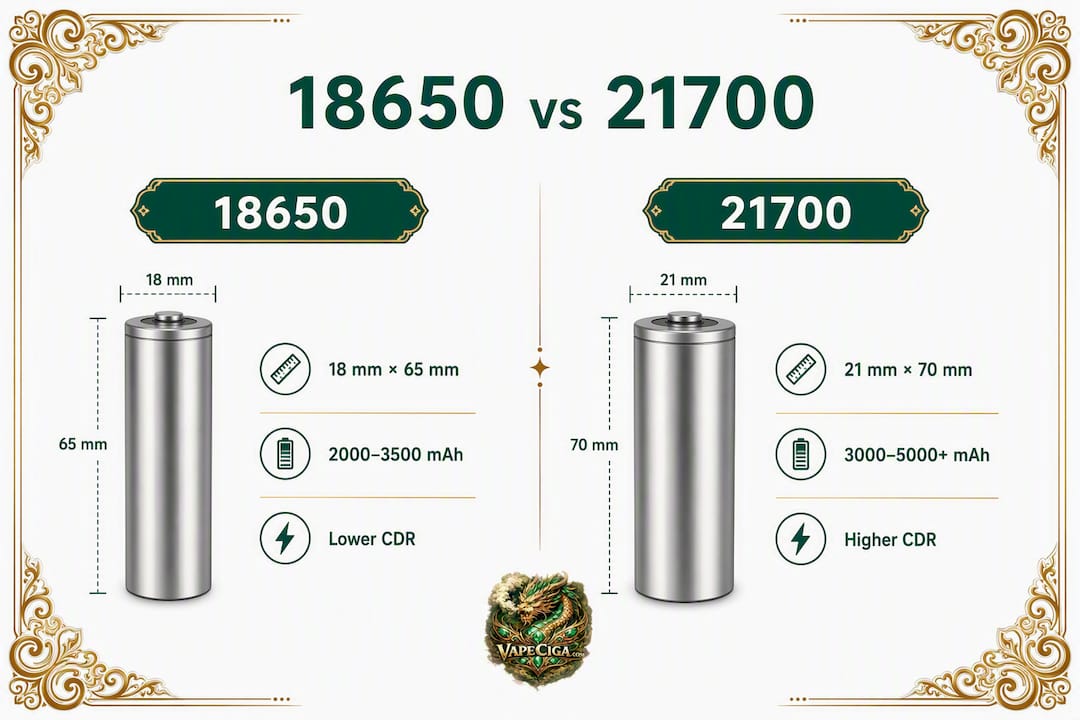
There’s a hard trade-off baked into lithium-ion chemistry: a cell cannot simultaneously maximize capacity and discharge current. High-capacity cells (like a 3,500 mAh 18650) typically carry a lower CDR than a 2,500 mAh high-drain cell of the same format. Choose based on what your device actually draws, not the highest mAh number on the wrapper.
Marketing figures frequently cite pulse or peak discharge values rather than true continuous discharge ratings. A cell advertised as “40A” may sustain only 20–25 A continuously before thermal limits kick in. The datasheet CDR is the number that matters.
Pro Tip: Mooch315 (a widely cited independent battery tester) publishes measured CDR and capacity results for dozens of cells. Cross-referencing his test data against the manufacturer datasheet takes about two minutes and can prevent a genuinely dangerous mismatch.
Which format performs better for vaping, flashlights, e-bikes, and tools?
Vaping
Under roughly 45 W, an 18650 is usually sufficient; between 45 and 75 W, either format works. Above 75 W, the 21700 is the better choice for both runtime and safe power delivery. Switching to a 21700 in the same mod commonly yields 40–60% longer runtime depending on wattage and cell selection.
For MTL (mouth-to-lung) vapers running 12–25 W, a quality 18650 lasts a full day easily. Sub-ohm users at 80–100 W will notice the 21700 difference immediately. The Vaporesso Swag Ⅱ VW Box Mod 80W is a good example of a single-18650 device that sits right at the edge of that wattage band — fine for moderate use, but a 21700-capable mod gives you more headroom.
| Wattage band | Recommended format | Notes |
|---|---|---|
| Under 45 W | 18650 | Sufficient runtime; lighter device |
| 45–75 W | Either | 21700 gives longer sessions |
| Above 75 W | 21700 | Better thermal behavior, longer runtime |
Flashlights
Single-cell EDC lights are almost universally built around 18650 tubes. The format’s 18 mm diameter fits the standard flashlight body that’s been the industry norm for two decades. A 21700 simply won’t slide into that tube. High-output lights that push 1,000+ lumens for sustained periods benefit from a 21700’s higher capacity and lower voltage sag, but only if the light is designed for it. Weight matters here too: a 21700 typically weighs 60–72 g compared to an 18650’s 44–50 g, so the difference is noticeable in a pocket light.
E-bikes and battery packs
This is where 21700 earns its strongest case. Fewer cells per pack for a given capacity means simpler battery management system (BMS) wiring, more physical space for thermal management materials, and generally better pack efficiency. A 48 V, 14 Ah e-bike pack built with 21700 cells uses fewer cells than the equivalent 18650 pack, which reduces the number of spot-weld joints and potential failure points.
Power tools
Most modern cordless tool platforms have migrated toward 21700 cells in their packs. The higher CDR handles the burst current demands of a circular saw or impact driver more comfortably, and the lower internal resistance means less heat buildup during sustained use. If you’re rebuilding a tool pack, check the original cell format before sourcing replacements.
Can you swap 18650 and 21700 cells in the same device?
Physical incompatibility is absolute in one direction: a 21700 will not fit a device designed for 18650. The 3 mm diameter difference is not negotiable. Going the other way, some 21700-designed devices accept an 18650 with an adapter sleeve, but that introduces additional contact resistance at the sleeve interface. For high-drain applications, that added resistance generates heat and reduces efficiency. It’s workable for low-drain use; it’s not a good idea for a mechanical mod or a high-current tool.
Charger compatibility is a separate issue. Older smart chargers may not accommodate a 70 mm cell — check the charger bay length and spring travel before attempting to charge a 21700. A charger bay designed for 65 mm cells may not make reliable contact with a 21700, or the spring may not compress enough to seat the cell properly.
Pro Tip: Before buying a 21700 cell for an existing charger, measure the usable bay length with a ruler. Most modern multi-bay chargers (Nitecore, Xtar, Opus) accommodate both formats, but chargers more than five years old often don’t.
Key checks before swapping formats:
- Confirm the device’s tube or bay diameter (18 mm vs. 21 mm internal clearance)
- Measure charger bay length against the cell’s physical length
- Check spring travel and contact type (flat top vs. button top matters in some devices)
- For pack builds, verify spot-welding nickel strip width and BMS current ratings match the new cell format
What safety practices apply to both formats?
Authentic cells are the foundation of everything else. A counterfeit 18650 or 21700 can have a CDR a fraction of what the wrapper claims, a capacity that’s been inflated by 30–50%, and a protection circuit that doesn’t function. The consequences range from a dead device to a thermal runaway event.
Checklist for authenticating a cell before use:
- Weight check: compare the cell’s actual weight against the manufacturer’s datasheet spec. A 21700 should weigh 60–72 g, and an 18650 should be 44–50 g. Significantly lighter cells are a red flag.
- Buy from authorized distributors: in the U.S., reputable sources include established vape hardware retailers, battery specialty stores, and direct manufacturer distributors. Avoid marketplace listings from unknown sellers with no return policy.
- Look up the datasheet: every legitimate cell from Sony/Murata, Samsung SDI, LG Chem (now LG Energy Solution), and Molicel has a published datasheet. If you can’t find one, that’s a problem.
- Inspect the wrapper: nicks, bubbles, or thin spots in the PVC wrap expose the cell’s metal casing and create short-circuit risk. Re-wrap or discard damaged cells.
Pro Tip: Store loose cells in a hard plastic case, never loose in a pocket or bag with keys or coins. Metal contact across the positive and negative terminals causes immediate short circuits — this is how most vaping-related battery incidents start.
Charging guidance:
- Use a charger with per-bay current control and a termination voltage of 4.20 V ±0.05 V.
- Charge at 0.5C or lower when possible (for a 3,000 mAh cell, that’s 1.5 A or less).
- Never leave cells charging unattended overnight.
- For 21700 cells in older chargers, confirm bay length accommodates 70 mm before charging.
How long do these cells last, and what shortens their life?
Both formats share similar cycle life ranges under comparable conditions, typically 300–500 full charge/discharge cycles before capacity drops to about 80% of rated capacity. The bigger variable is how hard you push them.
High C-rate discharge (drawing current at or near the CDR continuously) accelerates degradation faster than moderate use. A 21700 cell used in a 100 W mod every day will age faster than the same cell in a 40 W device, even if the CDR is technically within spec. Depth of discharge matters too: cycling a cell from 100% to 0% repeatedly stresses it more than partial cycles between 20% and 80%.
Temperature is the other major factor. Heat above 45°C during charging or discharging accelerates electrolyte breakdown. Cold storage below 0°C doesn’t damage cells but reduces available capacity temporarily.
Do/don’t list for maximizing lifespan:
- Do store cells at 40–60% charge if they’ll sit unused for more than a few weeks.
- Do keep cells in a cool, dry location away from direct sunlight.
- Don’t discharge below 2.5 V per cell — most regulated mods cut off automatically, but mechanical setups don’t.
- Don’t charge immediately after heavy use; let the cell cool to near room temperature first.
Pro Tip: Partial cycles (topping off from 50% rather than running to empty) genuinely extend lithium-ion cycle life. If your device allows it, charging at 80% and discharging to 20% can roughly double the number of usable cycles.
What do 18650 and 21700 cells cost in the U.S., and who makes them?
18650 cells are widely available from Samsung SDI (25R, 30Q), Sony/Murata (VTC5A, VTC6), LG Chem (HG2, MJ1), and Molicel (P26A). Retail prices in the U.S. typically run $5–$12 per cell depending on the model and seller. The format has been in mass production for over 20 years, so supply is deep and counterfeits are also common.
21700 cells are produced by the same manufacturers plus Panasonic/Sanyo and several Chinese producers. U.S. retail prices generally run $8–$15 per cell. The format has scaled rapidly since Tesla’s adoption of the 2170 cell, and production volumes have grown enough that pricing is now competitive with premium 18650 cells.
The 20700 format sits between the two and has a noticeably shrinking ecosystem. New removable-battery devices and tool packs are increasingly designed around 21700, while 20700 selection continues to narrow. If you’re choosing between 21700 vs 20700 for a new build, the 21700 is the forward-compatible choice.
Buying tips:
- Purchase from authorized vape hardware retailers, battery specialty stores, or direct manufacturer distributors.
- Avoid marketplace listings with no brand storefront, no return policy, or prices well below the typical range.
- Check the cell’s weight on a kitchen scale before first use — it takes 30 seconds and catches most fakes.
How do you pick the right cell for your device or build?
Follow this sequence before buying:
- Check your device’s spec sheet for the required cell format (18650 or 21700) and any button-top vs. flat-top requirement.
- Identify your device’s maximum continuous current draw. For vape mods, divide wattage by the minimum voltage (usually 3.2 V) to get approximate amps. A 100 W mod at 3.2 V draws about 31 A.
- Select a cell whose CDR exceeds your device’s draw with a safety margin. For regulated mods, 10–20% headroom is reasonable. For mechanical setups, use a much larger margin and choose the highest verified CDR cell available.
- Confirm charger compatibility. If your charger is more than five years old, measure the bay length before buying 21700 cells.
- Weigh size and weight trade-offs. A 21700-capable mod is larger and heavier. If portability matters more than runtime, an 18650 device may be the better daily carry.
- Source from a reputable vendor and verify authenticity on arrival.
For specific use cases:
- MTL vaping (12–25 W): 18650, high-capacity cell (3,000+ mAh), lower CDR is fine. The Vaporesso GTX One Vape Mod 2000mAh 40W uses an integrated cell, but for external-battery MTL rigs, 18650 is the standard.
- Sub-ohm vaping (75 W+): 21700, high-drain cell with verified CDR of 30 A+. The GeekVape T200 (Aegis Touch) Mod is a dual-18650 device that handles this range well, but a 21700-capable mod gives you more runtime per charge.
- EDC flashlight: 18650, high-capacity cell. The format is universal for this application.
- Single-cell power tool: match the OEM cell format exactly; don’t substitute.
Pro Tip: Buying a 21700-capable mod now is a form of future-proofing. As 21700 production scales and prices continue to normalize, the format is where new high-performance cells are being developed. An 18650-only device limits your cell options going forward.
Which cells do enthusiasts and vendors actually use?
Commonly referenced 18650 cells among vapers and flashlight users:
- Samsung 25R: 2,500 mAh, 20 A CDR. Reliable high-drain workhorse, widely available.
- Sony/Murata VTC6: 3,000 mAh, 15 A CDR (30 A pulse). High capacity, better for moderate-drain devices.
- LG HG2: 3,000 mAh, 20 A CDR. Popular balance of capacity and drain capability.
- Molicel P26A: 2,600 mAh, 35 A CDR. One of the higher CDR options in the 18650 format.
Commonly referenced 21700 cells:
- Samsung 50E: 5,000 mAh, 9.8 A CDR. High capacity, low drain — suited for e-bikes and low-current packs.
- Molicel P42A: 4,200 mAh, 45 A CDR. Strong balance of capacity and high-drain performance.
- Sony/Murata VTC6A: 4,000 mAh, 15 A CDR. Capacity-focused, moderate drain.
- LG M50LT: 5,000 mAh, 14 A CDR. High capacity for pack builds.
Pro Tip: Independent capacity and CDR test results are publicly available for most popular cells. Cross-referencing a cell’s measured capacity against its rated capacity is the fastest way to spot a counterfeit or an overstated spec.
Which format should you choose?
Pick the 21700 when your device supports it and you’re running above 75 W, building a pack, or want the longest possible runtime between charges. Pick the 18650 when your device is designed for it, portability matters, or you’re running moderate wattage where the extra size and weight of a 21700 aren’t worth the trade-off.
One rule applies to both formats equally: buy authentic cells from reputable vendors, verify the CDR against the datasheet, and never run a cell beyond its rated continuous discharge current.
- 21700 = more capacity, higher CDR, better thermal behavior, larger and heavier
- 18650 = smaller, lighter, wider device compatibility, lower cost per cell
- Both formats: authenticate before use, match CDR to device draw, store safely
Key Takeaways
The 21700 offers notably more capacity and higher CDR than the 18650, making it the better choice for high-wattage vaping, e-bikes, and power tools — but the 18650 remains the right pick for compact devices, legacy hardware, and moderate-wattage use.
| Point | Details |
|---|---|
| Size and capacity gap | 21700 has about 47% more internal volume than 18650, typically offering 35–50% higher capacity than an 18650. |
| CDR and drain matching | Match cell CDR to your device’s sustained current draw; never rely on pulse or marketing figures. |
| Compatibility is fixed | A 21700 will not fit an 18650 device; adapters add resistance and are not suitable for high-drain use. |
| Safety and authenticity | Weight-check every cell, buy from authorized vendors, and verify specs against manufacturer datasheets. |
| VapeCiga device selection | VapeCiga carries 18650 and 21700-compatible mods — check device specs to match the right cell format. |
A note on sourcing and responsible use
Picking the right cell format is only half the equation. Where you buy matters just as much as which format you choose. The vaping battery market has a persistent counterfeit problem, and the consequences of a fake cell in a high-drain device are serious. Reputable vendors provide authentic cells with real manufacturer warranties and return policies. VapeCiga stocks devices for adults 21 and over in the U.S., and the same standard of authenticity applies to every product on the site. If you’re unsure whether a cell or device is genuine, the answer is to buy from a vendor who can verify it, not to take a chance on a marketplace listing with no accountability.
Where to find compatible devices at VapeCiga
VapeCiga carries a range of mods and devices built around both cell formats, so you can match hardware to the cell size that fits your wattage and runtime needs. The EBCREATE BC40000 PRO demonstrates what high-capacity internal cell design looks like at the top end of the disposable category, while the GeekVape T200 (Aegis Touch) Mod gives dual-18650 users a regulated platform with real safety protections built in. For vapers who want a compact single-cell setup, the Vaporesso Swag Ⅱ VW Box Mod 80W covers the 18650 wattage range cleanly. All products are sold to adults 21 and over, with fast domestic shipping across the U.S. Browse the full device lineup and pick the hardware that matches your cell format.

Sources and datasheets
Cross-reference these sources to verify CDR, capacity, and application guidance before purchasing cells:
- 18650 Batteries vs. 21700 Batteries — Batteries Plus: dimensions, capacity ranges, CDR bands, and charger compatibility guidance.
- 18650 vs 21700 vs 20700 Batteries: Which Size Is Best for Vaping? — VapeObservation: wattage-band recommendations, runtime comparisons, and 20700 ecosystem notes.
- 21700 vs 18650: Behind the Lithium-Ion Battery Cell Battles — Pro Tool Reviews: volume calculation, EV/tool application context, and format history.
When reading a manufacturer datasheet, look for three numbers: nominal capacity (mAh), standard charge current, and continuous discharge current (CDR). The CDR is the only figure that tells you what the cell can safely sustain. Pulse or maximum values are not safe operating limits.