


For casual, zero-maintenance use, grab a disposable. For daily vaping with better value, flavor control, and less waste: a refillable pod system wins. The right call depends almost entirely on how often you vape and what you’re willing to manage.
Quick user map:
- Occasional or social vaper — Buy a disposable. No setup, no charging, no commitment. Toss it when it’s done.
- Daily vaper — A refillable pod kit pays for itself within roughly 4–6 weeks compared to buying disposables continuously. The math is hard to argue with.
- Hybrid user — Keep a pod kit as your daily driver and a disposable or two in your bag for travel or trying new flavors. Many experienced vapers land here.
If you spend more than $15–$20 a week on disposables, a pod kit will save you money fast. If you vape once a week at a party, a disposable is the smarter buy.
Table of Contents
- What is a disposable vape, exactly?
- How does a pod system work?
- Pros and cons of disposable vapes
- Pros and cons of refillable pod systems
- How do disposable vapes and pod systems compare side by side?
- How do you choose the right device for your situation?
- What does the cost math actually look like?
- What are the U.S. safety rules and buying guidelines?
- What is the environmental impact, and how do you dispose of devices responsibly?
- Which specific devices should you consider from VapeCiga?
- Key Takeaways
- A straight take on the disposable vs. pod debate
- VapeCiga has both formats, verified and ready to ship
- Useful sources and further reading
What is a disposable vape, exactly?
A disposable vape is a sealed, single-use device that comes prefilled with e-liquid, a built-in coil, and a non-rechargeable battery. You open the package, vape until it’s empty, and throw the whole thing away. No buttons, no settings, no refilling.
Puff counts typically run from around 600 on the low end to 5,000 or more on high-capacity models. Retail prices in the U.S. generally fall between $8 and $20 depending on puff count and brand. Nicotine salts are the standard format because they deliver a smooth, satisfying hit at higher nicotine concentrations without the harshness of freebase nicotine.
One device, one flavor. You pick your flavor at purchase and you’re locked in until the device is empty. That’s the core trade-off for all that convenience.
The flavor-lock limitation matters more than most people expect. If you want to switch flavors mid-week, you need a second device.

How does a pod system work?
A pod system has two parts: a rechargeable battery (the mod or base) and a removable pod that holds the e-liquid and coil. The pod snaps in, you vape, and when the pod is empty you either swap it for a new one or refill it from a bottle of e-liquid, depending on the device type.
Prefilled vs. refillable pods:
- Refillable pods — have a fill port. You buy a bottle of e-liquid and top up the pod yourself. This opens up thousands of flavor and nicotine options, including both nicotine salts and freebase nicotine.
- Adjustable power appears on higher-end pod mods. Devices like the Vaporesso GTX One Vape Mod 2000mAh 40W let you dial wattage up or down to match your preferred coil resistance and vapor style.
Basic pod kits start around $20–$30. Replacement pods typically run $3–$8 each, and a 30ml bottle of e-liquid costs roughly $10–$15 and fills a pod many times over.
Pros and cons of disposable vapes
Disposables earn their place in the market for real reasons. They also have genuine drawbacks that add up fast.
Pros:
- Ready to use straight from the package, no charging or filling required
- Compact and pocketable, fits anywhere
- Zero maintenance, no coils to replace, no tanks to clean
- Useful for travel, events, or sampling a flavor before committing to a bottle
- Premium mesh-coil disposables now rival pod kits for immediate flavor quality
Cons:
- Higher cost per puff for frequent use, the math turns against you quickly
- Locked into one flavor per device
- The entire device, battery included, goes in the trash when empty, creating more e-waste than pod systems
- Limited nicotine strength options compared to buying your own e-liquid
- No way to adjust airflow, power, or vapor output
Pro Tip: When a disposable’s puff count is high relative to its price, the cost-per-puff can temporarily approach what you’d pay with a pod kit. Divide the retail price by the advertised puff count. A $15 device rated at 5,000 puffs works out to $0.003 per puff. Compare that to your pod kit math before assuming pods always win on cost.
Pros and cons of refillable pod systems
Pod systems require a little more involvement, but the payoff in cost and flexibility is substantial for anyone who vapes regularly.
Pros:
- Lower ongoing cost per puff, refillables deliver significantly lower per-puff cost than single-use devices
- Access to thousands of e-liquid flavors and nicotine strengths, including 0mg options for tapering
- Much less device waste since the battery and body are reused repeatedly
- Some devices offer adjustable airflow and wattage for a more personalized draw
- Durable construction on quality pod mods means the device lasts months or longer
Cons:
- Higher upfront cost, $20–$50 for a decent starter kit
- Brief learning curve: filling pods, managing coil break-in, and recognizing when a coil needs replacing
- Pods can leak if overfilled or stored incorrectly
- You need to charge the battery regularly, a dead pod mod at the wrong moment is genuinely annoying
- Sweet and creamy e-liquids gunk coils faster than fruit or menthol flavors, which shortens pod life
Pro Tip: Switching from disposables to a pod kit is easiest when you choose an MTL (mouth-to-lung) style pod device and stick with nicotine salts. The tighter draw and throat hit feel nearly identical to what you’re used to, so the transition doesn’t feel like a downgrade.
How do disposable vapes and pod systems compare side by side?
| Dimension | Disposable Vapes | Pod Systems (Refillable) |
|---|---|---|
| Best for | Casual, occasional, travel | Daily use, value seekers, flavor chasers |
| Upfront cost | $8–$20 per device | $20–$50 for starter kit |
| Ongoing cost / cost per puff | Higher per puff at volume | Significantly lower per puff |
| Maintenance & ease of use | Zero maintenance | Low to moderate (fill, swap coil) |
| Refillability / flavor variety | One flavor per device | Thousands of e-liquid options |
| Nicotine options | Nic salts, limited strengths | Nic salts + freebase, 0–50mg range |
| Battery life & puffs | 600–5,000 puffs, non-rechargeable | Rechargeable, hundreds of sessions |
| Portability & convenience | Extremely portable, grab-and-go | Portable, requires charging |
| Environmental impact | Full device discarded each use | Battery/body reused, less waste |
| Durability / reliability | Single-use, no repair option | Durable body, replaceable parts |
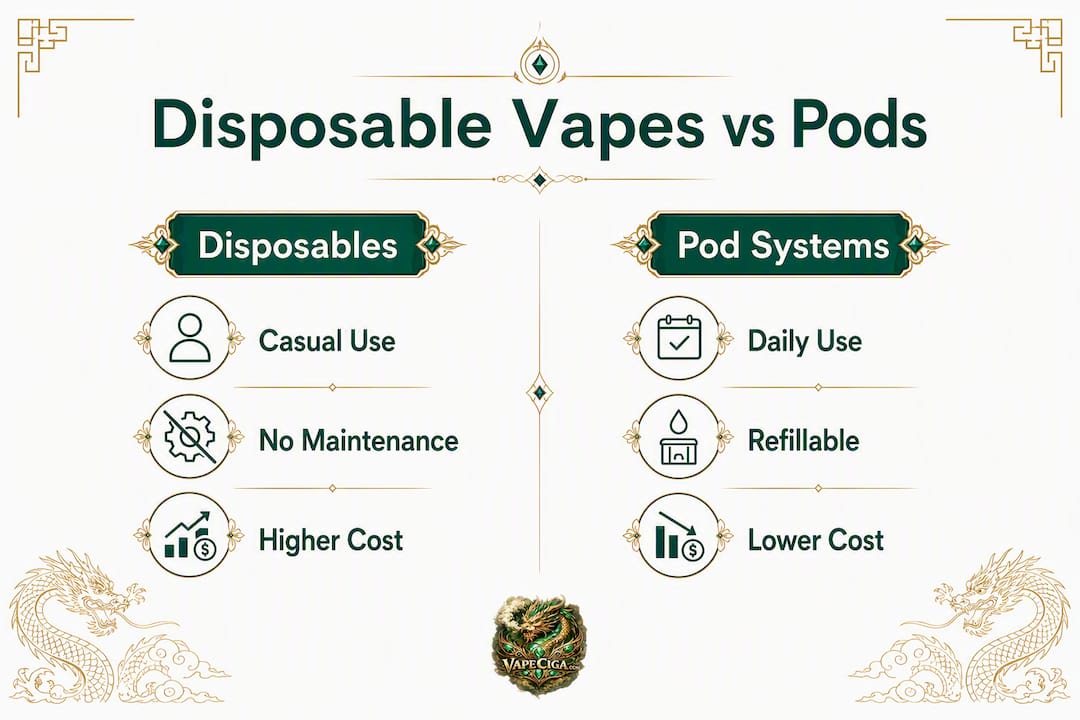
Daily vapers typically see a pod kit pay for itself within approximately four to six weeks compared to buying disposables at the same rate. After that break-even point, every week with a pod kit is money saved.
How do you choose the right device for your situation?
Run through this checklist before you buy:
- How often do you vape? Once or twice a week means disposables make sense. Daily use means a pod kit saves money within a month.
- What’s your budget? Can you put $25–$40 into a starter kit upfront, or do you need to spend $10–$15 at a time?
- Do you travel frequently? Disposables are TSA-friendly and require no accessories. Pod kits need a charger and spare pods.
- How important is flavor variety? If you like switching flavors often, a refillable pod is the only practical answer.
- Does sustainability matter to you? Pod systems generate far less device waste per puff.
Scenario examples:
- Occasional social vaper: You vape at parties or on weekends. A disposable is the right call. No maintenance, no commitment.
- Daily heavy vaper: You go through one or more devices a week. A pod kit will cut your monthly spend significantly and give you more flavor options.
- Commuter or traveler: Keep a pod kit at home and toss a disposable in your carry-on. High-capacity rechargeable kits, like those that replicate disposable simplicity with a rechargeable battery and replaceable pods, are worth considering for longer trips.
- Former smoker tapering nicotine: A refillable pod with nic salts lets you step down from higher to lower nicotine levels on your own schedule.
Red flags when buying any device: packaging with no nicotine strength label, no batch or lot number, missing child-safety features on the cap, and retailers who don’t verify age at checkout. Buy from verified U.S. retailers only.
Pro Tip: If you’re on the fence, start with an affordable disposable to confirm you like the flavor profile, then buy a pod kit and a matching e-liquid flavor. You get the trial without committing to a full bottle of something you might not enjoy.
What does the cost math actually look like?
Assumptions: 200 puffs per day (moderate use). Disposable priced at $15 for 2,000 puffs. Pod kit upfront cost $35; replacement pods at $5 each lasting 400 puffs; or refillable pod with 30ml e-liquid at $12 lasting roughly 3,000 puffs.
| Timeframe | Disposables (moderate use) | Pod Kit (prefilled pods) | Pod Kit (refillable + e-liquid) |
|---|---|---|---|
| 1 week | — | $35 + ~$5 = $40 | $35 + ~$5 = $40 |
| 1 month | $35–$50 | $35–$40 (pods only) | ~$12 (e-liquid only) |
Break-even example: If you spend $15 on disposables twice a week ($30/week), a $35 pod kit breaks even in just over one week of pod costs. After that, you’re saving $20–$25 per week with prefilled pods, or far more with a refillable setup.
The refillable pod system delivers the lowest cost per puff of any format, and that gap widens the more you vape.
What are the U.S. safety rules and buying guidelines?
The federal minimum purchase age for all tobacco and nicotine products, including vapes, is 21 years old under FDA regulations. Some states have additional restrictions, so check your state’s rules before buying.
Safe charging and storage basics: Always use the charger that came with your device or a compatible USB-C cable rated for the correct output. Never charge a device overnight or leave it unattended. Store devices away from direct sunlight and heat, and keep them out of reach of children. Never attempt to open, puncture, or modify a sealed disposable device. A swollen or leaking battery is a disposal issue, not a fix-it project.
For authenticity, look for these on the packaging before you buy:
- Nicotine strength clearly labeled in mg/mL
- Batch or lot number printed on the box
- Brand-specific authentication code or QR code where applicable
- Child-resistant packaging
- Purchased from a licensed U.S. retailer that verifies age at checkout
Counterfeit devices are a real problem in the U.S. market. Buying from a verified retailer like VapeCiga is the simplest way to avoid them.
This article provides general information only, not medical or legal advice. Confirm current regulations with the FDA or a qualified professional.
What is the environmental impact, and how do you dispose of devices responsibly?
Disposables create more e-waste per session than pod systems, and it’s not close. Every device you throw away contains a lithium-ion battery, a coil, plastic housing, and residual e-liquid. Pod systems reuse the battery and body; only the small pod itself gets replaced.
Practical disposal steps for U.S. consumers:
- Never put vape devices in regular trash or recycling bins. Lithium batteries are a fire hazard in landfills and recycling facilities.
- Use battery drop-off programs. Retailers like Best Buy and Home Depot accept lithium batteries for recycling. Call2Recycle maintains a drop-off locator for U.S. consumers.
- Check for municipal e-waste events. Many U.S. cities and counties hold periodic e-waste collection days where vape devices qualify.
- Ask your retailer. Some manufacturers and retailers run take-back programs for spent devices.
If sustainability is a priority, the path is straightforward: switch to a refillable pod system, buy e-liquid in larger bottles (100ml rather than 30ml reduces packaging waste per puff), and choose devices with replaceable coils and pods rather than sealed single-use units. The per-puff environmental footprint of refillables is significantly lower because the battery and body are reused across hundreds of sessions.
Which specific devices should you consider from VapeCiga?
These are representative picks available at VapeCiga, matched to the user profiles covered above.
-
2027 Date 7 2000 — A compact, high-puff device suited to casual users who want disposable-level convenience without hunting for a new device every few days. Good starting point if you’re new to vaping.
-
Packspod 5000 — 5,000 puffs in a slim form factor. Travelers and social vapers who want a single device to last a full trip will find this hits the sweet spot between capacity and portability.
-
EBCREATE BC40000 PRO — Built for heavy users who want a rechargeable device with serious puff capacity. The rechargeable battery means you’re not throwing away hardware every few days, which cuts both cost and waste.
-
GeekVape T200 (Aegis Touch) Mod — For vapers ready to move beyond pods into a full mod setup. The touchscreen interface and rugged build make it a strong pick for daily users who want precise control and durability.
-
Vaporesso Swag Ⅱ VW Box Mod 80W — A compact box mod with adjustable wattage up to 80W. Fits vapers who want more vapor production than a pod system delivers but don’t want a bulky device.
-
Vaporesso GTX One Vape Mod 2000mAh 40W — A reliable, approachable pod mod for daily users making the switch from disposables. The 2000mAh battery handles a full day comfortably, and the 40W ceiling gives you room to experiment with different coil resistances.
Pro Tip: Before buying a pod mod, confirm which coil types it accepts and whether replacement coils are widely available in the U.S. A great device with hard-to-find coils becomes a frustrating device within a month.
Key Takeaways
Pod systems beat disposables on long-term cost and sustainability for daily vapers, while disposables remain the smarter choice for occasional or travel use.
| Point | Details |
|---|---|
| Disposables suit casual use | Zero setup and no maintenance make them ideal for occasional vapers or travel. |
| Pod kits win on cost over time | Daily vapers typically break even within approximately four to six weeks versus ongoing disposable purchases. |
| Refillables cut waste significantly | Pod systems reuse the battery and body, reducing per-puff e-waste compared to full-device disposal. |
| Hybrid use is a real strategy | A pod kit as your daily driver plus a disposable for travel covers both needs without compromise. |
| VapeCiga covers both formats | From the Packspod 5000 for travelers to the GeekVape T200 for advanced users, VapeCiga stocks verified U.S.-available options across every use case. |
A straight take on the disposable vs. pod debate
The framing of “which is better” misses the more useful question, which is “better for what?” Disposables get unfairly dismissed as wasteful beginner devices, and pod systems get oversold as the obvious upgrade for everyone. Neither framing is accurate.
The real story is that disposables solved a genuine problem: they made vaping accessible to people who had no interest in learning a new piece of hardware. That’s a legitimate use case, and it doesn’t disappear just because pod kits are more economical at scale. Where the criticism lands is on the daily-use math. Spending $40–$60 a month on disposables when a $30 pod kit and $15 in e-liquid covers the same usage is a choice, not a necessity.
What the industry undersells is the hybrid approach. Keeping a pod kit at home and a disposable in your pocket isn’t indecision. It’s practical. You get the cost efficiency of a refillable for 90% of your vaping and the grab-and-go simplicity of a disposable for the 10% where setup doesn’t make sense.
The sustainability angle is worth taking seriously too. Lithium batteries in landfills are a real problem, not a marketing talking point. If you’re going through two or three disposables a week, switching to a rechargeable format isn’t just cheaper. It’s the more responsible call.
For anyone reading VapeCiga’s refillable vape pen guide before buying: the guidance there on matching device type to usage habits is worth your time. All purchases on VapeCiga are for adults 21 and over in the U.S.
VapeCiga has both formats, verified and ready to ship
VapeCiga stocks the full range, from compact disposables to advanced pod mods, with fast domestic shipping and verified authentic products. Whether you’re picking up a Packspod 5000 for a trip or stepping up to the EBCREATE BC40000 PRO for daily use, every device on the site comes from brands with real U.S. availability and proper nicotine labeling.
Browse the disposables and pod systems at VapeCiga, check device compatibility with your preferred coil type before checkout, and use the product pages to compare puff counts and nicotine strengths side by side. All purchases are for adults 21 and over. Follow safe charging and disposal practices with every device you buy.