


If you chase flavor and big clouds, get a mesh coil. If you vape mouth-to-lung or build your own coils and want more control over the draw, stick with a regular round-wire coil. That’s the short version, and it holds true across most sub-ohm tanks, pod systems, and RDAs on the market today.
The reasoning comes down to physical design, not marketing. Mesh coils spread heat across a wide, flat surface, which is why they tend to deliver better flavor and larger vapor production than a comparable round-wire coil running at the same wattage. Round-wire coils, on the other hand, give you more control over resistance and airflow if you’re hand-building or chasing a tight mouth-to-lung draw.
Quick pairing guidance before you buy anything:
- Sub-ohm tank, high-VG juice, direct-lung hits: mesh coil, typically 0.15Ω to 0.6Ω, 40W to 80W.
- Pod system or MTL tank, 50/50 or nic salt juice, tight draw: regular round-wire coil, typically 0.8Ω to 1.6Ω, 10W to 25W.
- RDA/RDTA builder who wants tweakability: round-wire wraps, or mesh strips if you still want that heat spread.
Key Takeaways
Mesh coils win on flavor, vapor, and lifespan for sub-ohm and direct-lung vaping, while round-wire coils win on control, low juice use, and MTL performance.
| Point | Details |
|---|---|
| Match resistance to style | Sub-ohm mesh coils run 0.15Ω to 0.6Ω for DTL; round-wire coils run 1.0Ω to 1.6Ω for MTL. |
| Mesh wins on flavor and clouds | Even heat distribution across mesh’s flat surface reduces hot spots and boosts vapor. |
| Round-wire wins on control | Better suited to hand-builders and low-wattage MTL pod setups with nic salts. |
| Prime before first use | Saturate the wick fully and rest the coil a minute before firing to prevent burnt hits. |
| VapeCiga stocks both types | Mesh coils like GeekVape MeshMellow and round-wire options like Smok Vape Pen V2 coils cover both use cases. |
Table of Contents
- Mesh vs Regular Coils: A Quick Comparison
- What Makes Mesh and Regular Coils Different?
- How Do Resistance and Wattage Change With Coil Type?
- Flavor, Vapor, Lifespan, and Running Costs Compared
- How Do You Pick the Right Coil for Your Setup?
- How Do You Prime, Maintain, and Troubleshoot Coils?
- What Coils and Devices Does VapeCiga Stock?
- What I’d Tell a Friend Buying Their First Replacement Coil
- Get the Right Coil Without the Guesswork
- Sources
- FAQ
Mesh vs Regular Coils: A Quick Comparison
Here’s how the two stack up across the traits that actually affect your vaping experience day to day.
- Flavor clarity: Mesh wins most of the time. Its larger surface area touches more of the wick at once, so flavor compounds vaporize more evenly instead of scorching in one hot patch.
- Vapor production: Mesh again, especially at higher wattage with high-VG juice.
- Ramp-up time: Mesh heats up faster because it has less metal mass to warm through.
- Coil lifespan: Mesh usually lasts longer, since even heating avoids the localized scorching that kills round-wire coils early.
- E-liquid consumption: Mesh burns through juice faster, a direct trade-off for the bigger vapor.
- Power/wattage demand: Mesh generally needs more watts to perform well; round-wire sips power at low wattage.
- Tweakability: Round-wire wins hands down. You can rewrap, adjust coil diameter, and dial in exact resistance if you build your own.
The pattern behind almost every one of these differences is surface area and mass. A flat perforated mesh strip touches more cotton across more of its length than a coiled wire ever can, which is also why most current sub-ohm tanks and pod systems now ship with mesh as the default rather than round-wire.
If your goal is flavor or clouds, go mesh. If your goal is a tight MTL draw, low juice use, or full control over your build, go round-wire.
What Makes Mesh and Regular Coils Different?
A mesh coil is a flat strip of perforated metal, usually rolled into a cylinder or folded into a flat pack, with wicking material packed against nearly its entire inner surface. A regular coil, sometimes called round-wire or standard coil, is wire wound into a spiral, with the cotton wick threaded through the center.
Despite the different shapes, both coil types share the same basic job. Each one:
- Uses a cotton (or alternative) wick to draw e-liquid from the tank or pod reservoir.
- Sits inside a coil head or build deck with a defined electrical resistance, measured in ohms.
- Relies on e-liquid saturation to convert electrical heat into vapor rather than burnt cotton.
The performance gap comes down to geometry. Round wire only makes contact with the wick along a narrow spiral path, so heat concentrates in small bands, and the coil often develops one or two hot spots that scorch the wick faster than the rest. Mesh, spread flat against the cotton, heats that whole contact area at nearly the same rate. Less concentrated heat means fewer hot spots, which is a big part of why mesh users report a cleaner draw from the first puff to nearly the coil’s last one.
How Do Resistance and Wattage Change With Coil Type?
Resistance, measured in ohms, determines how much current flows through a coil at a given voltage, and it’s the single biggest factor in matching a coil to a device. Lower resistance draws more current and produces more heat, which is why most mesh coils sit in sub-ohm territory (below 1.0Ω), while round-wire coils built for mouth-to-lung vaping usually sit above 1.0Ω.
Here’s the practical breakdown:
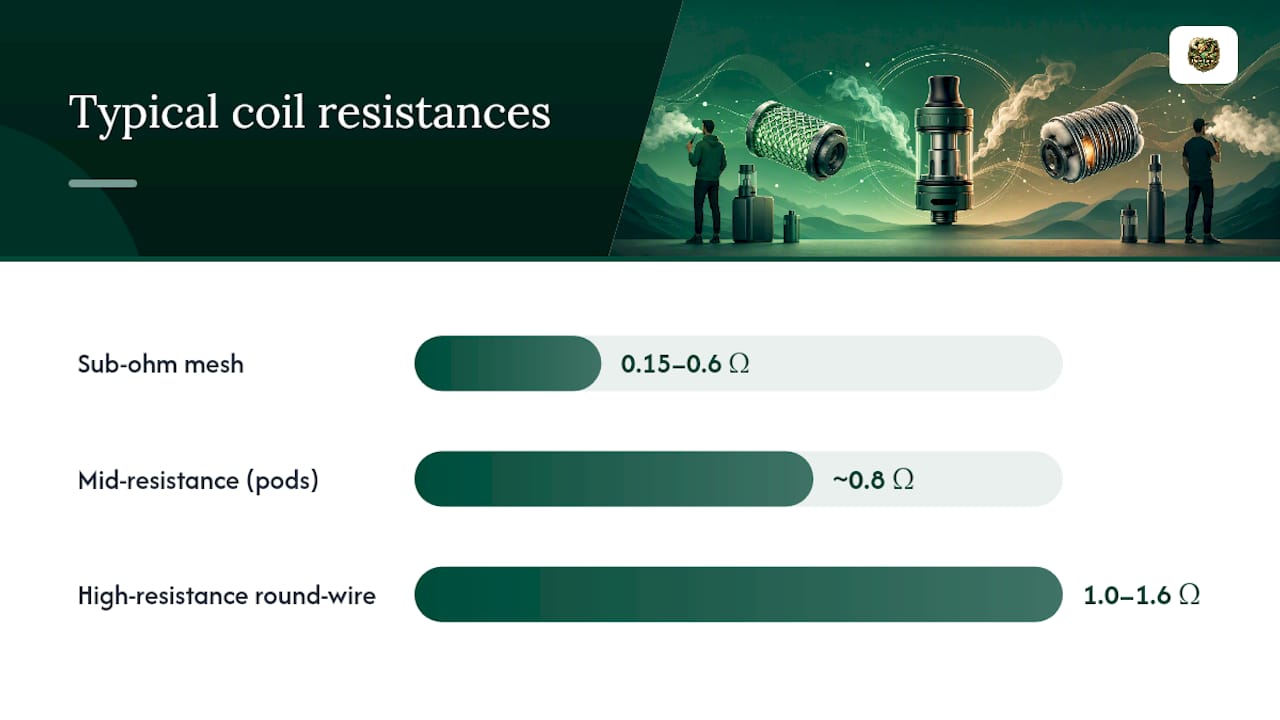
- Sub-ohm mesh coils (0.15Ω to 0.6Ω) typically run 40W to 100W and need a high-VG liquid to keep up with heat output without drying out.
- Mid-resistance coils (around 0.8Ω) strike a balance between flavor and efficiency, common in pod systems that split the difference between MTL and restricted DTL.
- Higher-resistance round-wire coils (1.0Ω to 1.6Ω) run 10W to 25W and pair with thinner 50/50 or nic salt liquids for a tighter, cigarette-like draw.
Material matters too. Kanthal is the industry default, cheap and reliable but not compatible with temperature control modes. Ni80 gives slightly better flavor and holds up well under sub-ohm wattage. Stainless steel is the outlier: it works in both standard variable wattage mode and temperature control, which matters if you’re chasing consistent flavor without dry hits over a long vaping session.
When you install a new coil, start at the lowest wattage the manufacturer lists on the coil packaging or wrapper, take two or three short test puffs, then step up in small 5 to 10 percent increments until the flavor and vapor feel right. Jumping straight to the top of the range is the fastest way to cause spitting or a burnt hit, and it applies double to mesh, which ramps up faster because it carries less metal mass to heat through.
Pro Tip: Always prime a new coil for a full 5 to 10 minutes before your first puff. Drip a few drops directly onto the visible mesh or wire, let the tank sit, then vape at low wattage for the first few puffs.
Flavor, Vapor, Lifespan, and Running Costs Compared
Flavor clarity is where mesh earns its reputation. Because it heats the wick evenly rather than in narrow bands, e-liquid vaporizes at a more consistent rate across the whole coil surface, and flavor compounds don’t get scorched in isolated hot spots the way they can with round wire. That consistency also means mesh tends to hold onto strong, clean flavor for a longer stretch of its working life, one reason users notice less flavor “fade” with mesh compared to round-wire coils as they age.
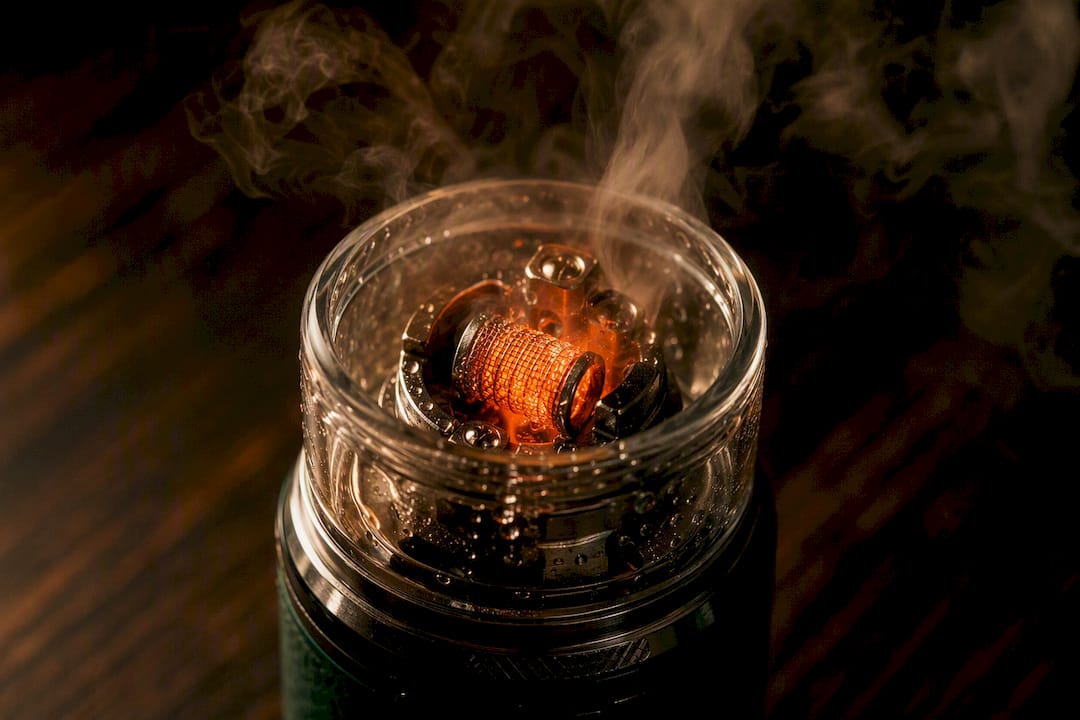
Vapor production follows a similar logic. More surface area in contact with liquid, at similar wattage, means more juice converts to vapor per puff. That’s the entire appeal of a sub-ohm mesh setup for cloud chasers.
Lifespan is where things get interesting. Mesh coils generally last longer under equivalent use because even heat distribution avoids the repeated scorching that kills a round-wire coil’s wick prematurely. That said, both coil types wear out faster under a few specific conditions:
- Sweetened e-liquids leave sticky residue on the coil surface that builds up faster than unsweetened juice.
- High-VG liquids are thicker and can be slower to fully saturate the wick between puffs, raising dry-hit risk if you chain vape.
- Chain vaping without pauses starves the wick of time to re-saturate, which cooks the cotton regardless of coil type.
On running costs, expect mesh to drink more juice and pull more from your battery, a direct consequence of the higher wattage it typically runs at. Round-wire coils sip power and juice by comparison, which is part of why they remain the default in low-wattage pod kits built for portability and all-day battery life.
How Do You Pick the Right Coil for Your Setup?
Work through this checklist before you buy a replacement coil or a new device:
- Check your device’s wattage range. A mod capable of 80W or more can run sub-ohm mesh comfortably; a pod system capped at 25W cannot.
- Decide your draw style. Mouth-to-lung feels like a cigarette pull through a narrow airflow; direct-lung is a wide-open, lung-filling pull. MTL favors round-wire; DTL favors mesh.
- Match your e-liquid’s VG/PG ratio. High-VG liquids pair with low-resistance mesh coils, while thinner 50/50 liquids and nic salts perform better in higher-resistance round-wire coils.
- Confirm your nicotine type. Salt nic is almost always vaped MTL on higher-resistance coils at lower wattage; freebase nicotine in high-VG juice is the standard sub-ohm mesh pairing.
A few real-world examples make this concrete. A low-wattage pod kit paired with a 1.2Ω round-wire coil and a nic salt e-liquid gives you a tight MTL draw with minimal juice waste. A sub-ohm tank running a 0.3Ω to 0.6Ω mesh coil on high-VG juice, mounted on a device like the Vaporesso TARGET PM80, gives you the big airy clouds and flavor pop that sub-ohm vapers want.
If you ever taste a burnt or acrid hit, stop immediately. Lower your wattage by 5 to 10 watts and re-prime the coil with a few drops of e-liquid before vaping again. Chasing the same wattage on a dry coil only makes the burnt taste worse.
How Do You Prime, Maintain, and Troubleshoot Coils?
Priming right the first time prevents most of the problems people blame on “bad coils.” Here’s the process:
- Saturate the wick. Drip 3 to 5 drops of e-liquid directly onto exposed mesh or visible cotton through the airflow holes.
- Let it rest. Give the coil a full minute, ideally longer, so the liquid soaks all the way through before power touches it.
- Fire at low wattage first. Take two or three short puffs at the bottom of the coil’s rated wattage range, then move up gradually.
This single step, letting the wick fully saturate before your first puff, is often the difference between a coil that lasts weeks and one that tastes burnt on puff three.
Routine care matters just as much as the initial prime. Sweetened e-liquids gunk up coils faster regardless of type, so if coil longevity matters more to you than flavor variety, favor unsweetened or lightly sweetened juice. Cycling wattage up and down constantly also stresses the wick; picking a stable wattage and sticking with it extends coil life more than most people expect.
When something goes wrong, work through it in order:
- Burnt taste right after installing: under-primed. Re-drip the coil and let it soak longer before firing again. This common troubleshooting flow covers the fixes in more depth.
- Spitting or gurgling: wattage is too low for the coil, or the tank is flooded. Raise wattage slightly or clear excess liquid from the airflow.
- Uneven heating on mesh specifically: usually a manufacturing or seating issue. Reseat the coil and check that the mesh sits flush in its housing.
- Coil shorting out (no vapor, no resistance reading): a wire has likely torn loose inside the coil head. Replace it. This happens more with round-wire builds that have been over-torqued.
- Dry hits on round-wire coils: chain vaping outpaced wick saturation. Slow your pace and give the cotton time to re-wet.
Pro Tip: Keep a spare coil primed and resting in your bag if you vape heavily throughout the day. Swapping to an already-saturated coil beats vaping on a dry one while you wait for a fresh prime.
What Coils and Devices Does VapeCiga Stock?
VapeCiga carries both coil families, so you’re not locked into one style regardless of what your device takes. For sub-ohm and direct-lung setups, the GeekVape MeshMellow coils and GeekVape mesh coils for the Zeus tank deliver the flavor and cloud output mesh is known for. For MTL setups and hand-built control, the Smok Vape Pen V2 replacement coils suit standard pen-style kits and lighter draws.
Before ordering, check your tank or pod’s printed coil spec, usually stamped right on the coil head or listed on its box. Mismatched resistance is the single most common reason a new coil underperforms out of the package.
- Sub-ohm mesh-ready mods pair well with high-VG e-liquids and 0.15Ω to 0.6Ω coils.
- MTL kits and pod systems typically call for 1.0Ω or higher coils and thinner juice.
- Always confirm coil compatibility against your specific tank model, not just the brand.
What I’d Tell a Friend Buying Their First Replacement Coil
Most people overthink this decision. If you’re chasing flavor or clouds, buy mesh and don’t look back. If you’re vaping MTL on a pod system, or you like building your own coils, round-wire still does that job better, and probably always will.
The one habit that separates good coil experiences from bad ones isn’t brand loyalty. It’s priming properly and testing a new coil at the bottom of its wattage range before pushing higher. Skip that step and even the best mesh coil on the market will taste burnt by puff five.
Get the Right Coil Without the Guesswork
VapeCiga stocks both mesh and round-wire coils across the exact resistance ranges this guide covers, plus the devices built to run them properly.
If you’re building a sub-ohm setup for flavor and clouds, the GeekVape T200 Aegis Touch Mod gives mesh coils the wattage headroom they need, and the Vaporesso Swag II 80W box mod works just as well for that role. Prefer a simpler pod setup? The Vaporesso GTX One handles mesh coils at a lower wattage ceiling, ideal if you want flavor without a full sub-ohm rig. Pair any of these with Vapetasia e-liquid in a VG ratio matched to your coil, and check the coil spec printed on your tank before you order replacements. Fast domestic shipping means you’re not stuck waiting on a dry tank while your old coil gunks up past the point of no return. Browse the current coil lineup and pick your resistance range based on the pairing rules above.
Sources
- Mesh Coils vs Regular Coils: What’s the Difference (and Which Is Better)?
- Mesh Coils: What Are Their Benefits?
- How coil resistance values impact pod kit flavor - Lost Vape
FAQ
Is a Mesh Coil Vape Better Than a Regular Coil?
For flavor and vapor production, yes. Mesh spreads heat more evenly across the wick, which usually produces clearer flavor and bigger clouds than a comparable round-wire coil at the same wattage.
Do Mesh Coils Last Longer Than Regular Coils?
Generally, yes. Even heat distribution reduces the localized scorching that shortens a round-wire coil’s life, though sweetened e-liquids and chain vaping shorten lifespan for both types.
What Are Common Problems With Mesh Coils?
Spitting from running below the recommended wattage, uneven heating from poor seating in the coil housing, and faster visible gunking with sweetened juices due to the larger surface area collecting residue.
Are Mesh Coil Vapes Safe?
Mesh coils are as safe as any properly matched coil and device combination. Using the correct resistance, wattage, and e-liquid VG ratio for your specific coil, and priming it fully before use, avoids the dry hits and burnt taste that create most safety concerns.
Which Coil Type Is Better for Mouth-to-Lung Vaping?
Round-wire coils, typically 1.0Ω or higher, suit mouth-to-lung vaping better because they run at lower wattage and pair well with thinner 50/50 or nic salt e-liquids used in most MTL pod systems, like the coils available for the Smok Vape Pen V2.