


The FDA’s 2026 PMTA updates shift the ground under every flavored vape product on the U.S. market. Three changes define this year: a flavor-specific, graduated evidentiary framework published March 9, 2026; a new enforcement-priorities policy issued May 8, 2026 that ties lower-priority treatment to accepted-and-filed application status; and the CTP Portal NextGen transition that retires eSubmitter for PMTA submissions after November 14, 2026. Manufacturers, importers, and retailers are all affected, and the compliance window is narrowing.
The immediate implications break down this way:
- Higher evidentiary burden for fruit, candy, and dessert flavors. Products in these categories now face the steepest adult-benefit evidence requirements under the March 9 draft guidance.
- Device access restrictions (DARs) no longer substitute for adult-benefit evidence in high-youth-appeal flavor categories. Relying on DARs alone for a fruit-flavored product is no longer a viable PMTA strategy.
- Accepted-and-filed PMTAs may receive lower enforcement priority, but that status is not authorization. A product in FDA review can still be pulled from shelves under state law or targeted if it triggers youth-appeal concerns.
- Portal workflows must be updated before November 14, 2026. eSubmitter is being retired; all PMTA and SE submissions must move to CTP Portal NextGen.
The one-sentence verdict: pause any flavored product launch that relies on DARs as the primary mitigation, assemble adult-benefit study data now, and migrate submission workflows to Portal NextGen before the November deadline.
Key Takeaways
The 2026 PMTA updates require immediate action on flavor classification, evidence assembly, and portal migration before the November 14 deadline.
| Point | Details |
|---|---|
| Flavor tier determines evidence burden | Fruit, candy, and dessert flavors face the highest adult-benefit evidence requirements under the March 9, 2026 draft guidance. |
| DARs cannot replace adult-benefit data | Device access restrictions remain relevant but cannot substitute for clinical adult-benefit evidence for high-youth-appeal flavors. |
| Enforcement deprioritization is not authorization | Accepted-and-filed status may reduce federal enforcement risk but does not authorize sales or override state flavor bans. |
| Portal migration deadline is November 14, 2026 | eSubmitter is being retired; all PMTA and SE submissions must move to CTP Portal NextGen before that date. |
| VapeCiga stocks compliant products for adults 21+ | VapeCiga offers fast U.S. shipping on disposables, mods, pod systems, and e-liquids from established brands. |
Table of Contents
- What changed in PMTA regulations in 2026: a timeline
- How does the March 9, 2026 flavor framework actually work?
- What evidence does FDA expect in a 2026 PMTA submission?
- Which products did FDA authorize in 2026?
- How does FDA’s 2026 enforcement policy interact with state flavor bans?
- What should manufacturers, importers, and retailers do right now?
- What FDA’s 2026 industry engagement signals for your submission
- The 2026 changes favor patience over speed, not the other way around
- VapeCiga carries authorized and compliant products for adults 21+
- Sources
What changed in PMTA regulations in 2026: a timeline
The pace of FDA action this year has been faster than most manufacturers anticipated. Here is the sequence that matters.
| Date | FDA Action | Practical Effect |
|---|---|---|
| February 10, 2026 | Roundtable on PMTA submissions for ENDS products | FDA signaled pharmacokinetic profiles and adult-benefit study design as top review priorities |
| March 9, 2026 | Flavored ENDS draft guidance published | Formalized graduated evidentiary framework; comment period opened |
| May 5, 2026 | FDA press announcement: new ENDS marketing authorizations | Confirmed agency continues issuing marketing granted orders (MGOs) when APPH standard is met |
| May 8, 2026 | Enforcement-priorities guidance finalized | Replaced April 2020 policy; tied lower-priority treatment to accepted-and-filed status and data sufficiency |
| July 2026 | CTP Portal NextGen expansion announced | Folder uploads, document labeling, saved contacts added; eSubmitter phaseout confirmed for November 14 |
A few operational notes on open windows. The March 9 draft guidance comment period was active at publication; manufacturers with pending submissions should check whether the comment window has closed before treating the guidance as final. The November 14, 2026 eSubmitter retirement is a hard operational deadline, not a soft transition. Any company still building submissions in eSubmitter needs to migrate now, not in October.
How does the March 9, 2026 flavor framework actually work?
The March 9 draft guidance introduces what FDA calls a “graduated risk-proportionate evaluation.” The core idea: the higher a flavor’s appeal to youth, the more adult-benefit evidence an applicant must produce to satisfy the appropriate-for-public-health (APPH) standard under section 910 of the FD&C Act.
Three tiers emerge from the guidance:
- Highest burden: fruit, candy, and dessert flavors. These face the steepest evidentiary requirements because surveillance data consistently links them to youth initiation. Applicants must demonstrate positive adult-benefit evidence, not merely show that youth access is restricted.
- Intermediate burden: menthol, mint, coffee, and spice flavors. These require meaningful adult-benefit evidence but the threshold is lower than for sweet flavors. Menthol’s long history in combustible products and its documented role in adult cessation attempts factor into FDA’s calculus here.
- Baseline: tobacco flavor. Tobacco-flavored ENDS face the lowest evidentiary burden. Most authorized products to date fall in this category.
The DAR question is where the guidance makes its sharpest break from prior practice. Legal and regulatory analyses of the March 2026 guidance confirm that device access restrictions, age-gating, and retail controls are still relevant mitigation measures. They count. But for high-youth-appeal flavors, they cannot substitute for direct adult-benefit evidence. A fruit-flavored disposable with robust DARs and no adult-benefit clinical data will not clear the APPH standard under this framework.
Practically, classifying a product’s flavor tier is the first step in PMTA planning. A product marketed as “tropical” or “berry blast” sits in the highest-burden tier regardless of how the manufacturer describes the flavor internally. FDA looks at the flavor profile as a consumer would perceive it, not as the ingredient list describes it.
Pro Tip: When scoping evidence packages, build the adult-benefit study rationale before selecting the study design. For high-burden flavors, a cohort study or randomized controlled trial comparing switching rates versus combustible cigarettes gives FDA the direct adult-benefit signal it is asking for. For intermediate flavors, a well-designed cross-sectional survey with validated cessation measures may suffice, but confirm with FDA in a presubmission meeting first.
What evidence does FDA expect in a 2026 PMTA submission?
The February 10 roundtable made FDA’s current review priorities explicit. The agency is not looking for thicker submissions; it is looking for submissions that answer specific questions about pharmacology, adult benefit, and manufacturing control. Here is how the major evidence buckets map to what FDA needs to see.
| Evidence Type | What It Demonstrates | Minimum Acceptable Documentation |
|---|---|---|
| Pharmacokinetic (PK) study | Nicotine absorption, distribution, and elimination profile for the specific product | Full PK study report with product-specific data; literature alone is insufficient for novel devices |
| Adult-benefit clinical/behavioral study | That adult smokers benefit from switching (cessation, reduction, or harm reduction) | Cohort study or RCT with validated endpoints; cross-sectional data acceptable for lower-burden flavors |
| Toxicology and lifetime cancer risk | Long-term health risk estimate relative to combustible cigarettes | Quantitative cancer risk assessment using product-specific HPHC data |
| Constituent/chemical testing | Aerosol and liquid HPHC levels, heavy metals, carbonyl compounds | Validated lab certificates from an accredited testing facility |
| Manufacturing controls | Consistency, quality, and GMP-level documentation | Batch records, SOPs, supplier qualification records |
| Battery and electrical safety | Device does not pose fire, explosion, or overheating risk | UL 8139 test certificates; documentation of over-voltage, over-current, and short-circuit protections |
| Packaging and labeling | Child-resistant packaging; nicotine exposure warnings | Child-resistant packaging test results; label mock-ups with required warnings |
Battery and electrical safety deserves particular attention for device manufacturers. FDA’s finalized PMTA guidance for ENDS specifies that submissions should include battery chemistry, amperage, voltage, and wattage data, along with test certificates from voluntary standards programs like UL 8139. High-capacity devices such as the EBCREATE BC40000 PRO or mods like the GeekVape T200 (Aegis Touch) and the Vaporesso Swag II VW Box Mod 80W carry more complex battery systems than simple disposables, and their PMTA submissions need correspondingly detailed electrical safety documentation.
On the administrative side, FDA’s PMTA final rule sets out a two-stage review before substantive evaluation: acceptance review (does the submission contain the required sections?) and filing review (is the evidence sufficient to permit a substantive review?). Deficiency letters at either stage are common. The most frequent acceptance-review deficiencies involve missing product-specific PK data and incomplete manufacturing documentation. Filing-review deficiencies tend to center on inadequate adult-benefit evidence and missing constituent testing for the specific product formulation. A resubmission or supplemental PMTA (sPMTA) must address every deficiency letter item explicitly; partial responses restart the clock.
Which products did FDA authorize in 2026?
FDA has continued issuing marketing granted orders in 2026, confirming the agency will authorize products when applicants satisfy the APPH standard. The May 5, 2026 press announcement confirmed new ENDS authorizations, with Glas among the manufacturers receiving MGOs this year.
A few patterns are visible across 2026 authorizations:
- Authorized products have predominantly been tobacco-flavored or menthol-flavored ENDS, consistent with the lower evidentiary burden those categories carry under the graduated framework.
- Larger manufacturers with dedicated regulatory affairs teams have accounted for most MGOs. Small manufacturers have faced higher deficiency rates, partly because product-specific PK studies and adult-benefit clinical data are resource-intensive.
- Device-only authorizations (where the e-liquid is separately reviewed) have appeared alongside combination product authorizations.
What an MGO actually gives you: A marketing granted order authorizes the specific product described in the application for sale in the United States. It does not preempt state law. A product with a federal MGO can still be banned from sale in California, Massachusetts, or any other state with an active flavor prohibition. Postmarket obligations under 21 C.F.R. § 1114.41 also attach immediately: manufacturers must establish and maintain records and submit reports as specified in the MGO terms. Authorization is the beginning of a compliance relationship with FDA, not the end of one.
The practical lesson for applicants watching 2026 authorizations: FDA is granting orders, but the bar is real. A submission that clears the evidentiary threshold for tobacco flavor will not automatically clear it for a fruit variant of the same device. Each flavor requires its own evidence package under the March 9 framework.
How does FDA’s 2026 enforcement policy interact with state flavor bans?
The May 8, 2026 enforcement-priorities guidance replaced the April 2020 policy and introduced a more structured framework for when FDA generally will not prioritize enforcement action. The key conditions: an application submitted on or after November 4, 2021 must have been accepted and filed, or a qualifying sPMTA must have been pending more than 180 days. Data sufficiency for non-tobacco flavors also factors in.
What that lower-priority status does not do is equally important. It does not authorize the product. It does not shield the product from state enforcement. And it does not protect products that trigger specific youth-appeal or safety concerns. FDA retains enforcement priority for products that display:
- Cartoon-like or youth-oriented designs or branding
- Disguised product formats (e.g., products designed to look like USB drives, food packaging, or children’s items)
- Unusually high nicotine concentrations
- Child-safety failures in packaging or labeling
Youth surveillance data from CDC/MMWR reporting consistently shows that fruit, candy, and dessert flavors account for a disproportionate share of youth ENDS use, which is precisely why FDA’s enforcement-priority framework keeps high-youth-appeal products on the enforcement radar even when an application is pending.
The state-law gap is significant for retailers and importers. Several states maintain their own PMTA-directory or flavor-ban laws that operate independently of federal review status. A product accepted and filed with FDA can still be subject to a state-level sales prohibition or a state registry requirement. Importers face an additional layer: products detained at the border by U.S. Customs and Border Protection are not automatically released because a PMTA is pending. Federal enforcement deprioritization does not bind CBP.
For cross-border sellers and importers, hazmat shipping requirements for e-liquids add another compliance dimension that sits entirely outside the PMTA framework but affects whether a product can move through the supply chain at all.
What should manufacturers, importers, and retailers do right now?
The 2026 changes require different responses depending on where a company sits in the supply chain. Here is a prioritized sequence.
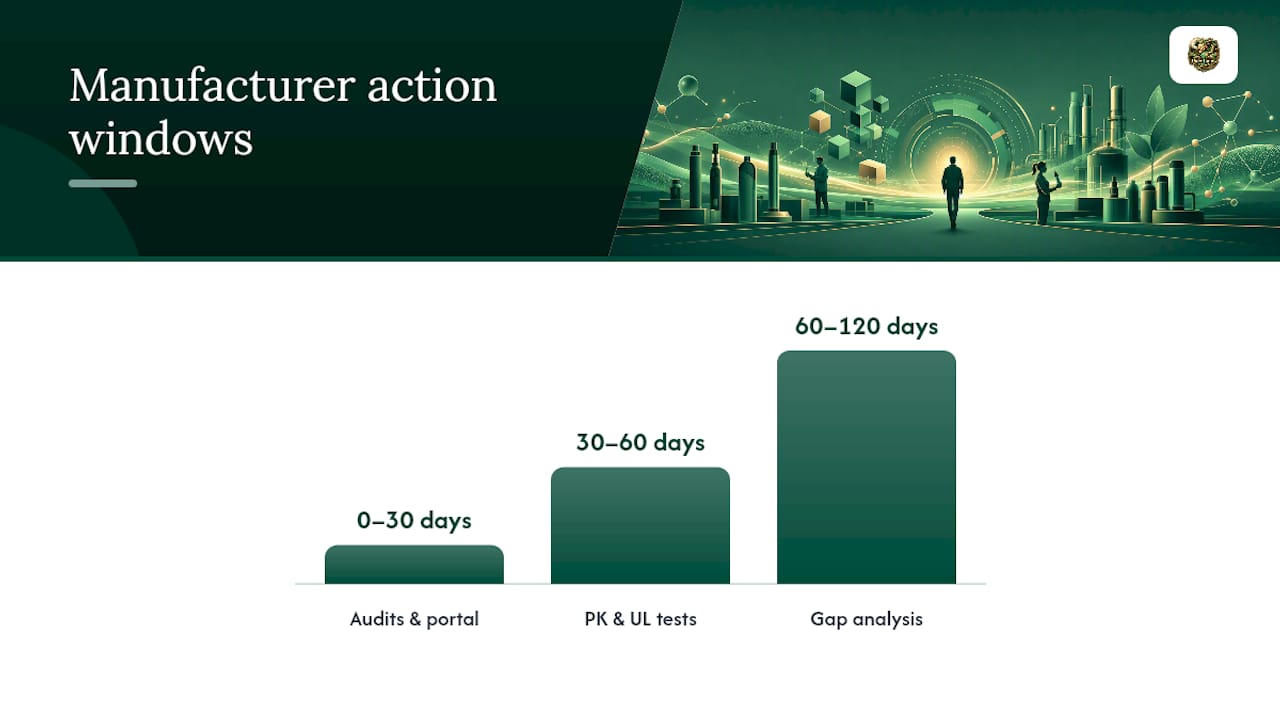
Manufacturers: 30/60/120-day checklist
- Immediately (0–30 days): Audit your flavor portfolio against the March 9 tiering. Classify every product by flavor tier (fruit/candy/dessert vs. menthol/mint/coffee/spice vs. tobacco). Flag any product in the highest-burden tier that lacks adult-benefit clinical data.
- Immediately (0–30 days): Migrate submission workflows to CTP Portal NextGen. The November 14 eSubmitter retirement is a hard deadline. Train regulatory staff on folder uploads and document labeling now.
- 30–60 days: Commission missing PK studies and adult-benefit study designs. For high-burden flavors, a product-specific PK study is non-negotiable. Engage a CRO with tobacco product experience. For e-liquid formulation controls, a low-MOQ e-liquid manufacturer with documented quality systems can help small firms meet manufacturing-control requirements without building a full in-house lab.
- 30–60 days: Pull UL 8139 test certificates for all devices. If certificates are missing or expired, initiate testing. This applies to every device in the portfolio, not just new submissions.
- 60–120 days: Conduct a PMTA acceptance and filing gap analysis. Compare your existing submission against the March 9 guidance and the February roundtable priorities. Identify deficiency risks before FDA does.
- 60–120 days: Request a presubmission meeting with FDA’s RHPM (Regulatory Health Project Manager). Use the meeting to confirm flavor classification, discuss study design adequacy, and request public listing on FDA’s PMTA directory if your application qualifies.
Importers: specific steps
- Verify that every imported product has an accepted-and-filed PMTA or a valid MGO before it enters the supply chain.
- Check state-directory requirements for every state where the product will be sold. Federal accepted-and-filed status does not satisfy state registry laws.
- Review VG/PG ratio formulation documentation for imported e-liquids to confirm constituent testing aligns with FDA’s HPHC expectations.
Retailers: inventory and compliance
- Pull any product from active inventory that lacks an accepted-and-filed PMTA or MGO. The enforcement-priorities guidance does not protect retailers from state enforcement.
- Check your state’s flavor-ban and PMTA-directory status. Several states updated their lists in 2026.
- For online sales, review age-verification protocols against current state requirements. The 2026 online buyer’s guide for electronic cigarettes covers the current state-by-state landscape for adult purchasers.
Pro Tip: Small manufacturers with limited budgets should sequence evidence investment this way: PK study first (it feeds the toxicology and constituent analysis), then adult-benefit study design (which can be staged, starting with a smaller pilot), then UL testing. Trying to run all three simultaneously without adequate project management typically produces incomplete data packages that trigger deficiency letters across all three areas at once.
What FDA’s 2026 industry engagement signals for your submission
The February 10 roundtable was the clearest public signal FDA has given about what it actually wants to see in a PMTA submission right now. The agency’s discussion covered five topic areas: product characterization, manufacturing controls, pharmacological profile, adult-benefit studies, and toxicological profile. That sequence is not accidental.
A few specific signals from the roundtable are worth translating into submission strategy:
- FDA is skeptical of literature-only PK rationales. The agency wants product-specific pharmacokinetic data, not just citations to studies on similar devices. If your device has a novel coil design, wattage range, or nicotine salt formulation, existing literature on earlier-generation devices will not carry the submission.
- Manufacturing controls are a filing-review trigger, not just a background section. Incomplete batch records and missing supplier qualification documentation have been cited as filing-review deficiencies. FDA wants to see that the product in the application is the product that will be manufactured at scale.
- Adult-benefit study design matters more than study size. FDA has signaled it prefers well-designed smaller studies with validated endpoints over large surveys with weak outcome measures. A 200-person RCT measuring biochemically confirmed cessation at 6 months is more useful than a 2,000-person online survey asking about self-reported reduction.
FDA is also actively engaging small manufacturers, defined as companies with under 350 employees. The February roundtable was specifically oriented toward this segment. If your company qualifies, the RHPM relationship is your most direct channel to clarify evidence expectations before you invest in studies.
Pro Tip: Use presubmission meetings strategically. Submit a detailed briefing document that includes your proposed study design, flavor classification rationale, and a draft evidence summary. FDA’s written responses to presubmission questions become part of your administrative record and can support your APPH argument if the submission is later challenged.
The 2026 changes favor patience over speed, not the other way around
The instinct in a competitive market is to move fast: launch the product, file the PMTA, deal with deficiencies later. The 2026 framework punishes that approach more than any prior version of the rules did.
The March 9 graduated framework means that a fruit-flavored product submitted without adult-benefit clinical data will almost certainly receive a filing-review deficiency letter. That letter resets the clock and signals to FDA that the applicant did not engage seriously with the guidance. Repeated deficiency cycles are not just expensive; they affect how FDA’s review team perceives the applicant’s overall regulatory sophistication.
Small manufacturers will feel this disproportionately. The cost of a product-specific PK study, an adult-benefit RCT, and UL 8139 testing for a single device is substantial. For a company with three or four flavored SKUs in the highest-burden tier, the math gets difficult quickly. The practical result is likely further consolidation: manufacturers who can afford the evidence investment will capture the authorized market; those who cannot will either exit flavored categories or remain in an enforcement-priority gray zone.
Retailers and cross-border sellers face a different version of the same pressure. A product with an accepted-and-filed PMTA is not authorized. It is not safe from state enforcement. And if it carries cartoon branding or unusually high nicotine levels, it is not even safe from federal enforcement. The 2026 updates make the gap between “in FDA review” and “authorized to sell” wider and more consequential than it has ever been.
VapeCiga carries authorized and compliant products for adults 21+
Navigating 2026 PMTA compliance is complex for manufacturers and retailers. For adult consumers, the clearest path is buying from a retailer that stocks products from established brands with documented regulatory histories.
VapeCiga is a U.S.-based online vape store built for adults 21 and over, offering a wide selection of devices and e-liquids from top brands, with fast domestic shipping. The catalog includes disposables like the Packspod 5000 and the 2027 Date 7 2000, along with mods, pod systems, salt nicotine e-liquids, replacement coils, and accessories. Every order ships within the U.S., and the selection spans multiple nicotine strengths and flavor options. Browse the full catalog at VapeCiga and find the device or e-liquid that fits your setup.
Sources
The following primary documents and agency resources underpin this article. Check each for current status, as draft guidance and comment periods may have updated since publication.
- Flavored electronic nicotine delivery systems (ENDS) premarket applications: considerations related to flavored ENDS (draft guidance) — FDA
- FDA expands market access, authorizes new ENDS products — FDA
- FDA establishes enforcement priorities policy for unauthorized ENDS and nicotine pouch products
- February 10, 2026: Roundtable on Premarket Tobacco Product Application (PMTA) Submissions for Electronic Nicotine Delivery Systems (ENDS) Products - 02/10/2026 | FDA
This article is general information, not a substitute for advice from a qualified lawyer. Consult a qualified legal professional about your own circumstances before acting on anything here.