


If your throat hit feels too harsh, the fastest fix is switching to a nicotine salt e-liquid or dropping your nicotine strength, then opening your airflow and lowering wattage. Those two or three changes together fix the majority of cases within a single session.
Here’s the short version of what to try right now, in order of likely impact:
- Switch to nicotine salts or lower your freebase nicotine strength. Freebase nicotine at high mg/mL is the single biggest driver of a harsh throat sensation. Nicotine salts deliver the same or higher nicotine with far less bite.
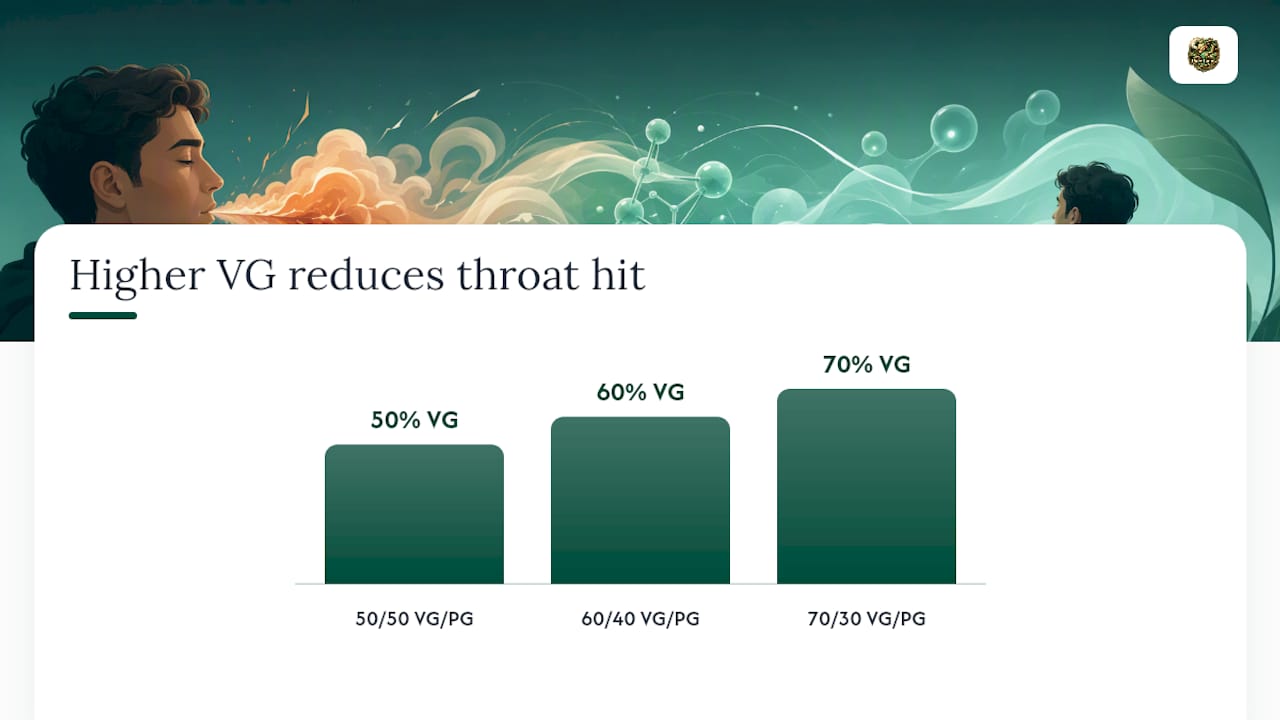
- Increase your VG ratio. Move toward a 70/30 VG/PG blend if you’re currently running 50/50 or higher PG. PG carries more bite than VG.
- Open your airflow. A tighter draw concentrates vapor and increases how much nicotine hits your throat per puff.
- Lower your wattage. Hotter vapor is harsher vapor. Drop power by 5–10W and test.
- Check your coil. A burnt or dry wick produces a sharp, acrid hit that no juice swap will fix. If it tastes burnt, replace the coil before changing anything else.
Health warning: Stop vaping and see a clinician if you experience difficulty breathing, pain when swallowing, blood in your sputum, or throat irritation that persists beyond two weeks despite adjustments. Those are not tunable vaping problems.
Pro Tip: Change only one variable at a time. If you swap juice, lower wattage, and open airflow simultaneously, you won’t know which fix actually worked, and you’ll have no baseline if the problem returns.
Key Takeaways
Switching to nicotine salts and raising your VG ratio are the two highest-impact changes for reducing a harsh throat hit, and they work because they directly reduce gas-phase nicotine absorption in the throat.
| Point | Details |
|---|---|
| Nicotine form is the biggest lever | Salt nic produces far less gas-phase nicotine than freebase, making it smoother even at higher mg/mL. |
| Gas absorption drives harshness | Research found every 100 ng/s increase in gaseous nicotine absorption raised throat hit score by 5.7 points. |
| Change one variable at a time | Adjust nicotine type, then VG ratio, then airflow, then wattage, then coil, in that order. |
| Two-week rule for medical attention | Persistent irritation beyond one to two weeks despite adjustments warrants a clinician visit, per Cleveland Clinic guidance. |
| VapeCiga device options | Low-power pods like the Packspod 5000 and adjustable mods like the Vaporesso GTX One 40W pair well with smoother setups. |
Table of Contents
- What is throat hit, and how do you know it’s the real issue?
- What variables actually control how harsh your throat hit feels?
- How to troubleshoot a harsh throat hit step by step
- Which devices and coil types give you a gentler or firmer hit?
- Practical e-liquid swaps that actually reduce harshness
- Why nicotine form and pH govern how harsh your vape feels
- How your puffing technique and hydration affect the sensation
- When throat irritation means you should see a doctor
- Sources
What is throat hit, and how do you know it’s the real issue?
Throat hit is the physical sensation you feel at the back of your throat and upper airway when you inhale vapor. It ranges from a barely perceptible tickle to a sharp, scratchy burn, and it’s driven primarily by gaseous nicotine absorbing into the mucosal tissue of your throat.
That last part matters. Research confirms that throat hit is a measurable physiological response, not just a subjective impression. Gas-phase nicotine absorption is the dominant driver, and it’s tunable through device and liquid choices. PG also contributes by drying out the mucous membrane on contact, which amplifies the scratchy sensation.
Before you start adjusting hardware, though, confirm the sensation is actually a vaping variable and not something else. Ask yourself:
- Did it start after a specific juice or device change? That points to a tunable cause.
- Does it happen only when you vape, or also when you’re not? Persistent irritation unrelated to vaping suggests allergies, dry air, acid reflux, or infection.
- Is there a flavor pattern? Menthol, cinnamon, and citrus juices can sharpen throat feel even at low nicotine.
Pro Tip: If the irritation disappears within an hour of stopping vaping and returns only when you pick it back up, it’s almost certainly a device or juice variable you can fix. If it’s constant, see a doctor.
What variables actually control how harsh your throat hit feels?
Six primary levers govern throat hit: nicotine strength, nicotine type, PG/VG ratio, airflow, wattage and coil resistance, and juice freshness. Understanding each one makes troubleshooting faster.
Nicotine form: freebase vs. salts
Freebase nicotine is alkaline. At higher strengths (12 mg/mL and above), it produces significant gas-phase nicotine in the aerosol, which is what your throat actually absorbs and registers as a hit. Nicotine salts use an organic acid (typically benzoic acid) to protonate the nicotine molecule, lowering aerosol pH and dramatically reducing gas-phase nicotine. The result: you can vape higher-concentration salt nic and feel less throat bite than lower-concentration freebase. That’s not marketing. It’s chemistry.

Nicotine strength and device style
A low-concentration freebase nicotine in a sub-ohm device running at higher power delivers a very different throat experience than the same concentration in a low-power pod. The device amplifies or dampens the effect of nicotine concentration. High-power, low-resistance setups vaporize more liquid per puff, so the effective nicotine dose per inhale is higher even without specifying exact concentrations.
PG/VG ratio
Propylene glycol (PG) is the carrier that delivers flavor and nicotine bite. It also dries out throat tissue on contact. Vegetable glycerin (VG) produces denser, smoother vapor with far less bite. A balanced VG/PG blend with higher PG hits noticeably harder than one with higher VG at the same nicotine level.
Wattage, coil resistance, and aerosol temperature
Higher wattage means hotter aerosol. Hotter aerosol increases the rate of nicotine absorption per puff and produces a sharper sensation. Burnt or dry wicks compound this: a coil that isn’t fully saturated runs even hotter and delivers a harsh, acrid hit that feels nothing like normal throat hit.
Airflow and draw style
Mouth-to-lung (MTL) draws restrict airflow and concentrate the vapor before it reaches your throat. Direct-to-lung (DTL) draws use open airflow and dilute the vapor with more air. Tighter draws increase the concentration of nicotine per breath, which intensifies the hit.
Flavorings and pH
Menthol creates a cooling sensation that some vapers read as harshness. Cinnamaldehyde (the compound in cinnamon flavoring) is a known airway irritant at higher concentrations. Citrus and sour profiles tend to lower e-liquid pH, which can increase perceived sharpness on the inhale.
| Variable | Makes hit harsher | Makes hit smoother |
|---|---|---|
| Nicotine form | Freebase (alkaline) | Nicotine salts (protonated) |
| Nicotine strength | Higher mg/mL | Lower mg/mL |
| PG/VG ratio | High PG (50%+) | High VG (70%+) |
| Wattage | Higher power | Lower power |
| Airflow | Restricted (MTL) | Open (DTL) |
| Coil condition | Burnt or dry wick | Fresh, saturated coil |
| Flavorings | Menthol, cinnamon, citrus | Creamy, dessert, tobacco |
How to troubleshoot a harsh throat hit step by step
Work through this in order. Test each change for at least 10–15 puffs before judging its effect. Give a new coil or fresh juice a few full fills before you decide it’s not working.
-
Check and replace your coil first. If the hit is sharp and acrid rather than just strong, a burnt or dry wick is the most likely culprit. Replace it, prime it with a few drops of juice, and let it sit for five minutes before vaping.
-
Switch nicotine type or lower strength. If you’re on freebase at 12 mg/mL or above, drop to 6 mg/mL or switch to a nicotine salt at a comparable strength. This is the highest-impact change for most vapers. Salt nic at higher concentration will typically feel smoother than freebase at lower concentration.
-
Move to a higher-VG juice. If you’re at 50/50, try 60/40 VG/PG. If that’s still rough, go to 70/30. Note: high-VG juice is thicker and may not wick properly in small pod coils designed for 50/50 blends. Check your device’s recommended VG range.
-
Open your airflow. If your device has an adjustable airflow ring, open it one notch and test. More air dilutes the vapor and reduces the concentration of nicotine hitting your throat per breath.
-
Lower your wattage by 5–10W. Cooler vapor is gentler vapor. Most coils have a recommended wattage range printed on the side. Start at the low end of that range and work up only if flavor suffers.
-
Check juice freshness. Oxidized nicotine in old or improperly stored juice produces a harsh, peppery taste. If the juice has darkened significantly or smells off, replace it.
Pro Tip: If you’ve worked through all six steps and the hit is still harsh, the issue is almost certainly nicotine form. A freebase juice at any strength will hit harder than a comparable salt nic in the same device. That’s physics, not preference.
Which devices and coil types give you a gentler or firmer hit?
The device you use shapes throat hit as much as the juice you put in it. MTL devices and higher-resistance coils (above 1.0 ohm) produce a tighter, more concentrated hit. DTL sub-ohm setups (below 0.5 ohm) dilute vapor with high airflow and are typically run with low-nicotine freebase (3–6 mg/mL) for that reason.
Pairings that work:
- Low-power pod system (under 20W) + nicotine salt at 25–50 mg/mL = smooth, satisfying hit with minimal bite. The Packspod 5000 and Vaporesso GTX One 40W both sit in this category.
- Adjustable box mod (40–80W) + 70/30 VG/PG freebase at 3–6 mg/mL = open, airy DTL draw with almost no throat bite.
- MTL pod or starter kit + 50/50 juice at 12 mg/mL freebase = moderate hit, similar to a cigarette draw.
Pairings to avoid:
- High-nicotine freebase (12 mg/mL+) in a sub-ohm DTL device. The combination of high power and high freebase nicotine produces an extremely harsh hit and delivers a large nicotine dose very quickly.
- Nicotine salt at 50 mg/mL in a high-wattage mod. Salt nic is designed for low-power devices. Running it at 60W+ will produce a harsh, overwhelming hit and potentially deliver an unsafe nicotine dose.
- Any juice in a coil past its service life. Mesh coils typically last 1–2 weeks with regular use. Ceramic coils run longer but still degrade.
Pro Tip: If you’re switching from cigarettes and finding vaping too harsh, an MTL pod with salt nic at 25 mg/mL is almost always the right starting point. It mimics the draw resistance of a cigarette and delivers nicotine without the freebase bite.
Practical e-liquid swaps that actually reduce harshness
The fastest e-liquid fix is almost always nicotine form, not nicotine strength. Vapers often chase lower and lower mg/mL freebase trying to reduce harshness, when switching to a salt nic at a higher mg/mL would feel smoother and satisfy nicotine cravings better. If you’re at 12 mg/mL freebase and still finding it rough, try a salt nic e-liquid at 25 mg/mL before dropping to 6 mg/mL freebase.
For VG steps, move gradually:
- Start at your current ratio and drop PG by 10% at a time.
- 50/50 → 60/40 → 70/30 is the standard progression.
- Check your device’s coil specs before going above 70% VG. Thin coil wicking channels in small pods can’t pull thick VG fast enough, leading to dry hits that are harsher than the original problem.
Flavor choice matters more than most vapers realize. Menthol and cinnamon profiles can produce a sharp, almost stinging sensation on the inhale that reads as harshness even when nicotine and PG levels are low. If you’re testing a new flavor and suddenly find the hit uncomfortable, the flavoring itself may be the cause. Try a creamy, dessert, or plain tobacco profile as a baseline before blaming your device settings.
When testing new flavors, buy the smallest available bottle first. A 30 ml bottle tells you whether a flavor works for your throat before you commit to 100 ml. Some citrus and sour profiles also lower e-liquid pH, which increases the sharpness of the inhale regardless of nicotine content.
Why nicotine form and pH govern how harsh your vape feels
Throat hit is not simply a function of how much nicotine is in your juice. It’s a function of how much nicotine reaches your throat in gas form per puff. That distinction changes everything about how you troubleshoot.
A PMC study on direct-to-lung vaping found that computed nicotine gas absorption in the throat correlated strongly with subjective throat harshness (r = 0.62; p < 0.00001). Every 100 ng/s increase in gaseous nicotine absorption produced a 5.7-point increase in throat hit score on the study’s scale. Nicotine concentration in the liquid alone was a poor predictor. What mattered was the rate of gas-phase uptake, which is controlled by nicotine form, device power, aerosol temperature, and inhalation speed.
Here’s what that means practically:
- Protonation lowers gas-phase nicotine. When nicotine is protonated (as in salt nic), it stays in liquid or particle form rather than becoming a free gas. Less gas-phase nicotine reaches your throat tissue, so the hit is softer. Modeling from the same research group showed that freebase conditions delivered substantially more throat nicotine absorption than protonated nicotine conditions in comparable setups.
- Higher device power increases aerosol temperature, which shifts more nicotine into gas phase per puff. This is why the same juice hits harder at 60W than at 30W.
- Faster inhalation increases the rate of gas delivery to the throat, amplifying the hit regardless of nicotine form.
A brief caveat: nicotine in any form is an addictive substance. Switching to salt nic for a smoother hit does not reduce nicotine exposure. If you’re trying to reduce overall nicotine intake alongside reducing harshness, stepping down mg/mL over time is the right approach. For guidance on managing nicotine levels, the vaping alternatives guide covers that territory.
How your puffing technique and hydration affect the sensation
Hardware and juice account for most of the harshness, but technique and hydration make a real difference at the margins, and they cost nothing to change.
- Take shorter, slower draws. A long, fast pull delivers more gas-phase nicotine to your throat per breath. A slow, 2–3 second draw gives the vapor more time to cool and dilute before it hits your throat.
- Pause between puffs. Chain vaping heats the coil progressively, raising aerosol temperature with each consecutive puff. Give the coil 20–30 seconds between draws to cool down.
- Stay hydrated. PG is hygroscopic, meaning it pulls moisture from the surfaces it contacts, including your throat. A dry throat registers harshness more intensely. Drink water regularly during a vaping session.
- Avoid vaping on an empty stomach. Acid reflux is a common cause of throat irritation that vapers often misattribute to their device. If the sensation is worse after meals or when lying down, reflux may be the actual cause.
- Warm-up puffs. If you’re using a sub-ohm device that’s been sitting cold, the first puff on a cool coil can feel sharper than subsequent ones. A very short, gentle draw before your first full inhale lets the coil reach operating temperature without a cold-start spike.
Pro Tip: Keep a glass of water next to you when you vape. It sounds trivial, but consistent hydration is one of the most underrated fixes for persistent mild throat irritation, especially with high-PG juices.
When throat irritation means you should see a doctor
Most harsh throat hit is tunable. But some throat irritation is not a vaping variable at all, and treating it as one delays care.
Stop vaping and see a clinician if you experience any of the following:
- Difficulty breathing or shortness of breath after vaping
- Pain or difficulty swallowing
- Blood in your sputum or saliva
- Throat irritation that persists beyond one to two weeks despite making device and juice adjustments
- Swelling in the throat or neck
- Fever accompanying throat symptoms
Cleveland Clinic guidance is clear that persistent throat irritation lasting more than about one to two weeks, or severe symptoms like difficulty breathing or swallowing, warrants evaluation by a healthcare professional. Allergies, GERD, dry air, and respiratory infections all produce throat symptoms that can look identical to vaping irritation from the inside.
The timeline matters. If you’ve made every reasonable adjustment (nicotine form, strength, PG/VG, wattage, coil, technique) and the irritation is still there after two weeks, the cause is almost certainly not your vape settings.
Important: Vaping-related lung injury (EVALI) is a documented medical condition. If you develop chest pain, fever, or significant breathing difficulty, seek emergency care, not a troubleshooting guide.
A note on the limits of this advice
The fixes in this guide cover the most common mechanical and chemical causes of a harsh throat hit, and the science behind them is solid. But no troubleshooting guide can diagnose a medical condition. If your symptoms are severe, worsening, or simply not responding to the adjustments described here, the right next step is a conversation with a clinician, not another coil swap. This is general information, not a substitute for professional medical advice.
Smoother vaping starts with the right setup
If you’ve worked through the checklist and still want a hardware upgrade, the device category matters as much as the settings. Low-wattage pod systems paired with salt nic are the most reliable path to a comfortable hit for most vapers.

VapeCiga stocks a range of devices built for exactly this. The Packspod 5000 is a compact, low-power pod that pairs naturally with salt nic e-liquids and produces a smooth, consistent draw without the bite of a high-wattage setup. For vapers who want wattage control, the Vaporesso GTX One 40W lets you dial power down to a range where even freebase juice softens considerably. The EBCREATE BC40000 PRO suits experienced vapers who want a high-capacity device with adjustable output. All orders ship domestically across the U.S. VapeCiga sells to adults 21 and over only. Vaping products contain nicotine, which is addictive. Browse the full selection at Vapeciga and filter by device type to find the right fit for your preferred draw style.
Sources
The following primary sources informed this guide. For persistent or severe symptoms, consult a healthcare professional rather than relying on any online resource.
- Effects of freebase/protonated nicotine concentration, liquid composition and electrical power on throat hit in direct-to-lung vaping: theory and clinical measurements - PMC
- Effects of freebase/protonated nicotine concentration, liquid composition, and electrical power on throat hit in direct-to-lung vaping: theory and clinical measurements
- Itchy throat: causes and treatments - Cleveland Clinic
- Vape Throat Hit Too Harsh or Too Weak? How to Fix It | The Vapers Guide
- Why Is My Vape So Harsh? 13 Causes & Solutions - Ecigator