


USPS treats vapes and e-cigarettes as generally nonmailable, full stop. The exceptions are narrow: intra-Alaska or intra-Hawaii shipments, businesses authorized through the Postal Service’s PCSC program, and certain individual noncommercial mailings that meet strict quantity and verification rules. Drop a vape in a regular mailbox outside those lanes, and you risk seizure and penalties under 18 U.S.C. § 1716E.
TL;DR:
- USPS only allows vape shipments within Alaska or Hawaii when tendered face-to-face at a retail counter with proper markings, not through drop boxes or curbside pickup.
- Commercial shipments require prior approval using PS Form 4615-E, relevant licenses, and correct labeling, including the PCSC eligibility number in the return address.
- Shipping a vape without proper authorization can lead to severe penalties, including criminal fines, prison time, and seizure of the package.
- Private carriers generally have restrictions on vape products similar to USPS, with no legal way for consumers to circumvent these limitations.
- The safest option is to buy finished vape products directly from licensed retailers that handle all compliance and age verification.
Table of Contents
- What USPS’s Final Rule Actually Requires
- Who Is Allowed to Ship ENDS Anyway?
- How Do Authorized Shippers Stay Compliant?
- What Happens If You Mail a Vape Anyway?
- Do Private Carriers Offer a Way Around This?
- What Should You Actually Do Right Now?
- Packaging and Labeling That Actually Passes Inspection
- What Happens to a Hobbyist Who Just Tries It Anyway
- How Do You Verify a Recipient Is Actually an Adult?
- Prohibited vs. Conditionally Allowed: The Clear Breakdown
- How Does This Compare to State Vape Shipping Laws?
- What Are the Legal Alternatives to Mailing a Vape?
- Where Vapeciga Fits Into the Compliance Picture
- Skip the Shipping Headache. Order What You Need Direct
- Sources
- FAQ
What USPS’s Final Rule Actually Requires
The rule tracing back to the Preventing Online Sales of E-Cigarettes to Children Act, better known as POSECCA, rewrote the mailability statute in 2021 to fold electronic nicotine delivery systems into the same category as cigarettes and smokeless tobacco. USPS responded with a final rule published in the Federal Register that October, updating Publication 52 and issuing Management Instruction PO-130-2021-2 to spell out how postal employees should handle suspected ENDS packages.
“ENDS” covers more than the device itself. It includes e-liquids, coils, batteries, atomizers, and any component part or accessory tied to the vaping system, regardless of whether the liquid contains nicotine at all. A zero-nicotine pod counts the same as a 50mg salt nic cartridge under this framework.
The policy driver was youth access. The ATF’s guidance on vapes and e-cigarettes explains that the amended PACT Act was built to close the exact loophole that let minors order vapes online and receive them by mail with no one checking an ID at the door. Regulators have consistently pointed to that gap as the reason the restriction exists, not general hostility toward the product category.
Who Is Allowed to Ship ENDS Anyway?
Three exceptions carve out room in an otherwise closed system, and each comes with its own fine print.
- Intra-Alaska and intra-Hawaii shipments. Packages that start and end within the same state qualify, but only with face-to-face tender at a retail counter and correct nonmailable-matter markings on the package.
- Business and regulatory mailings. Manufacturers, distributors, and retailers can apply for authorization through the Postal Service’s Pharmacy/PCSC-style compliance channel. That means filing PS Form 4615-E along with supporting documentation, including relevant licenses and safety data sheets for lithium batteries or chemical components.
- Certain-individual mailings. An adult can mail ENDS to another adult under a noncommercial exception, but only within tight weight and quantity limits, capped at 10 shipments in any 30 day period, and only after in-person acceptance with age and identity verification at the counter.
None of these exceptions permit dropping a package in a blue collection box or leaving it for curbside pickup. Every legitimate path runs through a human being at a retail counter checking the paperwork before the package ever enters the mail stream.
How Do Authorized Shippers Stay Compliant?
Qualifying under an exception is only step one. Getting the package accepted and delivered without a seizure requires following the operational rules to the letter.
- Apply and document first. Submit PS Form 4615-E along with the applicable ENDS worksheets (4615-EM or 4615-ER), plus any required licenses or safety data sheets for battery and chemical components, before attempting to ship anything.
- Tender in person, every time. Present the package directly to a retail associate. Drop boxes, kiosks, and curbside pickup are all off limits for these shipments, and staff are trained to refuse anything that comes in through the wrong channel.
- Mark and label correctly. The package needs the required nonmailable-matter language, and business shipments must display the PCSC eligibility number in the return address block, according to Publication 52’s application procedures.
- Choose the right mail product. Use Priority Mail, Priority Mail Express, or Ground Advantage as applicable, and add Adult Signature service along with Domestic Return Receipt where the exception requires proof of who actually accepted the package.
Pro Tip: Missing the eligibility number in the return address is the single most common reason an otherwise-qualified business shipment gets refused at the counter. Double-check that field before you ever head to the post office.
What Happens If You Mail a Vape Anyway?
Getting caught isn’t a slap on the wrist. Under 18 U.S.C. § 1716E, a knowing violation carries criminal fines and up to one year in prison, with civil penalties and forfeiture calculated against a statutory multiplier of the retail value on top of that.
Postal Inspection Service referrals aren’t rare edge cases. Suspicious packaging routinely triggers a hold, an inspection, and in many cases outright seizure and destruction, according to USPS’s own operational guidance for handling nonmailable matter.
The burden of proving an exception applies sits with the shipper, not the Postal Service. If your paperwork doesn’t hold up when questioned, the package is gone. Reuters has documented enforcement actions showing the crackdown has measurably squeezed illicit online vape sellers who relied on the mail as their main distribution channel.
Do Private Carriers Offer a Way Around This?
No. This is where people get burned the most, because they assume UPS or FedEx will just handle what USPS won’t.
Major private carriers have adopted bans or restrictions on vaping products that are at least as strict as USPS’s, according to a legal explainer on vape shipping rules. Some carriers permit narrow business-to-business shipments under carrier-specific approval programs, similar in spirit to PCSC authorization, but there’s no consumer-level workaround hiding in a competitor’s shipping menu. International shipping adds customs and import restrictions on top of the domestic ban, which makes cross-border vape shipping even less viable for an individual seller.
What Should You Actually Do Right Now?
The safest move for almost everyone is simple: don’t put a personal vape shipment in the mail at all.
- Individuals: Skip mailing your device entirely. Use a manufacturer’s RMA process for warranty returns, hand-deliver locally, or confirm in writing that you meet every condition of the certain-individual exception before you try.
- Businesses: Register with the ATF, apply for PCSC authorization, and budget time for ongoing monthly reporting and state tobacco tax obligations, which run separately from federal mailing rules.
- Anyone unsure: Check eligibility before you show up at a retail counter, not after a clerk refuses the package.
| Situation | What USPS Allows | Best Move |
|---|---|---|
| Personal device, out of state | Not allowed | Don’t mail it; hand-deliver or use manufacturer RMA |
| Same-state (AK or HI only) | Allowed with face-to-face tender | Bring it to the counter with proper markings |
| Registered business with PCSC approval | Allowed under strict conditions | File PS Form 4615-E, use required markings and services |
| Adult-to-adult, under quantity limits | Allowed under certain-individual exception | Verify limits, tender in person, confirm ID checks |
Packaging and Labeling That Actually Passes Inspection
Even legitimate, exception-qualified shipments get rejected constantly over avoidable packaging mistakes. The nonmailable-matter marking has to appear exactly as specified, not paraphrased or abbreviated, and it needs to be visible on the outside of the package, not buried inside.
Battery-containing components need separate attention. Coils, mods, and disposable devices all contain lithium batteries, which carry their own hazardous materials labeling requirements independent of the ENDS rules. A package that satisfies the tobacco mailing exception but ignores battery labeling can still get flagged and held.
For business shipments, the PCSC eligibility number belongs in the return address block, not buried in an invoice or a packing slip inside the box. Retail staff are trained to check that specific location, and a package missing it at the counter gets refused before it ever ships, according to Publication 52’s mailability exceptions guidance. Use sturdy, tamper-evident packaging for anything containing e-liquid. Leaking cartridges or damaged tanks create secondary problems at inspection that have nothing to do with the mailability rules but can still trigger a hold.
What Happens to a Hobbyist Who Just Tries It Anyway
The person most likely to get burned by these rules isn’t a business owner with a compliance team. It’s the individual who sells a used mod on a forum, ships a spare tank to a friend, or mails back a defective device without reading the fine print first.
Here’s the part that catches people off guard: ignorance of the rule is not a defense, and “I didn’t know” doesn’t undo a seizure once Inspection Service flags a package. A hobbyist mailing a single disposable vape to a buyer three states away has no PCSC authorization, doesn’t qualify for the intra-Alaska or intra-Hawaii exception, and almost certainly exceeds what the certain-individual exception allows if they’re shipping regularly enough to call it a side hustle.
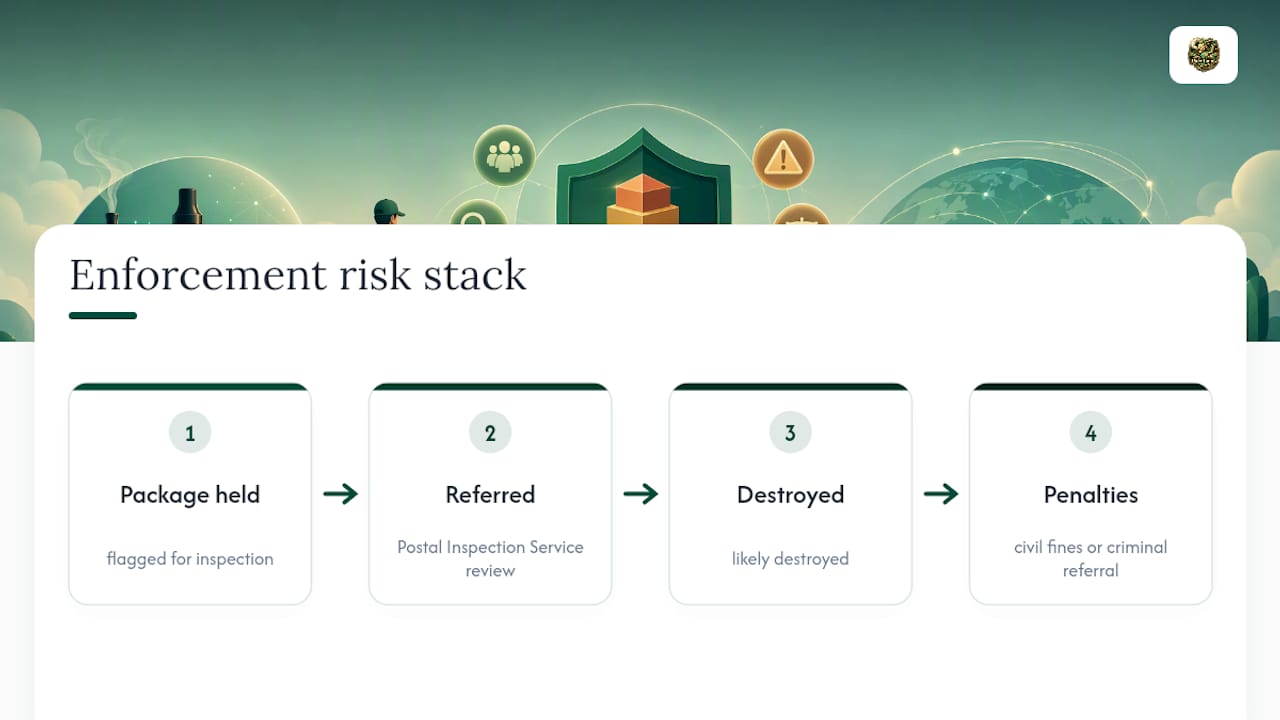
The practical risk stack looks like this: the package gets held, then referred to the Postal Inspection Service, then likely destroyed. If postal inspectors decide the pattern looks commercial, that opens the door to civil penalties tied to the retail value multiplier under federal mailability law, and in the worst cases, criminal referral. A single one-off mistake by someone unaware of the rule is treated differently in practice than a pattern of repeat shipments, but neither is actually safe, and neither comes with a guaranteed pass.
How Do You Verify a Recipient Is Actually an Adult?
Age verification isn’t optional paperwork. It’s the entire point of the restriction.
For the certain-individual exception, verification happens at the point of acceptance, not delivery. The retail associate accepting the package in person checks government-issued photo ID for the sender, confirming they’re a legal adult before the package is ever tendered into the mail stream. That’s a fundamentally different model from a website checkbox that asks “are you 21?” with no verification behind it.
On the delivery side, Adult Signature service requires the carrier to check ID at the door and confirm the person signing is 21 or older before releasing the package. This is the mechanism that closes the loophole regulators were worried about in the first place: a minor ordering online and grabbing an unattended package off the porch. For businesses shipping through the PCSC exception, that Adult Signature requirement isn’t a nice-to-have add-on. It’s baked into the required mail products under USPS’s operational guidance, and skipping it invalidates the shipment’s eligibility even if every other box gets checked.
Prohibited vs. Conditionally Allowed: The Clear Breakdown
Confusion usually comes from treating “vape products” as one single category, when USPS actually draws a sharper line.
Categorically prohibited for ordinary consumer mailing: disposable vapes, pod systems, mods, e-liquids and salt nic juices at any nicotine concentration including zero, replacement coils, tanks, atomizers, and batteries sold as vape accessories. It doesn’t matter if the device is new, used, empty, or full. All of it falls under the same nonmailable classification.
Conditionally allowed, with strict process attached: the same items, shipped intra-Alaska or intra-Hawaii with face-to-face tender; the same items, shipped by a PCSC-authorized business following the marking and reporting rules; the same items, shipped adult-to-adult under the certain-individual exception’s quantity caps and verification steps.
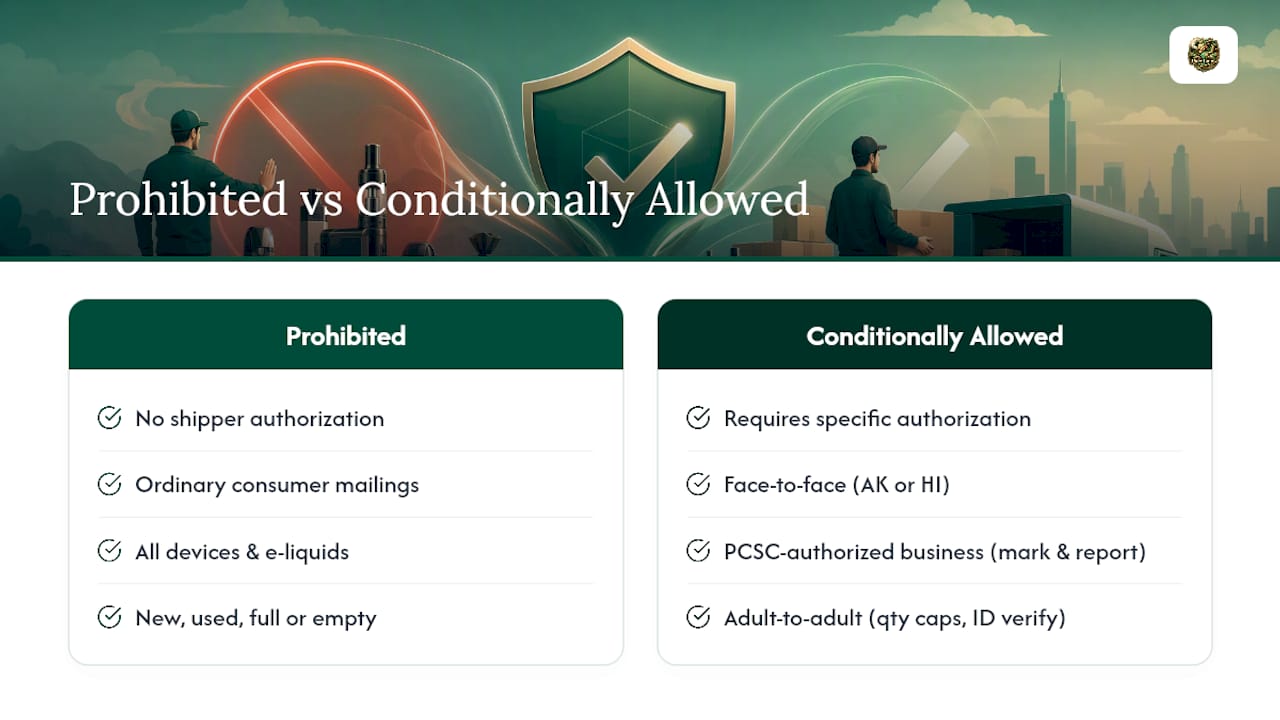
Nothing about the item itself changes between those two columns. What changes is the shipper’s authorization status and the process they follow to tender the package. A retailer with PCSC approval and a teenager mailing a spare pod to a friend are handling physically identical products under completely different legal outcomes.
How Does This Compare to State Vape Shipping Laws?
USPS’s federal restriction operates independently of state law, and that’s where a lot of people trip up. Several states, including New York and Massachusetts, have their own bans or heavy restrictions on shipping vape products into the state, layered on top of whatever USPS or a private carrier allows federally.
That means passing the federal mailability test doesn’t automatically mean a shipment is legal. A PCSC-authorized business shipping into a state with its own flavor ban or direct-shipment restriction still has to clear that state’s rules separately. State tobacco tax registration requirements, sometimes tied to the older Jenkins Act reporting framework, add another compliance layer for businesses that federal mailability rules don’t address at all.
The practical takeaway: federal authorization is the floor, not the ceiling. A business that only checks the USPS side of the equation and ignores destination-state law is one compliance audit away from a much bigger problem than a seized package.
What Are the Legal Alternatives to Mailing a Vape?
If you’re an adult who wants vape products without navigating any of this, the answer isn’t to find a sneakier shipping method. It’s to buy from a retailer that’s already built its shipping process around these rules.
Buying finished retail product from an established U.S. seller sidesteps the entire consumer-mailing problem, because the retailer, not the individual, handles compliance on outbound shipments. For someone who already owns a device and just needs replacement coils, tanks, or e-liquid, ordering direct from a compliant retailer avoids the face-to-face tender and PCSC paperwork altogether, since it’s not a peer-to-peer mailing situation in the first place.
For travel specifically, the rules diverge from shipping in an important way. Carrying a personal vape device on a plane falls under separate TSA and airline guidance rather than USPS mailability law, which is worth understanding if your real question is about bringing a device with you rather than shipping one. VapeCiga’s guide to TSA vape rules for air travel breaks down that distinction in detail.
Where Vapeciga Fits Into the Compliance Picture
VapeCiga is a U.S. based retailer serving adults 21 and older, and the guidance in this article exists because getting the shipping rules wrong carries real legal consequences for customers who don’t. Publishing plain explanations of USPS mailability law isn’t a side project for us. It’s part of taking a regulated product category seriously.
For readers weighing a purchase against the paperwork of shipping their own device, our guide on smart online shopping for adult vapers covers age verification and store shipping policy in more depth. If your situation involves an edge case, like a business trying to qualify for PCSC authorization, talk to a qualified attorney rather than relying on a blog post, ours included.
*— James
Skip the Shipping Headache. Order What You Need Direct
There’s a simpler path than wrestling with PCSC applications and face-to-face tender rules: buy finished product from a retailer that already handles compliance on its end. Ordering finished vape products from an established retailer is an alternative to mailing your own device or e-liquid across state lines, as the shipping burden and age verification are managed by the seller.
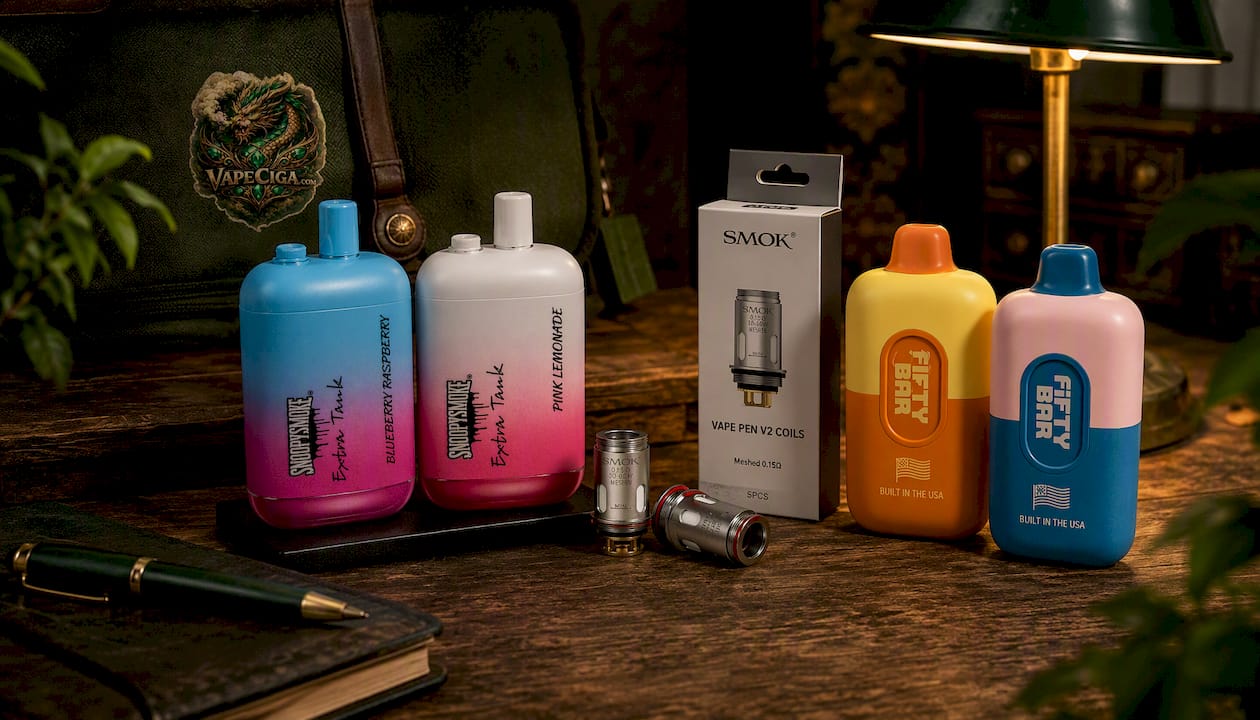
Our catalog covers the full range, from high-capacity disposables like the Snoopy Smoke Extra Tank to everyday replacement parts like Smok Vape Pen V2 coils and compact options like the Fifty Bar 6500. Every order ships to adults 21 and older with age verification built into checkout, in line with applicable shipping rules. Browse the current selection, check our shipping policy for your state, and place your order directly through Vapeciga instead of risking a seized package over a shipment you never needed to send yourself.
Sources
- Vapes and E-Cigarettes | ATF
- Treatment of E-Cigarettes in the Mail | Federal Register
- Publication 52 — USPS Postal Explorer (ENDS treatment and operational guidance)
- Management Instruction PO-130-2021-2 – Responding to Matter Nonmailable Under The PACT Act and POSECCA (USPS)
FAQ
Will USPS Know if I Ship a Vape?
Postal employees are trained to spot suspicious packaging consistent with ENDS products, and suspected shipments get referred to the Postal Inspection Service for hold and inspection rather than passing through unnoticed.
Can I Ship Vape Products With USPS?
Only under narrow exceptions: intra-Alaska or intra-Hawaii shipments, PCSC-authorized business mailings, or certain-individual noncommercial shipments that meet strict quantity and face-to-face verification rules.
Can I Mail a Vape to a Friend?
Only if you both qualify under the certain-individual exception, which caps shipments at 10 per 30 days, requires in-person tender, and requires ID verification at the counter, not a casual drop in a mailbox.
What States Allow Vape Mail?
USPS’s federal exception applies specifically to shipments that stay entirely within Alaska or entirely within Hawaii; every other state falls under the general nonmailable rule, and some states layer additional restrictions of their own on top of that.
Is Buying From an Online Vape Retailer Different From Mailing My Own Device?
Yes. A retailer like VapeCiga ships finished product to verified adult customers under its own compliance process, which is a different legal situation from an individual attempting to mail a personal device or used accessory through the regular mail.