


The safest rule is simple: use only the battery and charger your device came with or a replacement recommended by the device’s manufacturer, charge it on a flat, non-flammable surface where you can watch it, and never carry loose 18650 cells without a plastic case. That’s the core of every guideline from the FDA, the EPA, and the CPSC, and this is also advised by some vape industry experts to customers who bring in damaged devices.
TL;DR:
- Using only the original or manufacturer-recommended batteries and chargers significantly reduces the risk of thermal runaway and fire incidents.
- Removable lithium-ion cells must be inspected regularly for damage, proper wrapping, and weight to prevent counterfeits and unsafe batteries from being used.
- Charging in a flat, non-flammable surface, avoiding unattended sessions, and unplugging after full charge are critical habits for preventing overheating and fires.
- Store spare batteries in hard cases with terminals covered, and never carry loose cells alongside metal objects like keys to avoid shorts.
- Dispose of batteries and devices through hazardous waste programs, and avoid using damaged or swollen batteries to prevent dangerous failures.
Table of Contents
- What Makes Vape Battery Safety Different From Other Electronics?
- How Do You Choose and Inspect a Safe Vape Battery?
- What Charging Habits Actually Prevent Fires?
- How Should You Store and Transport Vape Batteries?
- How Do You Dispose of and Recycle Vape Batteries?
- What Should You Do if a Battery Overheats or Smokes?
- What Do mAh, Voltage, and Amp Limits Actually Mean for You?
- What’s the Right Way to Handle a Battery Day to Day?
- How Do You Extend Battery Life Without Compromising Safety?
- Li-ion vs. Li-po: Does Battery Chemistry Change the Safety Rules?
- A Retailer’s View on What Actually Breaks
- Safer Devices Start With Less Handling, Not More Rules
- Where to Report Issues or Learn More
- Sources
- FAQ
What Makes Vape Battery Safety Different From Other Electronics?
Vape devices run on lithium-ion cells, but not all of them work the same way. Disposable vapes and most pod systems use a small, sealed, integrated battery you never touch directly. Box mods and some higher-capacity kits use removable cells, most commonly 18650 or 21700 format, that you handle, charge, and swap yourself. That distinction matters because removable cells carry more of the risk.
Lithium-ion batteries store a lot of energy in a small package, and when something goes wrong (a puncture, a short circuit, extreme heat) that energy can release all at once. This is called thermal runaway: internal temperature spikes, gases build up, and the cell can vent, swell, or ignite. It’s a chain reaction, not a random glitch, which is why catching early warning signs matters so much.
Counterfeit and rewrapped cells raise the odds of this happening. A cell pulled from a laptop pack, relabeled with an inflated capacity rating, and sold loose online often lacks the protection circuitry a legitimate consumer battery includes. The CPSC has specifically warned that cells separated from their original battery packs and reused as standalone consumer batteries are far more dangerous, since their exposed terminals short easily against metal.
How Do You Choose and Inspect a Safe Vape Battery?
Buy batteries designed for the device you own, not whatever loose cell is cheapest online. Manufacturer-recommended cells and reputable protected 18650/21700 batteries include a built-in circuit that cuts power if voltage, current, or temperature go out of range. Bare industrial cells pulled from power tools or laptop packs almost never have that protection, and CPSC data links them to serious burn injuries.
Before you buy, and before every charge, run through a quick check:
- Look for a torn, wrinkled, or loose wrapper. Exposed metal underneath is a shock and short risk.
- Check the printed capacity against the brand’s published specs. A “10000mAh” 18650 cell is physically impossible; real cells top out around 3000 to 3500mAh.
- Weigh it in your hand. A cell that feels unusually light for its size may be a hollowed-out counterfeit.
- Confirm the wrap has no bare spots at the positive or negative terminal.
- If a cell fails any of these checks, set it aside in a metal or ceramic container away from other batteries until you can dispose of it properly. Never use it “just this once.”
Pro Tip: Keep one small fireproof bag or metal tin labeled “quarantine” near your charging station. Any battery that looks even slightly off goes straight in there instead of back in rotation.
What Charging Habits Actually Prevent Fires?
Charging errors cause more vape battery incidents than manufacturing defects do. The fix is almost entirely behavioral.
- Use the charger that came with your device, or one the manufacturer explicitly lists as compatible. Mismatched fast chargers can push more current than the cell or circuit board is rated for.
- Charge on a hard, flat, non-flammable surface, such as a kitchen counter or a ceramic tile, never on a bed, couch, or carpet.
- Stay in the room, or at least check in regularly. The FDA specifically warns against charging unattended or overnight, since overheating tends to happen gradually and unnoticed.
- For removable cells, charge them in a dedicated external charger with individual slots rather than in the device itself when possible.
- Unplug once charging finishes. Leaving a full battery on the charger for hours adds unnecessary heat stress.
Gov echoes the same points: supplied chargers, visual monitoring, and never charging on soft furniture. Room temperature matters too. Charging in a hot car or near a sunny window pushes the cell closer to its thermal limit before it’s even done a single cycle.
How Should You Store and Transport Vape Batteries?
Loose cells rattling around in a pocket, bag, or junk drawer are how most accidental shorts happen. A key or a coin bridging the two terminals can trigger a short in seconds.
- Store spare 18650 or 21700 cells in hard plastic battery cases, never loose.
- If you must carry a single loose cell, tape over both terminals first.
- Keep batteries away from keys, coins, and other metal objects in the same pocket or bag compartment.
- Use any transport lock or child-safety lock your device offers when it’s not in use.
- Never leave a device or spare batteries in a hot car or on a sunny dashboard.
If you’re flying, the TSA requires vaping devices and spare batteries to travel in carry-on luggage, with spare cells protected from shorting, not in checked bags.
How Do You Dispose of and Recycle Vape Batteries?
Vape batteries and disposable devices do not belong in household trash or curbside recycling. Compactor trucks and sorting equipment can crush a lithium cell, and a crushed cell is a fire risk in the middle of a waste stream where nobody’s watching for it.
- Take used batteries and devices to a household hazardous waste (HHW) collection site; many local programs accept them free of charge.
- Check for retailer take-back programs, since some vape and battery retailers accept spent cells directly.
- Bag batteries individually and tape over exposed terminals before drop-off.
- Keep any remaining e-liquid separate and sealed, since nicotine liquid itself can qualify as hazardous waste under EPA guidance.
This isn’t red tape for its own sake. It exists because lithium cells and nicotine e-liquid pose real risk to the sanitation workers and facilities handling your trash after it leaves your curb.
What Should You Do if a Battery Overheats or Smokes?
Certain warning signs mean stop using the device immediately: a swollen or bulging battery, a case that’s uncomfortably hot to the touch, a chemical or metallic smell, or a device that fires on its own without you pressing the button.
- Set the device down on a hard, non-flammable surface right away, ideally outdoors or near an open window.
- Move people and pets away and give the device space; don’t try to grab or move it once it’s actively smoking.
- If it catches fire, call 911 and let firefighters handle it rather than attempting to extinguish a lithium battery fire yourself.
- Once it has cooled completely, bag it separately and take it to an HHW site rather than the trash.
Pro Tip: Never puncture a swollen battery to “release the pressure,” and never submerge one in water hoping to cool it. Both actions can trigger the exact thermal runaway you’re trying to avoid.
What Do mAh, Voltage, and Amp Limits Actually Mean for You?
Every removable battery is stamped with numbers that matter more than most papers realize. Capacity (mAh) tells you how long a charge lasts, not how safe the cell is. A 3000mAh cell and a 3500mAh cell of the same brand and size can be equally safe; a “10000mAh” cell in the same physical size is a red flag, since that capacity isn’t achievable in that form factor with current lithium-ion chemistry.
Voltage matters because your device’s circuit board expects a specific range, usually 3.6 to 4.2 volts for a standard lithium-ion cell. Using a battery type your device wasn’t designed for can confuse the regulation circuit and push current outside safe limits.
Continuous discharge rating (CDR), often listed in amps, is the number most papers skip and shouldn’t. It tells you the maximum current the cell can safely deliver without overheating. A sub-ohm tank pulling high wattage needs a battery with a CDR that comfortably exceeds what the device demands. Running a low-CDR cell at high wattage is one of the fastest ways to overheat a battery even when everything else about your charging and storage habits is correct.
If your device lists battery requirements in the manual, treat those numbers as a floor, not a suggestion. Mismatching capacity, voltage, or amp rating with what the manufacturer specifies is one of the more preventable causes of battery stress. Readers curious about the underlying math can walk through Ohm’s Law as it applies to vaping for a plain-language breakdown of resistance, current, and safe limits.
What’s the Right Way to Handle a Battery Day to Day?
Physical handling habits matter as much as the battery you choose. A cell that’s perfectly safe on the shelf can become dangerous through careless daily handling.
Avoid metal-on-metal contact entirely. Batteries carried loose against keys, coins, or a second battery can short in the time it takes to reach into a pocket. That’s a large share of the “battery just exploded in my pocket” stories that circulate online, and it’s almost always preventable with a $5 plastic case.
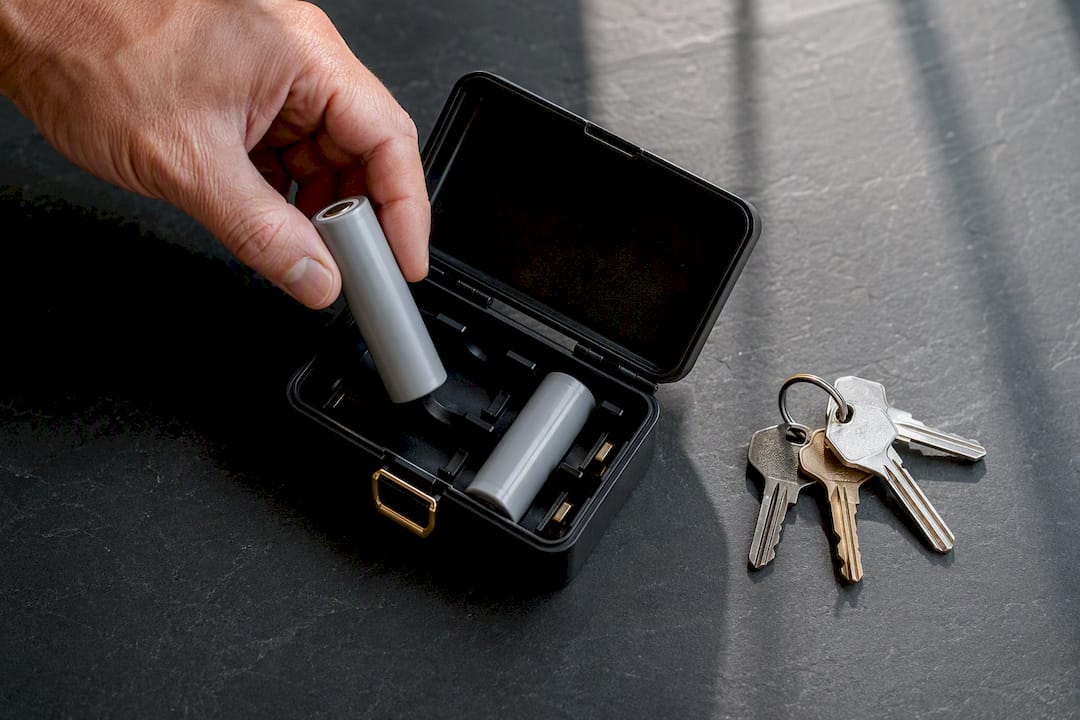
Punctures are equally serious. Dropping a battery hard enough to dent the wrap, pressing it too tightly into a mod that’s not built for it, or prying it out with a metal tool can compromise the internal separator that keeps the cell’s two sides from touching directly. Once that separator is breached, a short circuit can happen instantly.
Temperature extremes stress a battery even without visible damage. Leaving a device in a hot car, direct sunlight, or near a stove pushes internal temperature toward the range where thermal runaway becomes more likely. Cold isn’t risk-free either. Very cold temperatures reduce a lithium-ion cell’s performance and can cause it to draw current unevenly when it warms back up. Room temperature storage, away from direct heat sources, remains the simplest safe range for both storage and use.
How Do You Extend Battery Life Without Compromising Safety?
Battery health and battery safety are the same conversation, not two separate ones. A battery that’s been treated well tends to fail more predictably, with visible swelling or capacity drop, rather than suddenly.
Avoid running a battery all the way to zero repeatedly. Deep discharges stress lithium-ion chemistry more than partial discharges do, and consistently draining to empty shortens usable lifespan. On the other end, avoid leaving a battery on the charger long after it hits 100%. Trickle overcharging, even when a device’s protection circuit limits the danger, generates heat that adds up over hundreds of cycles.
Store spare batteries at a partial charge, roughly 40 to 60%, if you won’t use them for weeks. Storing a cell fully charged for extended periods accelerates capacity loss, and storing it fully empty risks it dropping below the voltage threshold where some protection circuits refuse to recharge it at all.
Rotate spare batteries rather than running one cell constantly while others sit unused. Uneven use ages cells at different rates, which becomes a safety issue once you start mixing an old, degraded cell with a newer one in a dual-battery device. Mismatched cells in series can discharge unevenly and stress the weaker one.
Li-ion vs. Li-po: Does Battery Chemistry Change the Safety Rules?
Most vape devices use one of two lithium chemistries, and the difference affects how you should handle them. Lithium-ion (Li-ion) cells, the kind found in most 18650 and 21700 batteries, use a rigid metal casing and a liquid electrolyte. They’re energy-dense and durable under normal handling, but that same rigid casing means internal pressure has fewer places to go if something goes wrong, which is part of why a compromised Li-ion cell can vent forcefully.
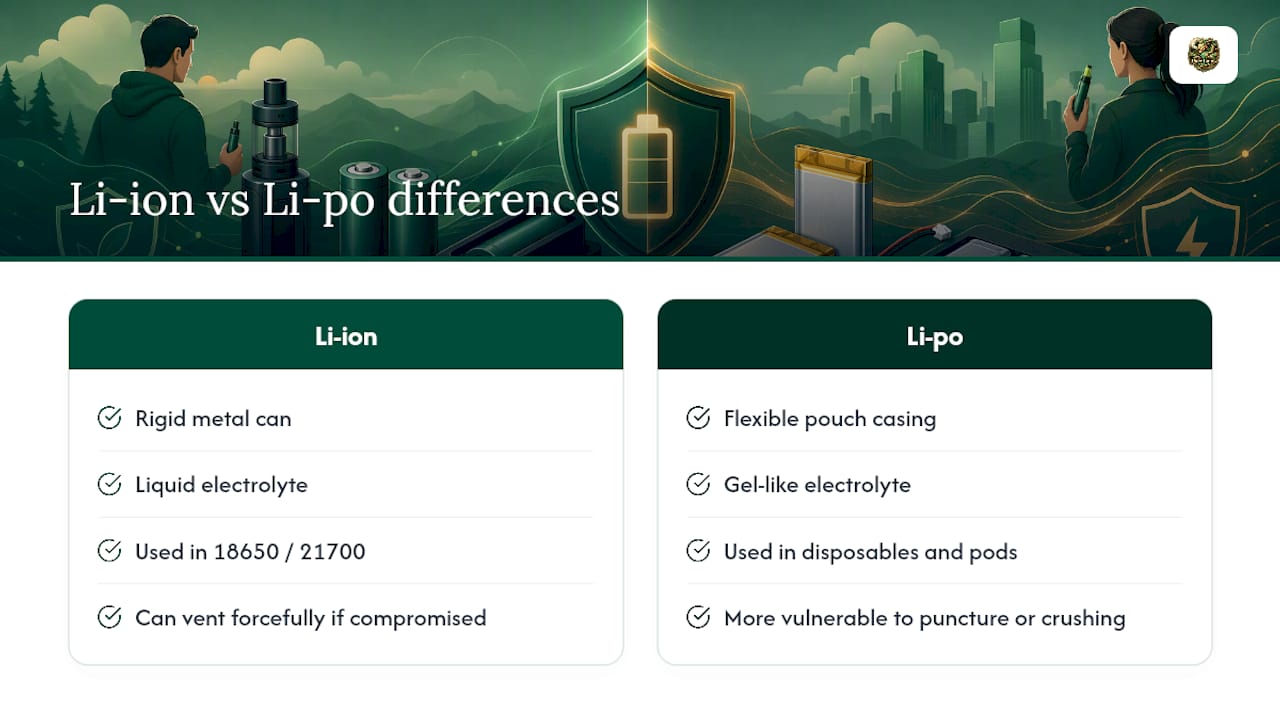
Lithium-polymer (Li-po) cells, more common in integrated disposable and pod device batteries, use a flexible pouch instead of a metal can and a gel-like electrolyte. They’re lighter and can be shaped to fit compact devices, but the flexible casing is more vulnerable to punctures from sharp impacts or crushing.
Neither chemistry is inherently “safer” in the way marketing sometimes implies. What matters more is whether the cell includes protection circuitry and whether it’s being used within its rated specifications. As one UK government testing report on vape batteries found, protection circuits reduce risk but don’t eliminate it. Abuse testing showed cells can still reach dangerously high temperatures even with protections in place. Good pack design helps. It’s not a substitute for the handling habits covered above.
A Retailer’s View on What Actually Breaks
Most of the damaged devices James sees at VapeCiga trace back to a handful of repeat causes: a swollen cell from being left on a cheap third-party charger, or a device that “just stopped working” after riding loose in a bag with keys. The fix is rarely a bad battery. It’s a missing case or the wrong charger. Devices with integrated safety chips and sealed pod designs cut a lot of that risk out simply by removing the handling step entirely.
— James
Safer Devices Start With Less Handling, Not More Rules
Every rule in this guide exists to manage risk that comes from handling loose cells: the wrong charger, a pocket full of keys, a swollen battery you didn’t catch in time. Sealed, integrated-battery devices sidestep a lot of that risk simply by design, since there’s no removable cell to mismatch, mishandle, or store incorrectly.

That’s part of why disposables and pod-style kits have become the practical choice for vapers who want fewer things to manage. The Fifty Bar 6500 and BC5000 both use sealed, integrated batteries with built-in protection circuitry, so there’s no loose cell to inspect, charge separately, or store in a case. For vapers who want higher capacity without switching to a removable-battery mod, the EBCREATE BC40000 PRO offers a sealed design built for extended use between charges. Browse VapeCiga’s current lineup to find a device that matches how much handling you actually want to deal with, and check the site’s guides on TSA travel rules and charging troubleshooting before your next order.
Where to Report Issues or Learn More
For incident reports and safety alerts, check the FDA’s vape battery safety tips and the CPSC’s warning on separated cells. For disposal rules, see the EPA’s e-cigarette disposal guidance, and for air travel, review TSA’s vaping device policy. Adult smokers considering a switch may also find this guidance on evaluating products before switching useful context.
Sources
- Tips to Help Avoid Vape Battery Fires or Explosions - FDA
- How to safely dispose of e-cigarettes (EPA)
- CPSC warning on separated lithium-ion battery cells
- Electronic cigarettes and vaping devices — TSA
FAQ
Are Battery Vapes Safe?
Vape batteries are safe when you use manufacturer-recommended cells and chargers, inspect them regularly, and follow charging and storage guidance from the FDA. Most reported incidents trace back to counterfeit cells, mismatched chargers, or unattended charging rather than the battery itself failing on its own.
Is It Safe to Vape Inside the House?
Vaping indoors doesn’t carry the same fire risk as charging does; the real hazard is charging your device on flammable surfaces like beds or couches. Keep charging confined to a hard, flat, non-flammable surface regardless of where you use the device.
Is It Bad to Leave the Vape Battery on Charge Overnight?
Yes. Charging overnight or unattended is one of the leading causes of battery fires, since overheating during a long, unmonitored charge often goes unnoticed until it’s too late. Unplug the device once it reaches full charge and keep charging sessions within sight.
How Do I Know if My Vape Battery Is Going Bad?
Watch for swelling, a case that feels hot even when not charging, a chemical smell, or a device that fires without you pressing the button. Any one of these signs means stop using it and prepare it for hazardous waste disposal.
Can I Recycle Loose 18650 Batteries at Home?
No, loose 18650 cells should never go in curbside recycling or household trash. Take them to a household hazardous waste collection site or a retailer take-back program, taping the terminals first to prevent shorts during transport.