


Mesh coils win on flavor and ease of use, single round-wire coils fit mouth-to-lung beginners, and Clapton or multi-coil builds push clouds for direct-lung vapers who don’t mind swapping coils more often. If you’re new to vaping and just want one solid answer, start with mesh. It heats evenly, ramps up fast, and forgives the small mistakes beginners make with wattage and priming.
Here’s the quick breakdown of when each family actually earns its place:
- Mesh coils: best all-around pick for flavor, vapor, and beginner-friendly reliability
- Round/spiral wire coils: cheapest, simplest, great for mouth-to-lung (MTL) setups
- Clapton/twisted coils: more surface area for flavor chasers and cloud builders
- Ceramic coils: slower ramp-up but longer life, good for high-VG juice
- Vertical, multi-coil, and rebuildable setups: maximum output and customization, best left to experienced users
Key Takeaways
Mesh coils deliver the best balance of flavor, ramp-up speed, and lifespan for most vapers, while resistance and wattage together decide whether you land on tight MTL puffs or big DTL clouds.
| Point | Details |
|---|---|
| Mesh is the default for flavor | Increased surface area means faster ramp-up and longer life than round wire. |
| Match resistance to style | Above 1.0Ω suits MTL; below 1.0Ω (sub-ohm) suits DTL and cloud chasing. |
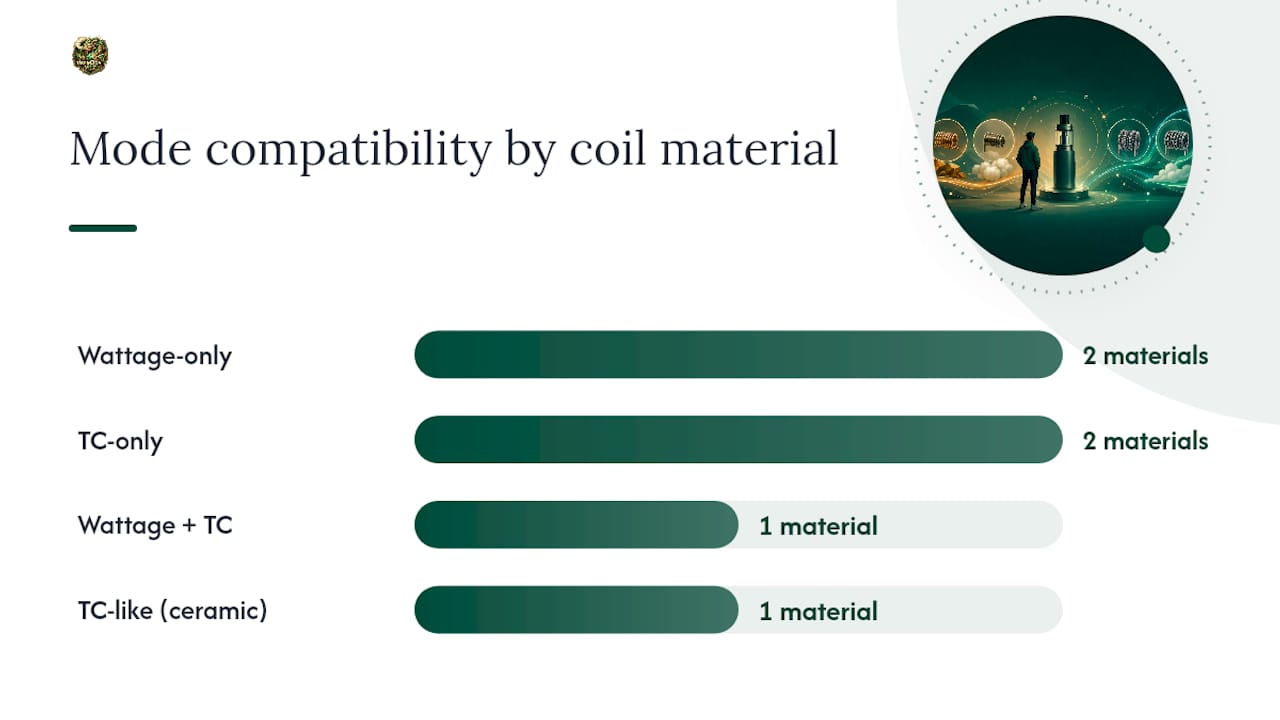
| Material dictates TC compatibility | Nickel and titanium require temperature control mode; never run them in wattage mode. |
| Lifespan varies by type | Mesh lasts roughly 2 to 3 weeks, ceramic 2 to 4 weeks, standard wire 1 to 2 weeks. |
| VapeCiga stocks fit-verified coils | Product pages list resistance, wattage range, and device compatibility for every coil sold. |
Table of Contents
- What Is a Vape Coil and How Does It Work?
- Common Vape Coil Types Compared: Mesh, Round Wire, Clapton, and More
- Coil Materials: Kanthal, Nichrome, Stainless Steel, Nickel, Titanium, and Ceramic
- How Resistance and Wattage Shape Flavor and Clouds
- How to Choose the Right Coil for Your Device and Style
- Coil Priming, Replacement Signs, and How to Extend Coil Life
- Coil Examples Worth Trying From VapeCiga’s Lineup
- Frequently Asked Questions
- Sources
What Is a Vape Coil and How Does It Work?
A vape coil is a heating element made from resistance wire or mesh, wrapped or paired with an absorbent wick. Power runs through the wire, it heats up, and the wick (usually organic cotton or a ceramic-based material) pulls e-liquid into that heat zone to turn it into vapor. The coil sits inside a housing called an atomizer head, which also controls airflow around the heating element.
Three things inside that small housing determine your whole vaping experience:
- Wire or mesh design: more surface area contacting the wick generally means faster, more even heating
- Wick material and saturation: a dry or poorly packed wick causes burnt hits regardless of coil quality
- Airflow path: wider airflow cools vapor and supports bigger clouds; restricted airflow tightens the draw for MTL
Surface area is the quiet variable most beginners overlook. A coil with more wire or mesh touching the wick heats the e-liquid faster and more uniformly, which is exactly why mesh coils tend to outlast and outperform basic round-wire builds in day-to-day use.
Common Vape Coil Types Compared: Mesh, Round Wire, Clapton, and More
Not every coil type solves the same problem. Some chase flavor, some chase clouds, and some exist purely to make a coil last longer between changes. Here’s what each one actually delivers.
Mesh coils
Mesh coils use a flat, perforated sheet of metal instead of a wound wire. That flat design dramatically increases the surface area touching your wick, which means more even heating across the whole coil rather than hot spots along a wire.
The payoff shows up in three places: flavor comes through cleaner, ramp-up time shortens because there’s more heating surface working at once, and the coil tends to last longer than a comparable round-wire build. Mesh has essentially become the default recommendation for flavor-focused vapers, and most modern pod systems and sub-ohm tanks ship with mesh as the standard option.
- Best for: flavor chasers and direct-lung (DTL) vapers who want reliability without fiddly maintenance
- Typical resistance: 0.15Ω to 0.6Ω, almost always sub-ohm
- E-liquid pairing: high-VG juice, since mesh handles thicker liquid well
- Downside: pricier per coil than basic round wire, and not ideal for tight MTL draws
Round and spiral wire coils
This is the original coil design and still the cheapest to manufacture. A single strand of resistance wire wraps around a core in tight, even loops. Simple, proven, and easy to wick correctly even for someone who’s never rebuilt anything.
Round wire coils dominate MTL pod systems and starter kits because they’re forgiving. Ramp-up is a touch slower than mesh, and flavor is good rather than exceptional, but the resistance sits comfortably above 1.0Ω in most beginner devices, which suits a tighter, cigarette-like draw.
- Best for: MTL beginners and anyone prioritizing battery life over cloud size
- Typical resistance: 1.0Ω to 1.8Ω for MTL; some sub-ohm versions run 0.5Ω to 0.8Ω
- E-liquid pairing: higher-PG juice and nic salts work best here
- Downside: shorter lifespan under heavy use, more prone to hot-spotting than mesh
Clapton and twisted wire coils
A Clapton coil wraps a thin wire tightly around a thicker core wire, similar to a guitar string. That extra wrapped layer increases surface area substantially, improving both flavor and vapor production without needing a dual-coil setup to get there. Twisted coils achieve a similar effect by twisting two or more strands of wire together before winding.
Pro Tip: If you’re chasing flavor on a rebuildable but don’t want the fuss of exotic wire, a simple Clapton build on a single-coil RDA often out-performs a stock dual-coil mesh head for pure taste.
These exotic wound-wire designs are popular with flavor-focused vapers and rebuildable atomizer users, but they require more building skill and careful wicking to avoid dry hits.
- Best for: experienced DTL vapers and rebuildable atomizer users chasing maximum flavor
- Typical resistance: 0.2Ω to 0.6Ω
- E-liquid pairing: high-VG, since these coils run hot and thick liquid keeps up with wicking demand
- Downside: harder to wick correctly if you’re building your own; not beginner-friendly
Vertical and multi-coil setups
Vertical coils stand upright inside the atomizer rather than lying flat, which changes how the wick interacts with airflow and often improves flavor consistency in certain RTA designs. Multi-coil setups (dual, triple, sometimes quad) run two or more coils in parallel, dropping overall resistance and dramatically increasing vapor output.
These configurations exist almost exclusively in sub-ohm tanks and rebuildable decks built for cloud production. They demand higher wattage, drink e-liquid faster, and wear out sooner than a single coil running at the same power.
- Best for: dedicated cloud chasers running high-wattage mods
- Typical resistance: 0.1Ω to 0.4Ω combined
- E-liquid pairing: maximum VG, always
- Downside: heavy e-liquid consumption, shorter coil life, needs a mod capable of high amp draw
Ceramic coils
Ceramic coils use a porous ceramic heating element instead of exposed wire. That material heats more slowly but retains heat well, producing a smooth, consistent flavor that many vapers describe as less “sharp” than wire-based coils. The tradeoff is a noticeably slower ramp-up.
Ceramic works especially well with thick, high-VG e-liquids because the porous surface resists the gunk buildup that clogs wire coils over time.
- Best for: vapers who want longevity and don’t mind a slightly slower draw
- Typical resistance: 0.15Ω to 1.0Ω, spanning both MTL and sub-ohm designs
- E-liquid pairing: high-VG and dessert-style juices in particular
- Downside: slower hit, and replacement ceramic heads often cost more
Rebuildable options: RDA, RTA, and RDTA
Rebuildable dripping atomizers (RDAs), rebuildable tank atomizers (RTAs), and rebuildable dripping tank atomizers (RDTAs) let you build and wick your own coil from raw wire instead of buying prebuilt heads. This is where round wire, Clapton, and vertical designs all come from originally.
Rebuildables reward experience. You control resistance, wire gauge, and wicking density down to the millimeter, which means better flavor and lower long-term cost per coil, but a bad build can burn out immediately or leak juice everywhere. New vapers should spend real time with prebuilt mesh or round-wire coils before touching a rebuildable deck.
Coil Materials: Kanthal, Nichrome, Stainless Steel, Nickel, Titanium, and Ceramic
Material determines whether a coil works in simple wattage mode or supports temperature control (TC), and it shapes how the vapor actually tastes.
- Kanthal: an iron-chromium-aluminum alloy, the most common wire on the market. Wattage mode only, no TC compatibility, reliable and cheap.
- Nichrome: heats faster than Kanthal and costs a bit more. Also wattage mode only, favored by flavor-focused rebuilders.
- Stainless steel: the versatile option. Works in wattage mode and TC mode, holds up well against high-VG e-liquid buildup, and lasts longer than Kanthal in daily use.
- Nickel (Ni200): TC mode exclusively. Never run nickel wire in wattage mode; it lacks the resistance stability to handle it safely and can overheat.
- Titanium: TC mode only, similar safety profile to nickel. Less common today due to safety concerns around titanium dioxide at very high temperatures.
- Ceramic: not a wire at all, but a heating element material. Naturally TC-like behavior since it resists rapid temperature swings.
Never run nickel or titanium coils in standard wattage mode. Both materials are built specifically for temperature control, and using them without TC enabled removes the safety mechanism that prevents overheating.
Pro Tip: If you vape high-VG juice daily and hate the metallic taste that creeps in after a week, switch to stainless steel or ceramic. Both resist the residue buildup that changes flavor on Kanthal coils over time.
For most everyday vapers running wattage-mode devices like pod systems or basic box mods, stainless steel gives the best mix of flavor neutrality and coil longevity without needing to touch temperature control settings at all.
How Resistance and Wattage Shape Flavor and Clouds
Resistance, measured in ohms, describes how much a coil restricts electrical current. Lower resistance lets more current through, which generates more heat, more vapor, and a warmer, airier draw. Higher resistance restricts current, producing a cooler, tighter pull closer to a cigarette drag.
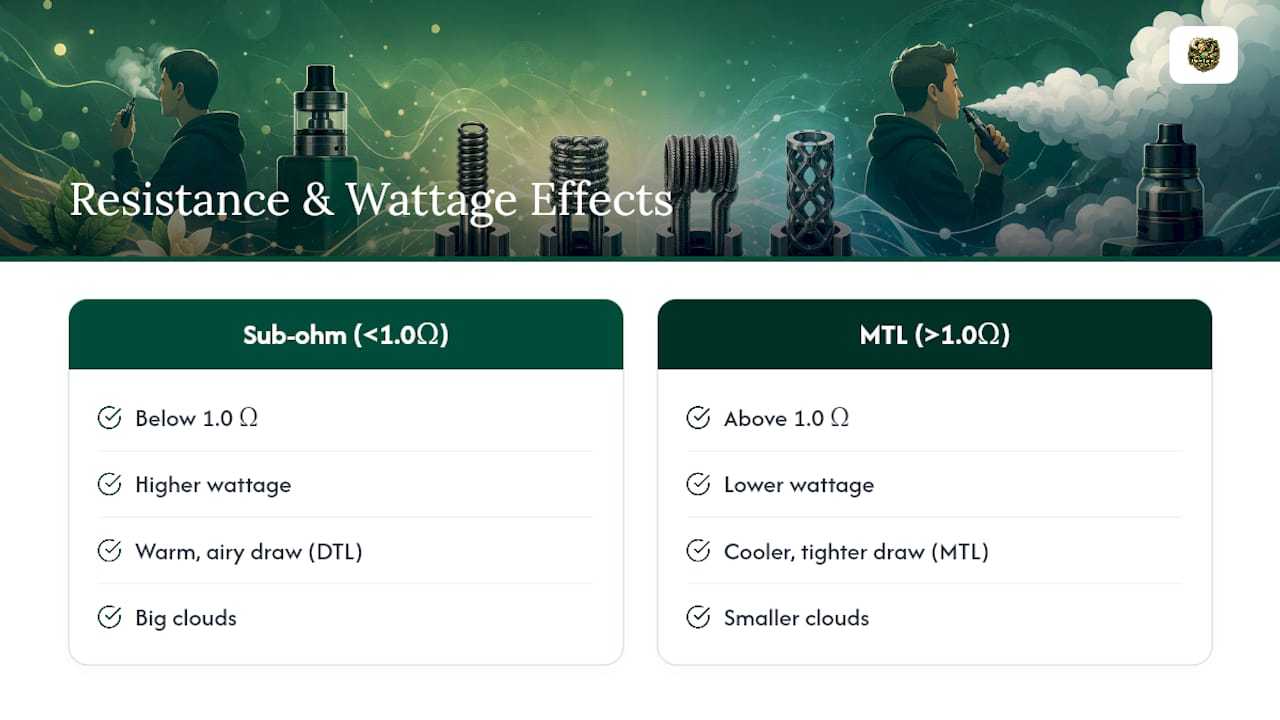
Sub-ohm coils sit below 1.0Ω and pair with higher wattage to push bigger clouds and often more intense flavor, but they burn through e-liquid faster and wear out sooner than higher-resistance coils. Anything above 1.0Ω is typically built for MTL, sipping e-liquid slowly at lower wattage for a longer coil life.
The resistance-flavor relationship also depends on e-liquid VG/PG ratio. High-VG juice needs the lower resistance and higher wattage of sub-ohm or mesh coils to vaporize properly, while high-PG juice and nic salts perform better at the lower wattage typical of MTL setups.
How to Choose the Right Coil for Your Device and Style
Picking a coil isn’t guesswork once you know your device and your goal. Run through this checklist before buying:
- Check device compatibility first. Pod systems, sub-ohm tanks, and rebuildable decks all use different coil footprints; the coil has to physically fit and thread correctly.
- Match the resistance to your style. MTL vapers want 1.0Ω or higher; DTL and cloud vapers want sub-ohm, typically 0.6Ω or below.
- Confirm your device’s wattage range covers the coil’s recommended range. A coil rated for 40 to 60W will underperform or burn on a device capped at 25W.
- Match e-liquid VG/PG to the coil. High-VG juice belongs in mesh or sub-ohm coils; high-PG and nic salts belong in higher-resistance MTL coils.
- Factor in replacement cost and availability. Popular coil families are easier to restock than niche or discontinued designs.
Before you buy, ask three quick questions: Is this coil actually rated for my tank or pod? What wattage range does the manufacturer recommend? How easy will it be to find replacements later?
Watch for these red flags:
- Sweet, dessert-heavy e-liquids run in sub-ohm coils tend to gunk up wicks faster than fruit or menthol profiles
- A coil not rated for TC being used in temperature control mode, which can cause inaccurate readings or overheating
- Wattage set noticeably above or below the coil’s printed range, which causes either weak vapor or a burnt taste almost immediately
Coil Priming, Replacement Signs, and How to Extend Coil Life
New coils need priming before their first use, or you risk a dry, burnt hit right out of the box. Here’s the routine:
- Drip a few drops of e-liquid directly onto the exposed wick openings on the coil before installing it.
- Fill the tank or pod and let it sit for 5 to 10 minutes so the wick fully saturates.
- Take a few slow, low-wattage puffs without firing the button, if your device allows dry draws, to help liquid settle in.
- Start vaping at the low end of the coil’s recommended wattage range and work up gradually.
Know the signs a coil is done: a burnt or muted taste, noticeably weaker vapor, a gurgling sound, or dark residue pooling around the coil. Any one of these means it’s time to swap, not troubleshoot further.
Lifespan varies by type. Standard wire coils typically last 1 to 2 weeks, mesh coils 2 to 3 weeks, ceramic coils 2 to 4 weeks, pod coils around 1 to 2 weeks, and heavy sub-ohm coils as little as 5 to 10 days, depending on usage and e-liquid.
To stretch that lifespan, keep wattage toward the lower end of the recommended range, avoid chain vaping (which never lets the wick re-saturate), and match your e-liquid’s VG level to what the coil is actually built to handle.
Coil Examples Worth Trying From VapeCiga’s Lineup
VapeCiga stocks coil options across every category covered here, and pairing the right coil with the right device matters as much as the coil itself. A few worth knowing:
- Smok NexMesh Coils: mesh design, strong pick for flavor-first DTL vapers upgrading from stock coils.
- GeekVape P Series Coils: mesh build tuned for higher-wattage sub-ohm tanks and bigger cloud production.
- Vaporesso Target Ceramic Coils: ceramic option for vapers prioritizing longevity and smooth, consistent flavor.
- Smoktech Vape Pen 22 Coils: round-wire coils suited to beginners running pen-style, MTL-leaning devices.
- Vaporesso Cascade One Coils: balanced option for mid-wattage devices bridging MTL and light DTL use.
Check each product page for the exact wattage range and compatible devices before ordering, since fit varies by tank and pod system.
A quick note from the author
I’ve spent enough time behind the counter talking vapers through burnt coils and mismatched wattage to know most coil problems trace back to one thing: buying based on price instead of fit. Match resistance and wattage to your device first, always follow the manufacturer’s printed range, and the rest gets a lot easier.
Find Coils That Match Your Device
There are other ways to hunt down replacement coils, from marketplace listings to big-box retailers with a thin vape aisle. The tradeoff is guesswork. VapeCiga lists the exact resistance, wattage range, and compatible devices right on every coil product page, so you’re not gambling on whether a five-pack actually fits your tank.
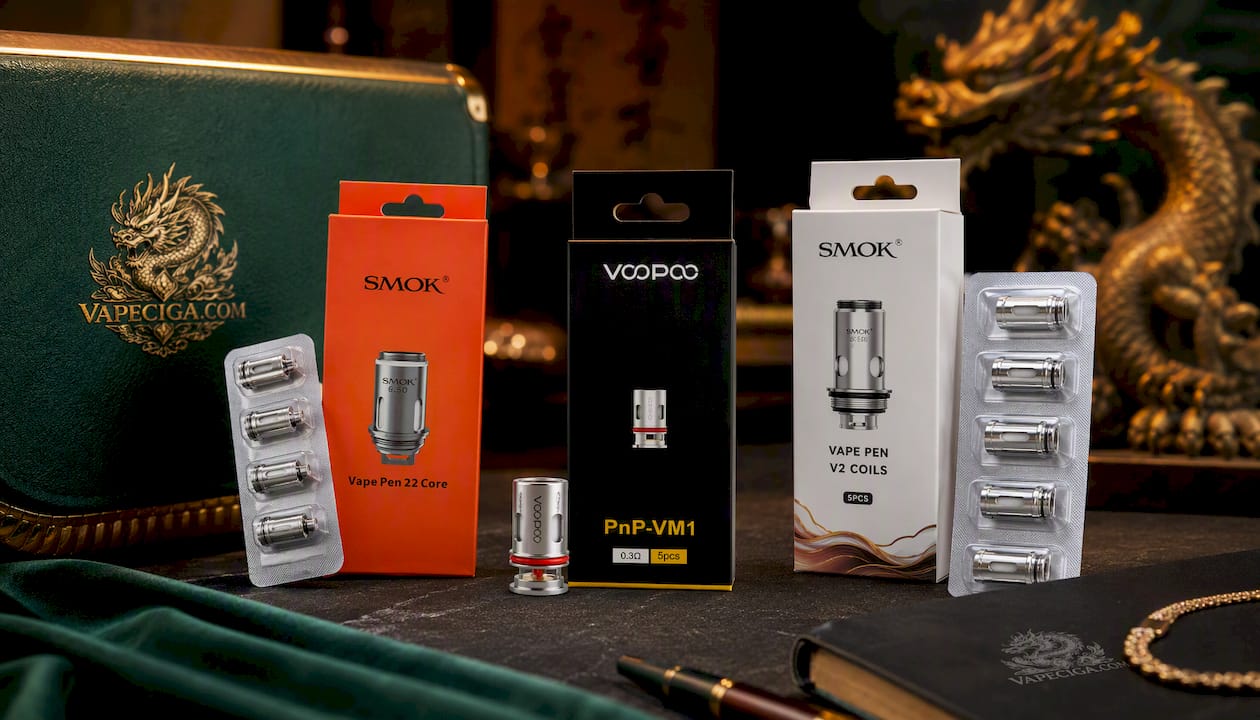
If you’re still running whatever coil came stock in your device, it’s worth checking whether a mesh upgrade like the GeekVape J Coils fits your setup better for flavor. Pod users looking for a fresh device to pair with reliable coils can check out the Vaporesso GTX One Vape Mod, a compact 40W option built around single-coil simplicity. Browse VapeCiga’s full coil selection, confirm compatibility on the product page, and get it shipped out fast.
Frequently Asked Questions
What is the most common type of vape coil? Mesh coils have become the standard across most modern pod systems and sub-ohm tanks because they heat evenly and produce reliable flavor with less troubleshooting than wire coils.
Which vape coil type lasts the longest? Ceramic coils typically last the longest, often 2 to 4 weeks, followed closely by mesh coils at 2 to 3 weeks. Heavy sub-ohm coils wear out fastest, sometimes in under 10 days.
Can I use any coil in any vape device? No. Coils are built to fit specific tank or pod threading and resistance ranges, so a coil designed for one device often won’t physically fit or perform correctly in another.
Is a lower resistance coil always better? Not for everyone. Lower resistance (sub-ohm) means bigger clouds and more e-liquid use, which suits DTL vapers, but MTL vapers get a better experience and longer coil life from higher-resistance coils above 1.0Ω.
How do I know if my coil is temperature-control compatible? Check the coil’s material: stainless steel, nickel, and titanium support TC mode, while Kanthal and Nichrome work only in standard wattage mode. The packaging or product page will state TC compatibility directly.