


Vaping is defined as inhaling aerosol produced by heating an e-liquid, without burning tobacco. That single distinction separates it from smoking, which requires combustion. Yet the two share enough overlap in nicotine delivery, addiction risk, and legal classification that the question “is vaping smoking” deserves a precise answer, not a casual one. The FDA and CDC both treat vaping as a distinct category from traditional cigarettes, but life insurers, employers, and public health bodies often apply the same rules to both. Understanding where vaping and smoking diverge, and where they do not, shapes every decision you make about health, coverage, and lifestyle.
Is vaping smoking, or is it something different?
Vaping is not smoking. The technical term for what vaping devices produce is aerosol, not smoke. Smoke results from combustion, the chemical process of burning tobacco that generates tar, carbon monoxide, and thousands of carcinogenic compounds. Vaping skips combustion entirely by heating e-liquid to a temperature that vaporizes it without igniting it.
Avoiding combustion is the single most important distinction between the two. Combustion is what produces the majority of the toxic chemicals responsible for smoking-related cancers, lung disease, and cardiovascular damage. Vaping eliminates that process, which is why scientific reports as of early 2026 confirm vaping carries a fraction of the risks associated with traditional cigarettes.

That said, vaping is not harmless. The aerosol still contains nicotine in most products, along with flavoring chemicals and trace heavy metals. Nicotine itself does not cause cancer, but it drives addiction and affects cardiovascular function. The distinction between “less harmful” and “safe” matters enormously when you are making a health decision.
How do the health effects of vaping compare to smoking?
The health effects of vaping and smoking overlap in some areas and diverge sharply in others. Both deliver nicotine, both affect the cardiovascular system, and both carry addiction risk. The difference is in what else they deliver alongside nicotine.
What smoking does to the body
Smoking produces tar, carbon monoxide, benzene, formaldehyde, and over 7,000 other chemicals through combustion. These byproducts cause lung cancer, chronic obstructive pulmonary disease (COPD), heart disease, and stroke. The American Heart Association links combusted tobacco to the leading causes of preventable death in the United States. Nicotine itself is not the primary driver of those diseases. The combustion byproducts are.
What vaping does to the body
Vaping aerosols contain heavy metals including chromium, lead, and nickel, along with particulate matter and flavoring chemicals. Some flavoring compounds, including diacetyl, are linked to respiratory disease. The long-term consequences of inhaling these substances are not yet fully known, because vaping as a widespread practice is less than two decades old. What is known is that vaping causes lung irritation and measurable cardiovascular effects.
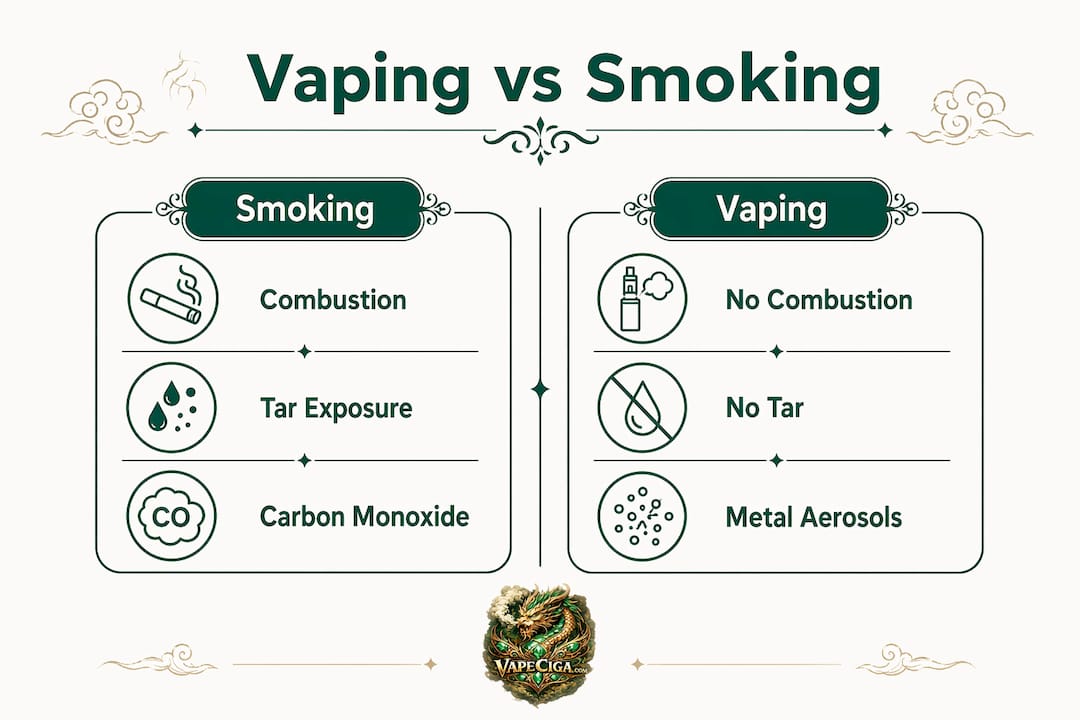
| Factor | Smoking | Vaping |
|---|---|---|
| Combustion | Yes | No |
| Tar exposure | Yes | No |
| Carbon monoxide | Yes | No |
| Nicotine delivery | Yes | Yes (most products) |
| Heavy metals in aerosol | Trace amounts | Chromium, lead, nickel |
| Established cancer risk | Yes | Under study |
| Long-term data | Decades of research | Limited |
Switching from smoking to vaping reduces risk significantly. A 2025 Cochrane review of 104 studies identified vaping as the most effective short-term smoking cessation method available. That finding does not make vaping a healthy habit. It makes it a less harmful one for people who would otherwise continue smoking.
Pro Tip: If you are evaluating personal health risk, the key question is not “is vaping safe?” but “is vaping safer than what I am currently doing?” For active smokers, the answer from current science is yes. For nonsmokers, the answer is to avoid both.
Does vaping count as smoking under insurance and legal rules?
Legally and financially, vaping often counts as smoking even though it is not. Life insurance companies classify vaping as tobacco use, which triggers the same higher premium rates applied to cigarette smokers. This applies even to nicotine-free vaping products, because insurers base their classification on the act of aerosol inhalation and the unknown long-term risk profile, not solely on nicotine content.
The practical consequences for adults in the United States include:
- Life insurance premiums: Vapers are rated as tobacco users, which can double or triple annual premium costs compared to nonsmoker rates.
- Workplace policies: Many employers apply smoking bans to vaping in the same indoor spaces, regardless of whether the aerosol contains nicotine.
- Cessation programs: Some employer-sponsored tobacco cessation programs cover vaping products as a quitting tool, but eligibility varies by plan.
- Taxation: The federal government and most states tax e-cigarettes separately from traditional tobacco, but many states have enacted vaping-specific excise taxes that mirror cigarette tax structures.
- FDA regulation: The FDA regulates e-cigarettes as tobacco products under the Family Smoking Prevention and Tobacco Control Act, even though they contain no tobacco leaf.
Insurers treat nicotine-free vaping as a tobacco risk category because the long-term inhalation data does not yet exist to justify a lower risk classification. That conservative stance costs vapers real money on premiums.
Pro Tip: If you have quit vaping for 12 consecutive months, request a policy review or new underwriting from your life insurer. Many companies will reclassify you as a nonsmoker after a verified cessation period.
Common misconceptions: does vaping count as smoking in public?
The most widespread misconception is that vaping and smoking are equally harmful. Only 12.3% of U.S. smokers in 2021 correctly recognized vaping as less harmful than cigarettes. That gap between public perception and scientific consensus has real consequences for how adults make decisions about cessation and risk.
Several specific myths persist among adults who are trying to make informed choices:
- “Vaping is just as bad as smoking.” The scientific consensus as of 2026 does not support this. Vaping avoids combustion and eliminates tar and carbon monoxide, which are the primary drivers of smoking-related disease.
- “Vaping produces smoke.” Vaping produces aerosol, not smoke. The two are chemically distinct. Aerosol lacks the combustion byproducts that make tobacco smoke so damaging.
- “Nicotine-free vaping is completely safe.” Nicotine-free products still deliver flavoring chemicals and heavy metals through aerosol inhalation. The absence of nicotine does not eliminate all risk.
- “Vaping is a gateway to smoking.” Research on this is mixed. For adult smokers, vaping functions primarily as a cessation tool. For nonsmokers and adolescents, initiation through vaping does carry risk of progressing to cigarettes.
- “All vaping products are the same.” Device type, e-liquid composition, and nicotine concentration vary widely. A disposable vape and a regulated pod system deliver very different experiences and aerosol profiles.
Public confusion over vaping risks has increased partly because media coverage and shifting regulatory stances send inconsistent signals. The FDA’s evolving authorization process for specific vaping products adds to the uncertainty. The clearest signal from health authorities is that vaping is not smoking, but it is also not neutral.
Practical lifestyle considerations for adults choosing between vaping and smoking
For adult smokers who cannot quit nicotine entirely, vaping represents a meaningful harm reduction option. Health New Zealand and the British Heart Foundation both recommend vaping solely for quitting smoking, with an explicit warning that nonsmokers should not start vaping. That framing reflects the current scientific and public health consensus.
Lifestyle factors that adults should weigh include:
- Odor and social acceptability: Vaping produces far less lingering odor than cigarette smoke. Many adults find this a significant quality-of-life improvement, particularly in shared living spaces.
- Indoor use: Most public indoor spaces and workplaces prohibit vaping alongside smoking. Do not assume a vaping device is permitted where cigarettes are banned.
- Lung and cardiovascular health: Switching from smoking to vaping reduces exposure to carcinogens substantially. Cardiovascular benefits from quitting combusted tobacco appear within weeks of switching.
- Cessation strategy: Vaping works best as a structured cessation tool, not an indefinite replacement. Adults who want to stop nicotine entirely can find guidance on quitting vaping cold turkey or understand the side effects of stopping suddenly.
- Device choice: The type of device affects nicotine delivery, aerosol volume, and overall experience. Pod systems and regulated mods give adults more control over nicotine concentration than many disposable options.
| Lifestyle Factor | Smoking | Vaping |
|---|---|---|
| Odor on clothing and breath | Strong, persistent | Minimal |
| Indoor restrictions | Banned in most public spaces | Banned in most public spaces |
| Cessation effectiveness | Baseline | Higher short-term success rate |
| Insurance classification | Tobacco user | Tobacco user (most insurers) |
| Cost over time | High | Moderate to high depending on device |
Nonsmokers should not use vaping as an entry point into nicotine. The harm reduction argument applies specifically to people who are already smoking and seeking a less damaging alternative.
Key Takeaways
Vaping is not smoking, but it shares enough legal, financial, and health overlap that adults must treat the distinction carefully rather than casually.
| Point | Details |
|---|---|
| Vaping is not smoking | Vaping produces aerosol without combustion; smoking burns tobacco and generates thousands of toxic chemicals. |
| Health risks differ significantly | Vaping eliminates tar and carbon monoxide but still delivers heavy metals and flavoring chemicals with unknown long-term effects. |
| Insurance treats them the same | Life insurers classify vaping as tobacco use, raising premiums even for nicotine-free products. |
| Public perception lags science | Only 12.3% of U.S. smokers in 2021 correctly identified vaping as less harmful than cigarettes. |
| Harm reduction applies to smokers only | Health authorities recommend vaping as a cessation tool for current smokers, not as a habit for nonsmokers to start. |
What I have learned after years of watching adults navigate this question
The most damaging thing about the vaping-versus-smoking debate is the false binary it creates. Adults hear “vaping is not as bad as smoking” and conclude vaping is fine. They hear “vaping is harmful” and conclude it is no better than cigarettes. Both conclusions are wrong, and both lead to poor decisions.
What I have observed is that the adults who benefit most from vaping are committed smokers who have tried and failed with patches, gums, and prescription medications. For them, vaping is not a lifestyle choice. It is a practical harm reduction tool that the 2025 Cochrane review of 104 studies validated as the most effective short-term cessation method available. That is a meaningful finding, and it should not be buried under generalized warnings.
The adults who get hurt by vaping are nonsmokers who pick it up because it seems low-risk. The aerosol is not smoke, but it is not clean air either. Heavy metals and flavoring chemicals have no business going into lungs that were never exposed to combusted tobacco in the first place.
My honest position is this: if you smoke, vaping is worth serious consideration as a step toward quitting nicotine entirely. If you do not smoke, vaping offers you nothing except a new set of risks. The science on this is clearer than the public conversation suggests. The confusion is a media and regulatory problem, not a scientific one.
— James
Quality vaping products for adults making the switch
Adults who have decided to transition away from cigarettes deserve products that are consistent, well-made, and clearly labeled. VapeCiga carries a full range of options suited to different experience levels, from straightforward disposables to advanced regulated mods.
The 2027 Date 7 2000 is a strong starting point for adults switching from cigarettes, offering a controlled nicotine experience without the complexity of a full mod setup. For those who want more output and longer sessions, the Packspod 5000 delivers consistent flavor and puff count in a compact form. VapeCiga stocks devices, e-liquids, coils, and accessories across every category, with products compliant with U.S. regulations. Browse the full selection at VapeCiga to find the right fit for where you are in your switch from smoking.
FAQ
Is vaping the same as smoking?
No. Vaping heats e-liquid to produce aerosol without burning tobacco, while smoking combusts tobacco and generates tar, carbon monoxide, and thousands of toxic chemicals. The two processes are chemically distinct.
Is vaping harmful to your health?
Vaping is not harmless. Aerosols contain heavy metals, flavoring chemicals, and usually nicotine, all of which carry health risks. However, vaping poses significantly fewer risks than smoking because it eliminates combustion byproducts.
Does vaping count as smoking for life insurance?
Yes, in most cases. Life insurers classify vaping as tobacco use and apply smoker premium rates, even for nicotine-free vaping products, because of the unknown long-term inhalation risks.
Is vaping safer than smoking for current smokers?
Scientific consensus as of 2026 supports vaping as a less harmful alternative for current smokers. A 2025 Cochrane review of 104 studies identified it as the most effective short-term smoking cessation method available.
Can nonsmokers safely start vaping?
No. Public health organizations including Health New Zealand and the British Heart Foundation explicitly advise nonsmokers to avoid vaping. The harm reduction argument applies only to people already smoking who are trying to quit.