


MTL suits beginners and smokers switching over: it mimics a cigarette’s tight draw and works with lower-wattage, low-VG devices. DTL is the open-airflow, high-power style built for big clouds and experienced users who’ve already found their nicotine sweet spot. Most people who quit smoking successfully start on MTL, and many later try RDL, a restricted direct-lung middle ground, before deciding if full DTL is even worth the switch.
TL;DR:
- Most beginner vapers and smokers switching to vaping start with mouth-to-lung devices that mimic cigarette draws, using coils of 0.8 ohms or higher at 8 to 25 watts.
- Direct-to-lung devices are designed for large clouds, using coils under 0.5 ohms at wattages above 40 watts with high-VG liquids, catering to experienced users.
- Adjusting airflow and matching coil resistance are the first steps to switch between MTL and DTL, with device upgrades only necessary if tuning adjustments are insufficient.
- Nicotine strength and PG/VG ratios should be tailored to your style, with MTL favors higher PG and nicotine salts, while DTL suits low nicotine freebase and high VG for cloud production.
- Transitioning from MTL to DTL is best done gradually by reducing nicotine, opening airflow gradually, and spending time in intermediate RDL setups to avoid harshness and maximize comfort.
Table of Contents
- MTL vs DTL: What Is Mouth-to-Lung Vaping?
- What Is DTL Vaping and How Does It Differ From MTL?
- MTL vs DTL Comparison: Which Style Matches Your Goals?
- Setting Up Your Device: What to Change First for MTL or DTL
- Choosing E-Liquid: PG/VG Ratios and Nicotine Strength
- How to Move From MTL to DTL Without Overdoing It
- VapeCiga Resources for MTL, RDL, and DTL Vapers
- What the Research Actually Says About Throat Hit
- An Editorial Take on the MTL vs DTL Debate
- Find Your Next MTL or DTL Setup at VapeCiga
- Sources
- FAQ
MTL vs DTL: What Is Mouth-to-Lung Vaping?
Mouth-to-lung vaping pulls vapor into your mouth first, then down into your lungs on a second breath, exactly the way a cigarette works. That two-step motion is the entire reason MTL feels familiar to smokers on day one. You draw for a second or two, hold the vapor in your cheeks briefly, then inhale it the rest of the way.
The sensory cues are distinct once you know what to look for. A true MTL device has a tight, restricted draw, almost like sipping through a coffee stirrer rather than a wide straw. The pull requires a bit of suction, and the resulting vapor stream is thinner and less visible than what you’d get from a sub-ohm tank.
Coil resistance sits at roughly 0.8 ohms or higher on most dedicated MTL gear, paired with wattage in the 8 to 25 watt range. That combination keeps vapor production modest and throat hit sharp, which is the whole point for someone replacing cigarettes.
Nicotine chemistry plays a bigger role in that throat hit than most new vapers realize. Higher PG liquids and nicotine salts both increase the harshness sensation on the throat, and research on device and liquid variables confirms that gaseous nicotine absorption in the throat correlates directly with subjective throat harshness, with every 100 ng/s increase in absorption producing roughly a 5.7-point jump in throat-hit score. That’s why a 35mg salt nic pod hits harder than a 3mg freebase tank, even at similar wattage.
Common MTL device categories include:
- Disposable vapes, which almost always ship pre-tuned for a tight MTL draw
- Pod systems with fixed or semi-adjustable airflow, the most popular entry point for smokers switching
- Dedicated MTL tanks with narrow airflow slots and higher-resistance coils, favored by vapers who want refillable control
- Starter kits marketed specifically as “cigalike” or “beginner” devices
If you’re shopping for your first setup, VapeCiga’s complete MTL guide breaks down tank and coil pairings in more depth.
What Is DTL Vaping and How Does It Differ From MTL?
Direct-to-lung vaping skips the two-step draw entirely. You pull vapor straight into your lungs in one continuous inhale, the same motion you’d use to blow out a candle in reverse. There’s no cheek-holding step, no pause. That single difference in mechanics explains almost everything else about DTL: the bigger clouds, the lower resistance, the different liquid.
DTL draws are wide open by design. Airflow slots on sub-ohm tanks are large enough that you can often see light through them when they’re fully open, and the resistance drops well under 1 ohm, typically landing below 0.5 ohms on dedicated sub-ohm coils. Wattage climbs to match, commonly running above 40 watts and sometimes well past 100 watts on RDA setups.
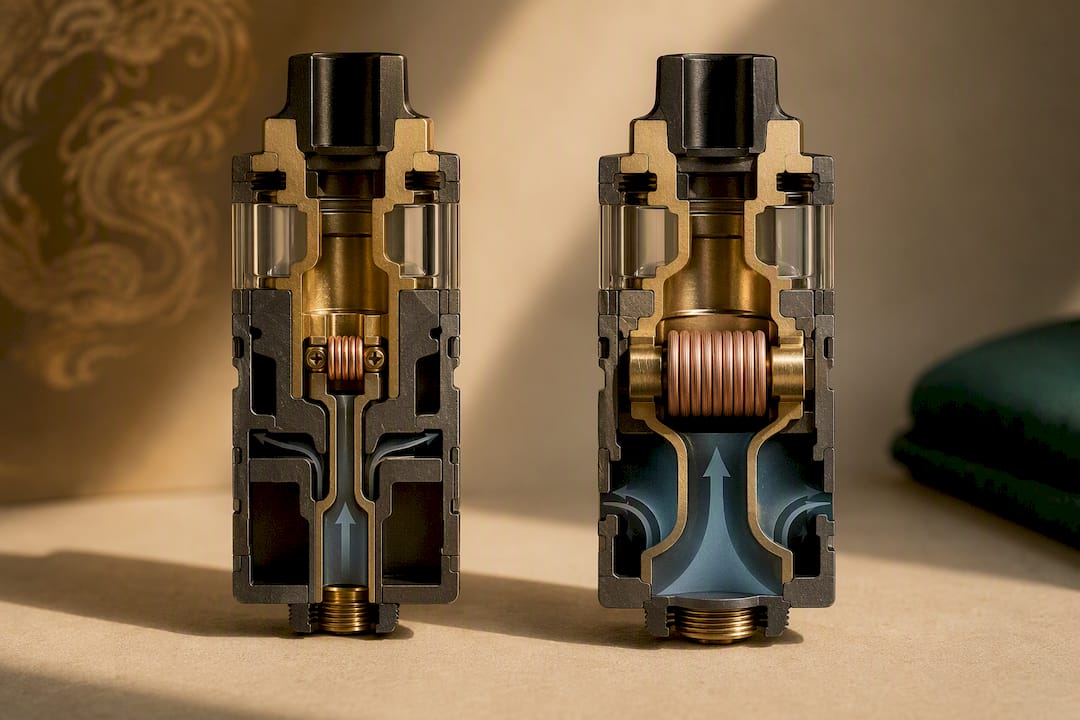
That much power vaporizes far more liquid per puff, which is why DTL users lean almost exclusively on low-nicotine freebase juice, usually 0mg to 6mg. Pushing high-strength nicotine through that volume of vapor would deliver way too much nicotine per puff and feel unpleasant fast. High-VG liquid also matters here: thicker VG produces the dense, visible clouds DTL vapers actually want, while a PG-heavy mix would scorch a coil rated for sub-ohm wattages.
DTL setups fall into a few recognizable categories:
- Box mods paired with sub-ohm tanks, the standard for most DTL vapers
- Squonk mods and RDAs (rebuildable dripping atomizers) for users who want to build and tune their own coils
- Mechanical mods for advanced users chasing maximum cloud output
- High-wattage pod mods that blur the line but still deliver an open, DTL-style draw
The tradeoff is real: bigger clouds and richer flavor come at the cost of faster battery drain and much higher juice consumption. A DTL vaper can burn through a 60ml bottle in a fraction of the time an MTL user takes with the same volume.
MTL vs DTL Comparison: Which Style Matches Your Goals?
The fastest way to settle the mtl vs dtl question for your own habits is to line the two up side by side across the variables that actually decide comfort, cost, and discretion.
| Factor | MTL | DTL |
|---|---|---|
| Draw style / inhale feel | Tight, cigarette-like, two-step draw | Open, single continuous inhale |
| Typical coil resistance & wattage | 0.8Ω+ at 8 to 25W | Under 0.5Ω at 40W and up |
| Recommended PG/VG ratio | 50/50 or higher PG | High VG, often 70/30 or higher |
| Nicotine form & typical strength | Salt nic or freebase, 20 to 50mg (salt) or 6 to 18mg (freebase) | Freebase only, 0 to 6mg |
| Cloud size / discretion | Small, thin, easy to conceal | Large, dense, hard to hide |
| Battery and juice consumption | Low draw on both battery and liquid | High draw on both battery and liquid |
If you want something that behaves like a cigarette in your hand and in your throat, MTL is the answer, full stop. If you want visible clouds and rich flavor and you’ve already weaned off high nicotine, DTL delivers that in a way MTL never will.
The nicotine and throat hit connection deserves its own callout, because it explains why switching styles without adjusting liquid so often goes wrong. A cross-sectional survey of 1,672 vapers found that people reporting “very strong” throat hit used liquids averaging 17.3 mg/mL nicotine, compared with just 7.1 mg/mL among those reporting “very weak” hit. Carry that 17mg habit straight into a DTL sub-ohm tank without dropping the strength, and the harshness will be brutal.
Use-case shortcuts worth remembering:
- Want something that feels like smoking? Choose MTL.
- Want a stealthy device for work or public spaces? Choose MTL.
- Want big clouds and rich, layered flavor? Choose DTL.
- Want to try both before committing? Start with an adjustable pod mod that flexes toward RDL.
Setting Up Your Device: What to Change First for MTL or DTL
Getting your device to actually behave the way you want it to usually comes down to three adjustable variables, tackled in a specific order.
- Check the airflow first. Twist the airflow ring toward closed for a tighter MTL pull, or toward open for a looser DTL draw. This costs nothing and takes ten seconds, so always start here before buying new parts.
- Match the coil to the resistance range you want. A 0.8 ohm to 1.2 ohm coil supports MTL; anything under 0.5 ohm pushes you into sub-ohm DTL territory. If your tank came with both options, swap it before assuming the whole device is wrong for you.
- Set wattage inside the coil’s printed range. Every coil has a manufacturer wattage window stamped on the packaging or coil head itself; running below it starves the flavor, running above it burns the wick fast.
- Only replace the entire device when airflow and coil swaps can’t get you there. A fixed-airflow disposable or a pod system with no coil options simply can’t flex into DTL, no matter how you tune the wattage.
- Adjust the mouthpiece if your tank allows it. A narrower drip tip tightens the perceived draw even further; a wide-bore tip opens it up, useful for pushing a borderline device further toward DTL.
VapeCiga’s wattage and coil tuning guide walks through specific ranges by coil type if you want exact numbers for your tank.
Safety matters here as much as taste. Always check that your battery is rated for the amperage your chosen wattage demands, especially on mechanical or unregulated mods, and never run a coil below its printed minimum resistance. Overdriving an unregulated device is one of the more common causes of vape battery failures.
Pro Tip: If your throat hit feels wrong after a coil swap, check airflow before blaming the juice. A closed airflow ring can make even a low-nicotine DTL liquid feel unexpectedly harsh.
Choosing E-Liquid: PG/VG Ratios and Nicotine Strength
Your airflow and coil setup only gets you halfway there. The liquid you pour in decides the rest, and PG/VG ratio is the biggest lever you control. Research on aerosol composition shows that higher PG ratios increase nicotine and vapor particle emissions, while higher VG ratios increase particle size and produce the thicker, more visible clouds DTL vapers chase, without proportionally increasing nicotine delivery.
That’s the core tradeoff in one sentence: PG sharpens throat hit and nicotine punch, VG builds bigger, softer clouds.
Recommended pairings by style:
- MTL: 50/50 PG/VG with salt nicotine at 20 to 50mg, or freebase at 6 to 18mg for a smoother sensation
- RDL: roughly 60/40 or 70/30 VG/PG with freebase nicotine in the 3 to 12mg range
- DTL: high VG (70/30 or higher) with freebase nicotine capped at 0 to 6mg
If you’re moving from a 35mg salt nic pod toward DTL, don’t just switch tanks and keep the same bottle. Step down gradually, something like 35mg to 18mg to 6mg over a few weeks, adjusting to taste at each stage. Using high-strength nic salts in a DTL setup isn’t recommended: the sheer volume of vapor a sub-ohm coil produces will dump nicotine into your system far faster than your body can comfortably handle, and it tends to feel harsh rather than satisfying. VapeCiga’s salt nicotine e-liquid selection is a reasonable starting point if you’re still in the MTL or RDL range.
How to Move From MTL to DTL Without Overdoing It
Switching styles works best as a staged process rather than a single leap, and rushing it is the most common reason people give up and go back to their old device.
- Lower your nicotine strength first, before touching hardware. Drop in small increments, watching for craving changes over 5 to 7 days at each level, so you know your body has adjusted before moving on.
- Open your airflow gradually and adjust wattage to match. Move one notch at a time rather than swinging straight from closed to fully open; give your throat a few days to adapt at each setting.
- Spend real time in RDL before attempting full DTL. Restricted direct-lung sits between the two, generally on coils in the mid-range resistance window with moderate wattage and a VG-leaning liquid, giving you warmth and flavor without the full open-throttle hit of sub-ohm DTL. Many vapers stay here permanently rather than progressing further.
- Watch for warning signs and back off if they appear. Coughing that doesn’t settle after a few puffs, dizziness, or chest discomfort all mean you’ve moved too fast, either on wattage, airflow, or nicotine reduction, and it’s time to dial back a step.
Pro Tip: Practice RDL for at least a week before buying full DTL gear. It’s the cheapest way to find out whether you actually want bigger clouds, or whether you just liked the idea of them.
If harshness shows up unexpectedly at any stage, the fix usually isn’t your device. VapeCiga’s guide on fixing throat hit that’s too harsh covers the liquid and airflow adjustments that solve most complaints before you spend money on new hardware.
VapeCiga Resources for MTL, RDL, and DTL Vapers
Picking the right gear gets easier once you’re comparing real product specs instead of guessing. Various vape retail sites include dedicated guides and category pages built for exactly this kind of decision.
- The MTL tank guide breaks down airflow and coil pairings specific to mouth-to-lung setups.
- The pod vs mod comparison helps you decide which device family fits your draw preference before you buy.
- Browse vape coils and vape tanks directly to check resistance and wattage specs against what your current mod supports.
Product pages list coil compatibility and resistance ranges directly, and customer reviews often flag whether a tank runs tight or loose out of the box, useful information no spec sheet fully captures. All purchases require age verification in line with PACT Act shipping rules, since these products are restricted to adults 21 and over.
What the Research Actually Says About Throat Hit
Throat hit isn’t just a subjective feeling vapers argue about online. It has a measurable chemical basis, and that matters for anyone trying to dial in comfort rather than guess at it.
Clinical work on direct-to-lung vaping found that computed nicotine gas absorption in the throat correlates with subjective harshness scores, tying device power, liquid composition, and nicotine form together into a single measurable relationship rather than three separate variables. That’s a meaningfully different claim than “nic salts feel harsher,” because it points to gaseous nicotine absorption specifically as the mechanism, not just nicotine concentration on its own.
Separate aerosol research backs up the PG/VG side of the equation, showing that liquid composition shifts both nicotine yield and particle size in measurable, opposite directions as the ratio changes. And survey data linking self-reported throat hit strength to actual nicotine concentration in vapers’ liquids confirms the pattern holds outside a lab, across more than 1,600 real users.
None of this is settled science on every variable, dosing standards for e-liquids remain far less regulated than pharmaceutical nicotine products, but the throat hit mechanism itself has real experimental grounding. That’s worth knowing before you dismiss a harsh hit as “just needing a better coil” when the actual fix might be nicotine form or PG ratio instead.
An Editorial Take on the MTL vs DTL Debate
Most guides treat MTL and DTL as a personality test, like you’re either a “cloud chaser” or you’re not. That framing undersells how much of this decision comes down to simple nicotine math rather than identity. If you’re switching from cigarettes, MTL almost always wins on the merits, not because DTL is inferior, but because your nicotine needs at month one are nowhere near where they’ll be at month six.
My honest recommendation: buy an adjustable pod mod before anything else. Not a fixed-airflow disposable, not a full sub-ohm kit. Something with a coil you can swap and an airflow ring you can turn. Spend two weeks in tight MTL mode, then loosen it into RDL territory and watch what happens to your cravings and your coughing. Only chase full DTL once you’ve proven to yourself you actually want it, not just the idea of it.
— James
Find Your Next MTL or DTL Setup at VapeCiga
Getting the right coil resistance and airflow match matters more than brand loyalty, and that’s exactly where VapeCiga’s catalog earns its keep: everything is organized by device type and coil compatibility so you’re not guessing whether a part fits your tank.
If you’re still on MTL and want a low-effort starting point, the Packspod 5000 gives you a pre-tuned tight draw without any setup. For readers ready to step into RDL or full DTL territory, the EBCREATE BC40000 PRO and the GeekVape T200 (Aegis Touch) Mod both handle higher wattage and sub-ohm coils comfortably. Need a tank that flexes between styles as you experiment? The Smok T-Air Subtank accepts a range of coil resistances, so you can swap toward MTL or DTL without buying a whole new device.
Before you check out, run through a quick buying checklist: confirm your age at checkout as required by law, match your coil’s resistance rating to your device’s wattage window, and pick liquid strength based on the PG/VG and nicotine guidance above rather than habit. Browse the full range of vape pods and pod system kits to compare specs side by side, and place your order once you’ve matched the setup to the style you actually want to vape.
Sources
The throat hit and nicotine claims in this guide rely on peer-reviewed and survey research rather than vaping folklore. The clinical study on freebase and protonated nicotine effects on throat hit ties device power and liquid chemistry to measurable harshness scores. Separate aerosol research on PG/VG ratio effects on nicotine delivery explains why cloud size and nicotine yield move in different directions. A cross-sectional survey of over 1,600 vapers connects self-reported throat hit strength to actual nicotine concentration in the field. For device-specific troubleshooting, VapeCiga’s guide on fixing harsh or weak throat hit covers practical adjustments beyond the chemistry.
- Effects of freebase/protonated nicotine concentration, liquid composition and electrical power on throat hit in direct-to-lung vaping: theory and clinical measurements
- Study on PG/VG ratio effects on nicotine delivery and aerosol characteristics
- Throat hit in users of the electronic cigarette: a cross-sectional survey
FAQ
Are Geek Bars MTL or DTL?
Most disposable vapes in that style, including popular geek bar type devices, are built for a restricted, MTL-leaning draw with tight airflow and salt nicotine, though a few higher-capacity models loosen the draw closer to RDL.
How Do I Know if My Vape Is MTL or DTL?
Check the airflow slot size and coil resistance: a narrow airflow with a coil above 0.8 ohms running under 25 watts is MTL, while wide-open airflow with a sub-0.5 ohm coil running 40 watts or higher is DTL.
What Are MTL Vapers?
MTL vapers use the mouth-to-lung draw style, pulling vapor into the mouth first before inhaling it into the lungs, the same two-step motion used when smoking a cigarette.
Are Disposables DTL or MTL?
The large majority of disposable vapes are tuned for MTL, using tight airflow and higher nicotine strength to mimic a cigarette, though a small number of high-puff-count disposables are built with looser airflow closer to RDL or light DTL.
What’s a Good First Device If I’m Not Sure Which Style I Want?
An adjustable pod mod with swappable coils lets you start in MTL mode and loosen the airflow toward RDL as you go, so you’re not committing to a single style before you know your preference.