


Airflow controls how much air mixes with the coil’s vapor before it reaches your mouth. More air means cooler, bigger clouds and thinner flavor; less air means warmer vapor, concentrated flavor, and a harder throat hit. The right setting depends on your coil, your nicotine strength, and whether you’re chasing flavor or clouds, so there’s no single “correct” position, only the one that matches your setup.
TL;DR:
- Wide open airflow produces cooler vapor, larger clouds, and milder flavor, but risks coil overheating at high wattages.
- Tight airflow creates warmer vapor, concentrated flavor, and a stronger throat hit, ideal for high-nicotine salt e-liquids in high-resistance coils.
- For MTL, use high-resistance coils of 1.0 ohm or above with tight airflow; DTL requires sub-ohm coils and wide airflow at higher wattages.
- Adjust airflow in small steps from a midpoint, testing each change to prevent wasting coils or e-liquid and ensure optimal flavor.
- Wide airflow settings increase battery drain and require more frequent cleaning, especially in box mods and devices used for cloud chasing.
Table of Contents
- How Vape Airflow Works Inside Your Device
- How Does Airflow Change Flavor and Vapor Temperature?
- What Airflow Setting Works Best for MTL, RDL, or DTL?
- How Do You Tune Airflow the Right Way?
- Why Is My Vape Gurgling, Leaking, or Giving Dry Hits?
- Matching Airflow to Coil, Wattage, and Nicotine Strength
- Vapeciga’s Take on Airflow Troubleshooting
- Does Airflow Setting Affect Battery Life?
- How Does Airflow Design Differ Across Pod Systems, Box Mods, and RDAs?
- Can the Wrong Airflow Setting Cause Overheating?
- Author Perspective: Match Hardware Before You Tune Airflow
- Gear That Matches Your Airflow Setup
- Sources
- FAQ
How Vape Airflow Works Inside Your Device
Every vape moves air along the same basic path: intake ports pull air in, that air crosses the coil where it picks up vapor, then it travels up the chimney and out through the mouthpiece. The size of the intake opening determines how much air joins that vapor before you inhale it.
Most adjustable devices give you a physical way to change that opening. Turning an airflow ring, sliding a switch, or twisting a base collar widens or narrows the intake, and that single adjustment changes cooling, particle size, and how hard you have to pull to get a draw.
Common designs include:
- Single adjustable ring around the base of a tank or RDA, rotated to open or close slots
- Dual airflow controls on some sub-ohm tanks, letting you fine-tune top and bottom intake separately
- Fixed or sliding airflow bars on pod systems, often with just two or three preset positions
Airflow is the volume of air that mixes with vapor on its way from coil to mouthpiece, and that single variable does more to change your vaping experience than almost any other setting on the device.
How Does Airflow Change Flavor and Vapor Temperature?
Wide open airflow pulls in more room-temperature air, and that air cools the vapor fast and spreads flavor molecules across a larger volume of gas. The result is a cooler, denser cloud that tastes noticeably lighter, even with the same e-liquid and coil.
Close the airflow down and less air enters, so vapor stays warmer and flavor compounds stay concentrated in a smaller volume of air. That’s why tight-draw setups deliver a sharper throat hit and a more intense taste from the same juice.
Restricting airflow too far raises the risk of overheating the coil, especially at higher wattages, because there’s not enough air moving through the chamber to carry heat away. Coil manufacturers typically rate resistance and wattage ranges together for exactly this reason.
- Wide airflow: cooler vapor, larger clouds, milder perceived flavor
- Narrow airflow: warmer vapor, stronger throat hit, more concentrated taste
- Particle size also shifts with airflow, which affects how the vapor feels on the throat and how nicotine gets delivered
What Airflow Setting Works Best for MTL, RDL, or DTL?
Your airflow setting should match your draw style, not the other way around. Trying to vape DTL through a tight MTL tank just produces a hot, harsh pull that fights you the whole time.
- Mouth-to-lung (MTL): Tight, restricted airflow that mimics a cigarette draw. This pairs with high-nicotine salt e-liquids and higher-resistance coils, usually 1.0 ohm or above. MTL setups suit high-nicotine, salt-based e-liquids precisely because the concentrated flavor and stronger throat hit balance out lower vapor volume.
- Restricted direct-lung (RDL): A mid-open setting that splits the difference. Coils here commonly sit in the 0.4 to 0.8 ohm range and deliver a fuller draw than MTL without the huge clouds of full DTL.
- Direct-lung (DTL): Wide, airy airflow built for sub-ohm coils and low-nicotine freebase juice. This style needs generous airflow because the higher wattages involved generate more heat, and that airflow is what keeps the vapor from turning harsh.
Vapeciga’s MTL guide breaks down specific coil and tank pairings if you’re building a tight-draw setup from scratch.
How Do You Tune Airflow the Right Way?
Guessing your way to the right airflow setting wastes coils and e-liquid. A short, deliberate routine gets you there faster.
- Start at the midpoint. Set the airflow control halfway open as your baseline before you change anything else.
- Adjust in small steps. Move the ring or slider one or two clicks (or a couple of millimeters on unmarked controls), then take two or three puffs before judging the result.
- Hold wattage steady while you test airflow. Change one variable at a time, since adjusting both together makes it impossible to know which change caused the difference you’re tasting.
- Only touch wattage after airflow feels right. Once the draw resistance and cooling feel correct, nudge wattage up or down in small increments to dial in flavor intensity.
Before you start tuning at all, confirm the basics: the correct coil is installed, the tank is sealed and not leaking, the wick has had a few minutes to prime with e-liquid, and the juice’s VG/PG ratio actually suits the coil you’re running.
Pro Tip: Change airflow and wattage separately, never in the same test puff. It’s the only way to know which adjustment actually fixed or wrecked your flavor.
Why Is My Vape Gurgling, Leaking, or Giving Dry Hits?
Most airflow complaints trace back to one of three root causes, and each has a fast fix.
- Gurgling or leaking: Usually caused by overfilled tanks, an airflow setting that’s too open for the coil, or a coil that isn’t seated correctly. Drop the e-liquid level slightly, reseat the coil, and close the airflow one notch.
- Dry hits or burnt taste: If this started right after you opened the airflow wider, the wick likely can’t feed liquid fast enough for the bigger draw. Close the airflow back down or drop the wattage until the wick catches up, and check Vapeciga’s guide on why your vape tastes burnt for deeper diagnostics.
- Whistling or odd sounds: Often just condensation buildup or a finger partially blocking an intake port. Wipe down the airflow ring and check your grip before assuming the device is broken.
Matching Airflow to Coil, Wattage, and Nicotine Strength
The general rule holds across almost every device: lower coil resistance paired with higher wattage needs more airflow, while higher resistance and higher nicotine strength want it tighter.
- High-resistance coils (1.0 ohm+) with high-nicotine salt juice: Tight airflow, lower wattage, MTL feel
- Mid-range coils (0.4 to 0.8 ohm): Half-open airflow, moderate wattage, RDL feel
- Sub-ohm coils (0.15 to 0.5 ohm) with low-nicotine freebase juice: Wide-open airflow, higher wattage, DTL feel
Airflow also affects how fast you burn through e-liquid and how long a coil lasts. Wider airflow at higher wattage vaporizes juice faster and runs the coil hotter, which shortens coil life. Vapeciga’s wattage tuning guide covers specific ranges if you’re trying to stretch coil life without giving up cloud volume.
Vapeciga’s Take on Airflow Troubleshooting
Device troubleshooting experts point to two habits that solve most airflow complaints before they become real problems. First, close the airflow slightly when storing a tank or pod, since a wide-open setting sitting unused invites leaking. Second, if a device starts whistling, clean the airflow ring before assuming anything is actually broken. For readers dealing with a device that lights up but produces no vapor, the disposable vape troubleshooting guide walks through airflow-related causes step by step.
Does Airflow Setting Affect Battery Life?
Airflow doesn’t drain your battery directly, but it changes how hard the battery has to work, and that difference adds up over a day of vaping. Wide-open airflow setups typically run at higher wattages to compensate for all that cooling air, and higher wattage pulls more current from the battery on every single puff.
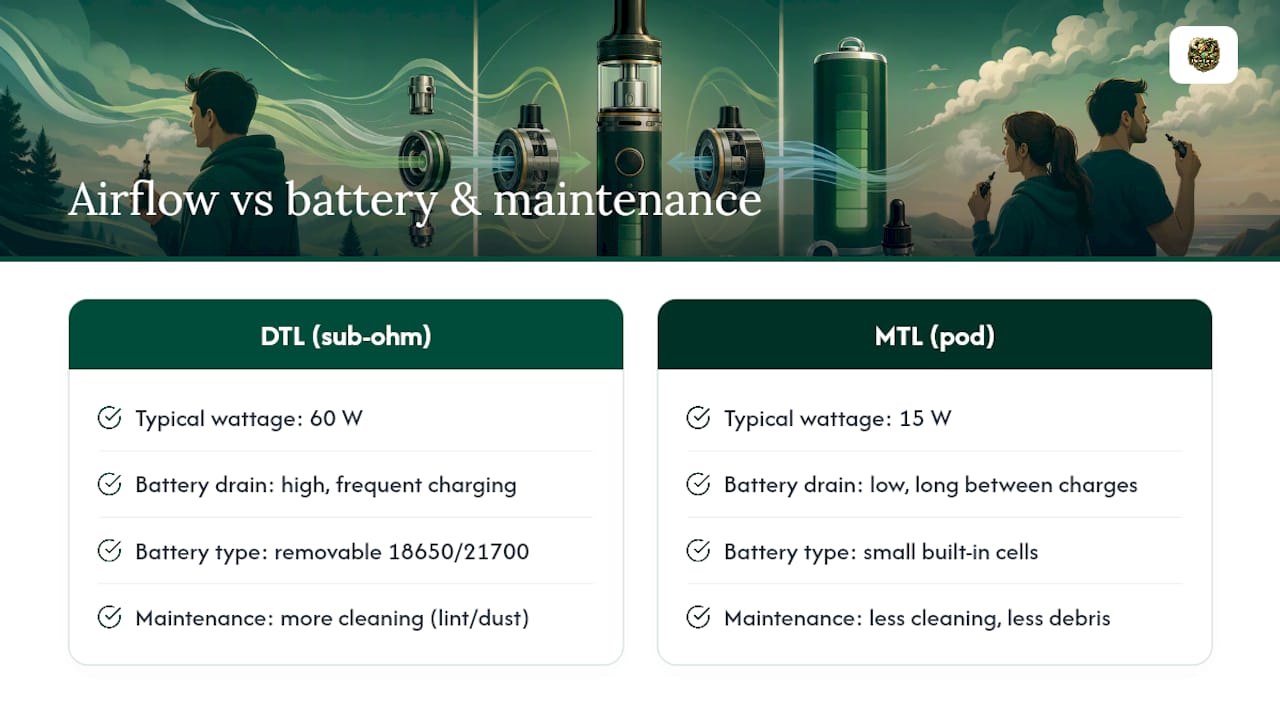
A DTL setup running at 60 watts drains a battery noticeably faster than an MTL setup sipping along at 15 watts, even with the same battery capacity. If you’re vaping a sub-ohm tank on a box mod, expect more frequent charging or a need for spare batteries compared to a tight-draw pod system.
There’s a maintenance angle too. Wider airflow settings pull in more ambient air, and that air carries dust and lint that can settle around the coil and airflow ports over time. Devices run wide open need more frequent cleaning of the airflow ring and chamber than tightly closed MTL setups, where less air movement means less debris intake.
Battery type matters here as well. Devices with adjustable wattage and open airflow, built for sub-ohm coils, almost always run on removable 18650 or 21700 cells rather than small built-in batteries, precisely because higher-wattage, high-airflow vaping draws down capacity faster than a low-power MTL device ever will. If you’re constantly recharging a pod system with the airflow wide open, dropping it back to a narrower setting is often the simplest fix, alongside checking whether your coil resistance actually calls for that much wattage in the first place.
How Does Airflow Design Differ Across Pod Systems, Box Mods, and RDAs?
Pod systems keep airflow simple by design. Most use a fixed or two-position slider near the base of the pod, giving you tight or slightly-less-tight options rather than a full range. That’s intentional. Pod systems target MTL and light RDL vaping, so manufacturers don’t build in the wide-open range a DTL vaper would want.
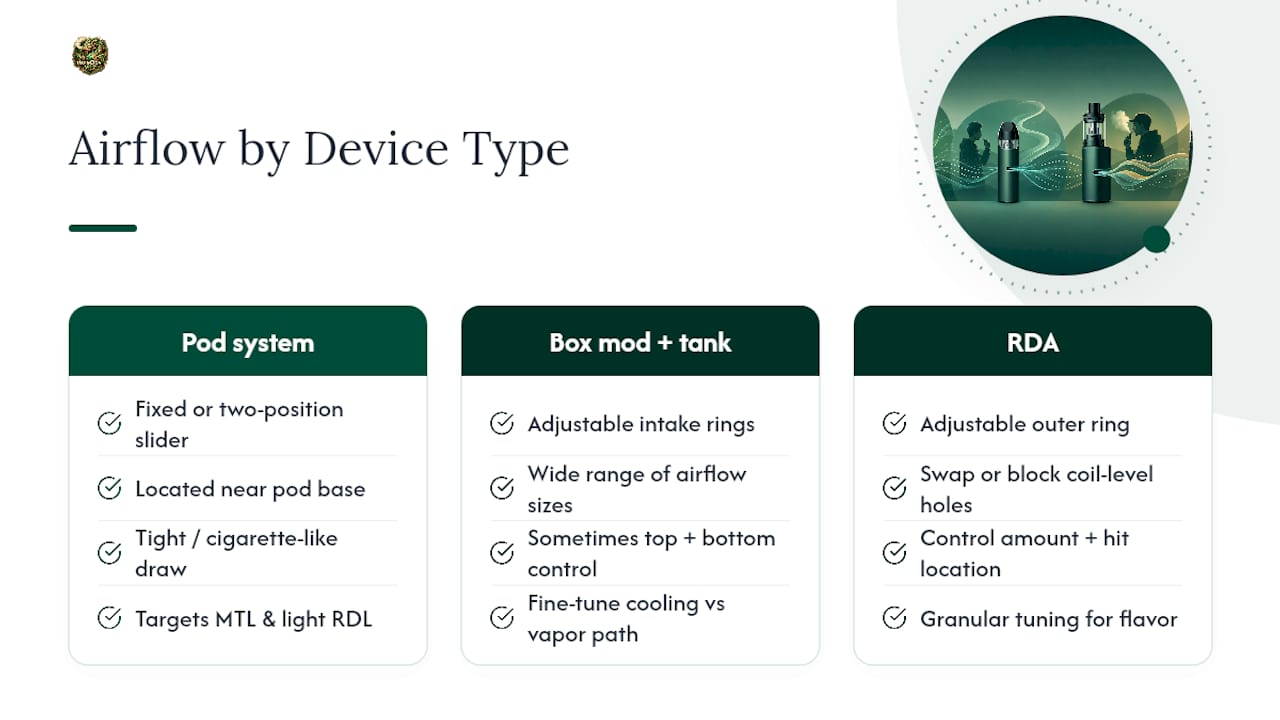
Box mods paired with sub-ohm tanks take the opposite approach. These tanks often have adjustable rings with a much wider range of intake sizes, sometimes with separate top and bottom airflow controls that let you fine-tune cooling independently of vapor path. That range exists because box mod users span the whole spectrum from RDL to aggressive DTL cloud chasing.
RDAs (rebuildable dripping atomizers) push airflow customization furthest. Beyond an adjustable outer ring, many RDAs let you swap or block specific airflow holes near the coil itself, changing not just how much air enters but exactly where it hits the coil. That granular control is why RDA builders can chase specific flavor profiles that sealed tanks can’t quite replicate.
The practical takeaway: if you want maximum airflow flexibility, box mods and RDAs give you the most range. If you want simplicity and a cigarette-like draw without fiddling with rings, pod systems handle that job with far less complexity.
Can the Wrong Airflow Setting Cause Overheating?
Airflow acts as the cooling system for your coil, not just a flavor adjustment. When you restrict airflow too far, especially at wattages suited for a wider-open setup, there isn’t enough moving air to pull heat away from the coil fast enough. That’s when you get the dry, burnt taste that signals a coil running hotter than it should.
Opening airflow wider actually helps you run higher wattages safely, since the airflow explanation from Vape Observation confirms that more airflow dilutes and cools vapor as it passes through the chimney. That’s the same mechanism protecting the coil from overheating.
The danger runs both directions, though. A tight airflow setting paired with a low-resistance sub-ohm coil at high wattage is close to a worst-case scenario for coil life and vapor quality, since the coil generates far more heat than the restricted airflow can carry off. If you notice a metallic or burnt taste creeping in that wasn’t there before, check your airflow setting before you assume the coil itself has failed. Sometimes closing airflow slightly on a struggling wick fixes a dry hit, but if you’re running high wattage on a sub-ohm coil, opening airflow wider is almost always the safer move.
Author Perspective: Match Hardware Before You Tune Airflow
Get the coil and device pairing right first. Airflow only fine-tunes an already-correct setup, it can’t fix a coil resistance that’s wrong for your wattage or nicotine strength. When you do experiment, change one variable at a time. Adjust airflow, test it, then move on to wattage. Change both together and you’ll never know which one actually fixed or ruined your vape.
— James
Gear That Matches Your Airflow Setup
Once you know which draw style you’re chasing, the coil and pod choice practically picks itself. If you’re running a tight or mid airflow setup and need reliable replacements, the Smok Vape Pen V2 Coils 5pk covers the higher-resistance builds that suit MTL and light RDL vaping without forcing you to guess at compatibility.
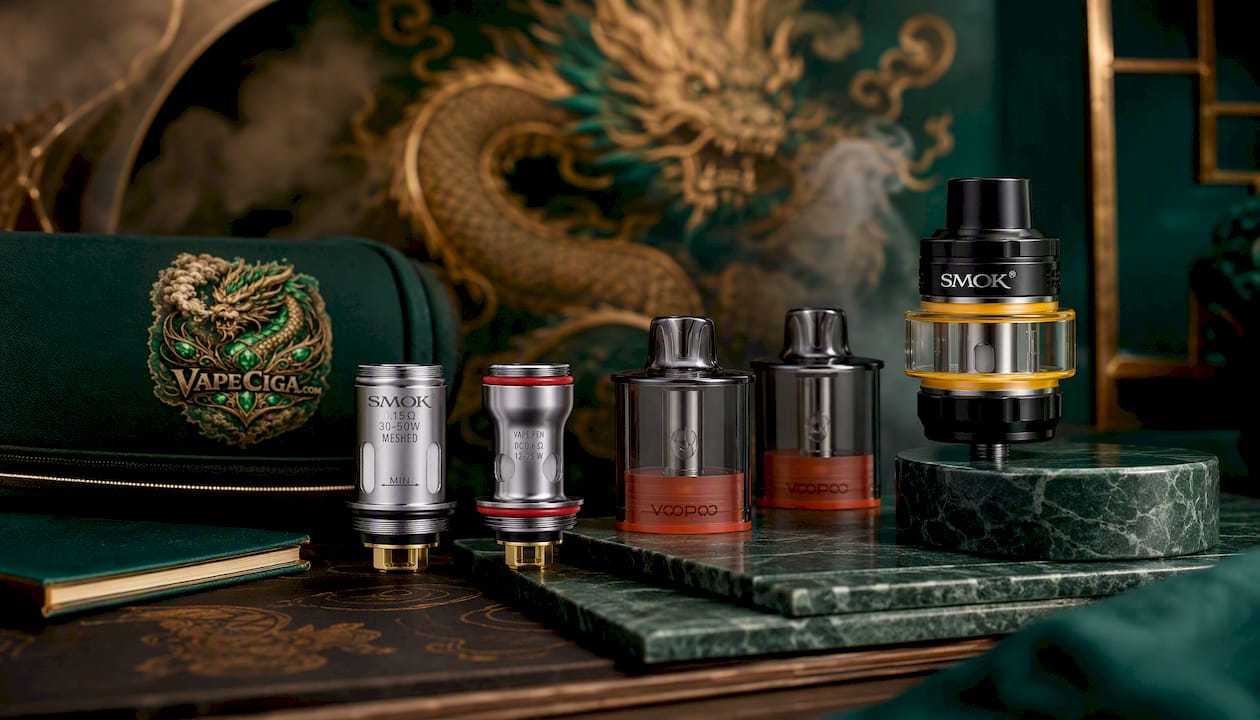
Pod vapers dialing in that tight-to-mid draw should look at the VOOPOO VRIZZ V2 Pods 2pk, built around the airflow range most pod systems are designed for in the first place. If you’re heading the other direction toward wide-open DTL clouds, the Smok T-Air Subtank gives you the adjustable airflow range and sub-ohm coil compatibility that tight tanks simply can’t offer. These products are shipped domestically, helping to minimize wait times for replacements. Browse the current coil and pod selection and get the right part on its way today.
Sources
For deeper troubleshooting context beyond vaping itself, Paradigm’s breakdown of cigar draw and burn problems covers similar airflow and combustion mechanics from a different angle, useful if you want to understand draw resistance more broadly.
- How to Adjust the Airflow on a Vaping Device | Vape Observation
FAQ
What Is the Best Airflow Setting on a Vape?
There’s no single best setting. It depends on your draw style: tight for MTL and high-nicotine salt juice, mid for RDL, and wide open for DTL sub-ohm setups chasing big clouds.
Is It Better to Have the Airflow Open or Closed on a Vape?
Neither is universally better. Open airflow gives cooler vapor and bigger clouds with milder flavor, while closed airflow gives warmer vapor with concentrated flavor and a stronger throat hit.
Is Higher or Lower Airflow Better for Vaping?
Higher airflow suits sub-ohm coils, low-nicotine e-liquid, and cloud chasing, while lower airflow suits high-resistance coils and high-nicotine salt juice for a cigarette-like draw. Match the airflow to your coil and juice rather than picking one as objectively better.
Does More Airflow on a Vape Make It Hit Harder?
More airflow generally softens throat hit because it dilutes the vapor with cooler air. If you want a stronger throat hit, close the airflow down rather than opening it further.
How Often Should I Clean the Airflow Ring on My Device?
Wipe down the airflow ring whenever you notice whistling, reduced draw, or visible condensation, which for most daily vapers means roughly every one to two weeks.