


No federal law bans vaping inside a car, and in most states, puffing on a nicotine vape while driving stays perfectly legal. The exceptions are what trip people up: vaping THC counts as drugged driving everywhere, several states specifically outlaw vaping with kids in the vehicle, and any vaping behavior that visibly impairs your driving can get you cited under ordinary traffic law. If minors are in the car or you’re using a THC device, don’t vape. Everything else falls into a state-by-state gray zone worth understanding before you assume you’re in the clear.
TL;DR:
- Vaping nicotine and CBD in a car is generally legal unless it causes unsafe driving behavior or involves minors, while THC vaping is considered impaired driving everywhere.
- States are increasingly updating laws to explicitly include vaping devices, with some making smoking and vaping restrictions with minors a primary offense.
- Most citations related to vaping behind the wheel come from distracted driving, obstructed visibility, littering, or THC impairment rather than the act of vaping itself.
- Penalties for vaping with minors are typically modest, but DUI or distracted-driving charges can lead to license suspensions, hefty fines, and increased insurance premiums.
- Always verify your state’s specific laws through official sources, as local ordinances and law language vary and influence enforcement chances.
Table of Contents
- Vape in Car Laws USA: The Federal Baseline and State Patchwork
- State Rules on Vaping With Minors in the Car
- When Vaping While Driving Actually Gets You Pulled Over
- Penalties, Points, and Insurance Fallout
- How to Verify the Law Where You Live
- Why VapeCiga Covers the Legal Side of Vaping
- A Publisher’s Take on Vaping and Driving
- Adult Vape Devices for Off-the-Road Use
- Sources
- FAQ
Vape in Car Laws USA: The Federal Baseline and State Patchwork
There’s no federal statute prohibiting vaping behind the wheel. The Food and Drug Administration and the EPA regulate device manufacturing, marketing, and public-health exposure, not what you do with your own vape on a private drive to work. That leaves traffic law entirely up to the states, and the results vary more than most drivers expect.
Here’s the mechanic that actually matters: states don’t need a vape-specific law to ticket you. Distracted-driving and negligent-driving statutes already on the books can apply to a driver who’s fumbling with a pod, refilling a tank, or exhaling a cloud thick enough to block the windshield. An officer doesn’t need a “no vaping” law to write you up if your driving looks unsafe because of what you’re doing with the device in your hand.
Nicotine and CBD vaping occupy a different legal category than THC vaping, and the line between them is absolute. Nicotine vaping while driving is treated like any other minor in-car activity, legal by default unless it causes unsafe driving or violates a minors-in-vehicle law. THC vaping while driving is impaired driving, full stop, regardless of state.
Whether a state’s law even touches vaping often comes down to a few words buried in the statute. Older smoking laws written before e-cigarettes existed sometimes only cover combustion, meaning a judge has to decide whether “smoking” includes vapor at all. Newer laws close that gap by naming the devices directly.
- Statutes using “electronic smoking device” or “inhalant delivery system” explicitly cover vapes, no interpretation needed
- Older statutes that just say “smoking” may or may not apply to vaping, depending on how a court reads the word
- Legal trackers note a steady trend of states updating this language, which means fewer ambiguous cases each year
- Distracted-driving and careless-driving statutes apply regardless of whether “vaping” is named anywhere in the code
State Rules on Vaping With Minors in the Car
A handful of states have gone further than federal or general traffic law and passed statutes specifically targeting smoking or vaping in a vehicle when a child is present. The CDC’s STATE System tracks these laws because vehicles are a documented source of secondhand smoke exposure for kids, and the aerosol from e-cigarettes raises similar air-quality concerns in an enclosed cabin.
California is the most cited example. Under California Health and Safety Code 118948, smoking is prohibited in a vehicle with a minor present, and the state has extended similar reasoning to e-cigarettes in public-health guidance. Louisiana, Oregon, and Utah all have their own versions of vehicle smoking restrictions tied to minors, but the age threshold isn’t standardized. Some states draw the line at under 18, others under 14 or under 8, so a law that applies to your teenager in one state might not apply at all across the border.
By the Numbers: The CDC’s STATE System fact sheet on vehicle smoking laws shows that state adoption of these bans has been steady but uneven, with meaningful differences in which ages and which devices each law actually covers.
Enforcement design is where things get interesting, and it’s the detail most drivers never check. Some states make vaping with a child in the car a secondary offense, meaning an officer can only add it to a citation after pulling you over for something else. Other states make it a primary offense, meaning the vaping itself is grounds for the stop. Tennessee’s HB1456, for example, structures its vehicle smoking restriction as a nonmoving violation, which limits an officer’s ability to stop a car solely for that reason. That single design choice determines whether the law is mostly symbolic or genuinely enforceable on the road.
If you want to know exactly where your state lands, a few search habits help:
- Search your state code for “electronic smoking device,” “vapor product,” or “inhalant delivery system” rather than just “vaping”
- Check whether the statute lists an age threshold for minors in the vehicle
- Look for the words “primary offense” or “secondary offense” in the enforcement section
- Check your city or county website separately. Local ordinances can add restrictions state law doesn’t cover
When Vaping While Driving Actually Gets You Pulled Over
Vaping itself rarely triggers a stop. The behavior around it does. Four scenarios account for most real-world citations tied to vaping in a car.
- Distracted driving. Taking a hand off the wheel to operate a device, refill a pod, or adjust airflow settings looks identical to texting in an officer’s eyes, and it’s cited the same way under most states’ distracted-driving statutes.
- Obstructed visibility. A dense cloud that fogs the windshield can be treated as a careless or negligent driving violation, since it impairs your own ability to see the road.
- Littering or fire hazard. Tossing a spent disposable or a battery out the window can trigger state litter and hazardous-waste statutes separate from anything related to vaping itself.
- DUI/DUID from THC. Vaping cannabis while driving is treated as drug-impaired driving in every state, and no state permits impaired driving with cannabis under any circumstance.
Pro Tip: If you vape in the car at all, keep it to a full stop at a red light or while parked, never mid-lane-change. Most citations tied to vaping trace back to the driving, not the device.
Penalties, Points, and Insurance Fallout
Fines for vehicle-smoking-with-minors laws tend to run modest for first offenses, and most states treat them as nonmoving violations that don’t add points to your license. That changes fast once a related charge escalates.
- A distracted-driving citation tied to vaping can be a moving violation, which does add points in most states
- A DUI or DUID charge from THC vaping carries far heavier penalties: license suspension, fines well into four figures, and possible jail time on repeat offenses
- Insurance carriers treat vaping-related citations similarly to smoking-related ones, and a moving violation or DUI on your record can raise premiums for years
- If an accident happens while you were vaping and visibility or distraction contributed, liability exposure increases regardless of who else was involved
Repeat offenses, injury, or any sign of impairment push a case from a simple ticket into criminal territory fast. That’s the point where talking to a lawyer stops being optional.
How to Verify the Law Where You Live
State codes change, and the surest way to know your actual risk is to check the primary source rather than a summary blog. Search your state legislature’s website for “electronic smoking device” or “vapor product” alongside “motor vehicle,” and read the enforcement section closely for age thresholds and primary versus secondary offense language.
- Your state legislature’s official website, searchable by bill number or code section
- Your state health department’s page on tobacco and vaping policy
- The CDC STATE System, which tracks vehicle smoking laws by state
- USA.gov for general guidance on how state and federal law divide authority
- Your city or county clerk’s office for local ordinances that layer on top of state law
If a ticket doesn’t match what the statute actually says, or the language is genuinely ambiguous, a local traffic attorney can read the specific wording faster and more reliably than any online guide.
Why VapeCiga Covers the Legal Side of Vaping
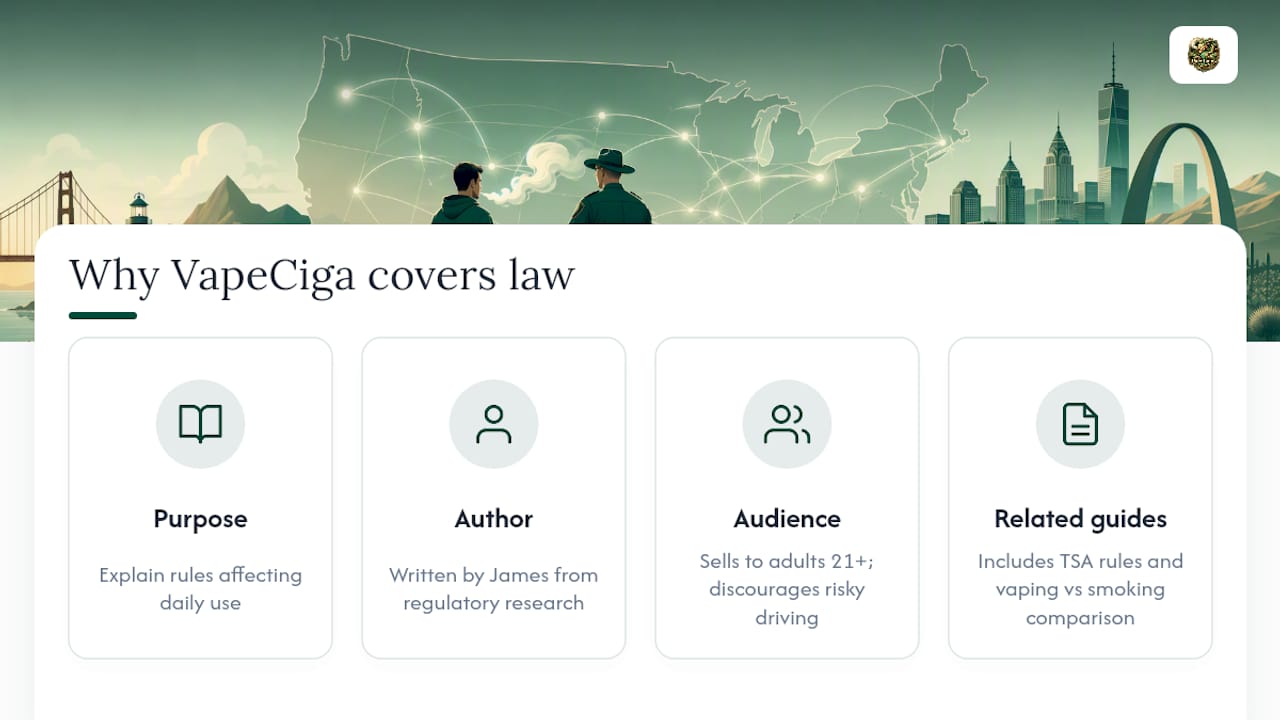
An online vape store serving adult vapers aims to provide clear information about the rules that affect daily use, not just product specs. This guide was written by James, drawing on the same research used across VapeCiga’s other regulatory guides, including a breakdown of TSA rules for air travelers and a fact-based look at what the vaping data actually shows.
Readers who want more background on how regulators distinguish vaping from combustible smoking can check this comparison of vaping and smoking, which explains why some older statutes don’t automatically cover e-cigarettes. The store offers devices for adults 21 and over and does not encourage risky behavior behind the wheel. The goal here is simple: help adult vapers understand the actual law, not the version that shows up in comment sections.
A Publisher’s Take on Vaping and Driving
The safest rule isn’t complicated: don’t vape while driving if you can avoid it, and never vape THC behind the wheel under any circumstance. State laws on minors in the vehicle exist because kids in an enclosed cabin have no way to opt out of what’s in the air, and that argument holds regardless of whether your state has caught up to it yet. Following the rules in your state protects more than your driving record. It protects your insurance rate and the people riding with you. If you vape, save it for when the car is parked, and check the product safety notes below before your next purchase.
— James
Adult Vape Devices for Off-the-Road Use
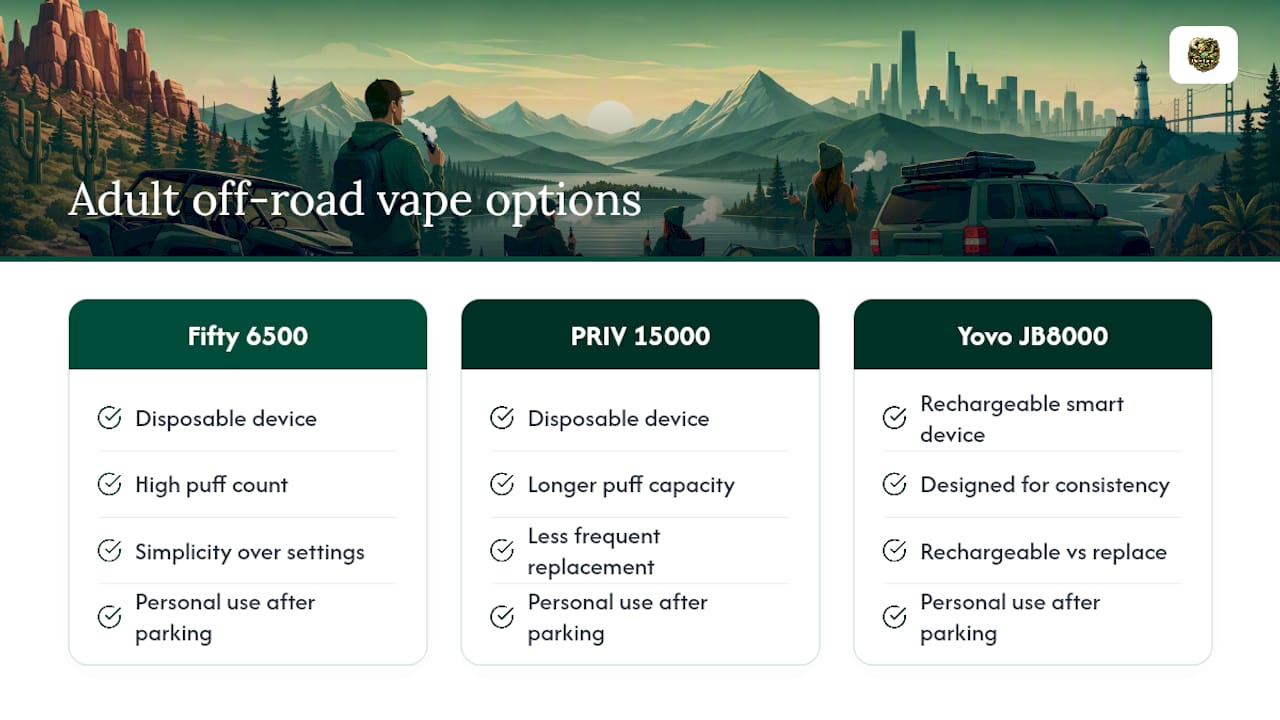
If you’re picking up a new device for use outside the driver’s seat, VapeCiga carries a lineup built for adults 21 and over who want reliable performance without the guesswork. The Fifty Bar 6500 is a straightforward disposable with a big puff count for anyone who wants simplicity over settings.
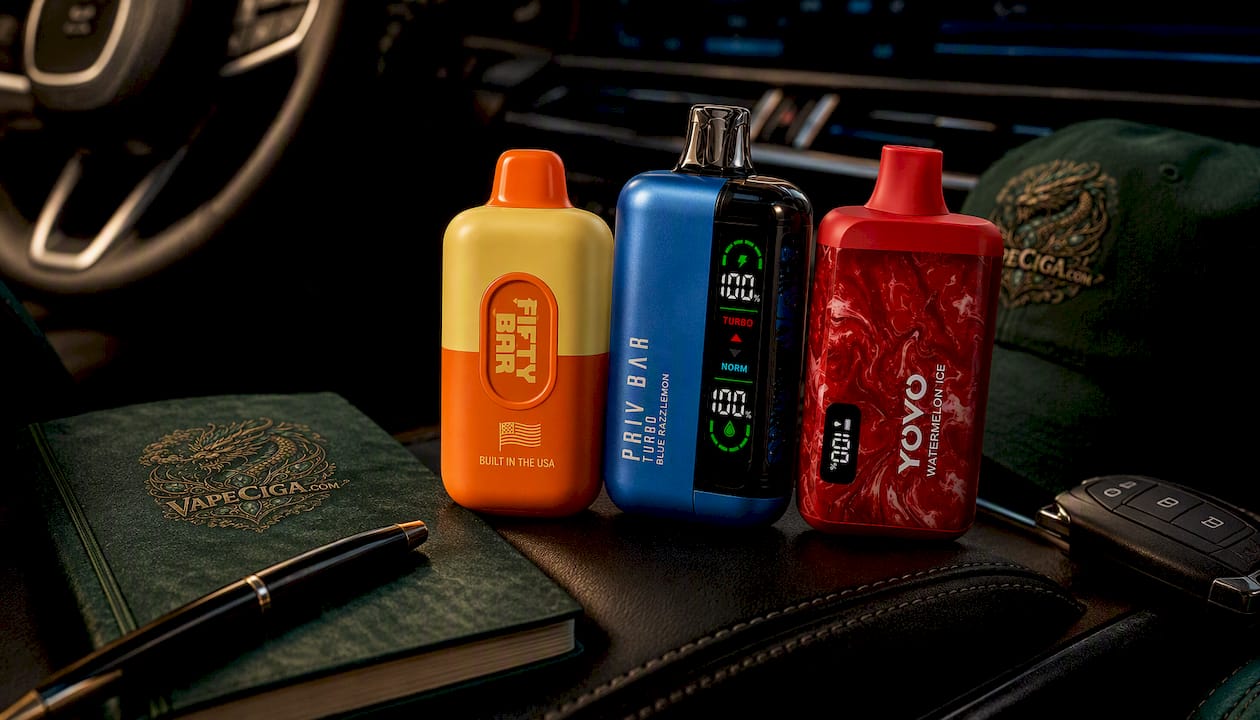
For a longer-lasting option, the PRIV Bar Turbo 15000 pushes puff capacity even further, which matters if you’re the type who doesn’t want to think about swapping devices every few days. If you’d rather recharge than replace, the Yovo JB8000 Smart is a rechargeable smart device built for adults who want consistency over the long haul.
Every one of these is meant for personal use once the car is parked, not for the drive itself, and never with a minor in the vehicle. Browse the full lineup and place an order through VapeCiga’s online store to get a compliant, age-verified device shipped to your door.
This article is general information, not a substitute for advice from a qualified lawyer. Consult a qualified legal professional about your own circumstances before acting on anything here.
Sources
- STATE System Vehicles Fact Sheet
- Is it illegal to vape and drive?
- Secondhand smoke and electronic cigarette aerosols | US EPA
- Is It Legal to Smoke or Vape While Driving? | The Zebra
FAQ
Is It Illegal to Vape and Drive in the USA?
No federal law bans it, and nicotine vaping while driving is legal in most states unless it causes distracted or unsafe driving, or a minor is in the car under a state law that specifically restricts it.
Can You Drive if You’ve Vaped?
If you vaped nicotine or CBD, you can legally drive as long as your driving isn’t impaired. If you vaped THC, you cannot legally drive afterward. It’s treated as drugged driving in every state.
What States Are Restricting Vaping With Minors in Vehicles?
California, Louisiana, Oregon, and Utah all have laws restricting smoking or vaping in a car with a minor present, though the age threshold and penalties vary by state, so check your state’s specific code.
Can You Tell if Someone Has Vaped in a Car?
Vapor dissipates faster than cigarette smoke and often leaves less lingering odor, but a strong flavor scent or visible residue on windows can still be noticeable, especially in a closed vehicle right after use.
Is Vaping THC While Driving Treated Differently Than Nicotine Vaping?
Yes. THC vaping while driving is treated as drugged driving nationwide, with no state exception, while nicotine vaping is regulated only through general traffic and distracted-driving statutes.