


Vaping while charging is generally not safe, even on devices built for it. Pass-through charging, the feature that lets you hit your device while it’s plugged in, reduces some risk compared to older tech, but it doesn’t eliminate the extra heat and electrical stress on the battery. The safest habit is simple: unplug before you puff.
That said, not every situation carries equal risk. A device with a fresh, integrated battery and a manufacturer-approved USB-C charger is a different animal than a cracked mod running a counterfeit 18650 cell on a bargain-bin adapter. The danger scales with battery condition, charger quality, and how long you keep firing while plugged in.
- Lowest risk: Integrated battery, OEM charger, short sessions, device stays cool.
- Highest risk: Removable cells, mismatched or damaged batteries, unbranded fast chargers, overnight use.
Quick Fact: Fire investigators at the U.S. Fire Administration have documented battery-charging incidents tied to e-cigarettes, which is why supervision during any charging cycle matters, pass-through or not.
Keep reading for the safe-charging checklist and the warning signs that mean you should stop immediately.
Key Takeaways
Vaping while charging always adds extra heat and electrical stress to a lithium-ion battery, and the safest habit is to unplug before you use your device.
| Point | Details |
|---|---|
| Pass-through reduces, doesn’t remove, risk | Chipset prioritization manages power routing but can’t fix a damaged or counterfeit cell. |
| Battery type changes the rules | Charge removable 18650/21700 cells externally; integrated batteries are generally fine in-device with OEM chargers. |
| Inspection comes before every charge | Swelling, corrosion, odd smells, or dents mean stop using the device and dispose of the battery safely. |
| Avoid unsupervised overnight charging | Charge on a hard, non-flammable surface while you’re awake and nearby. |
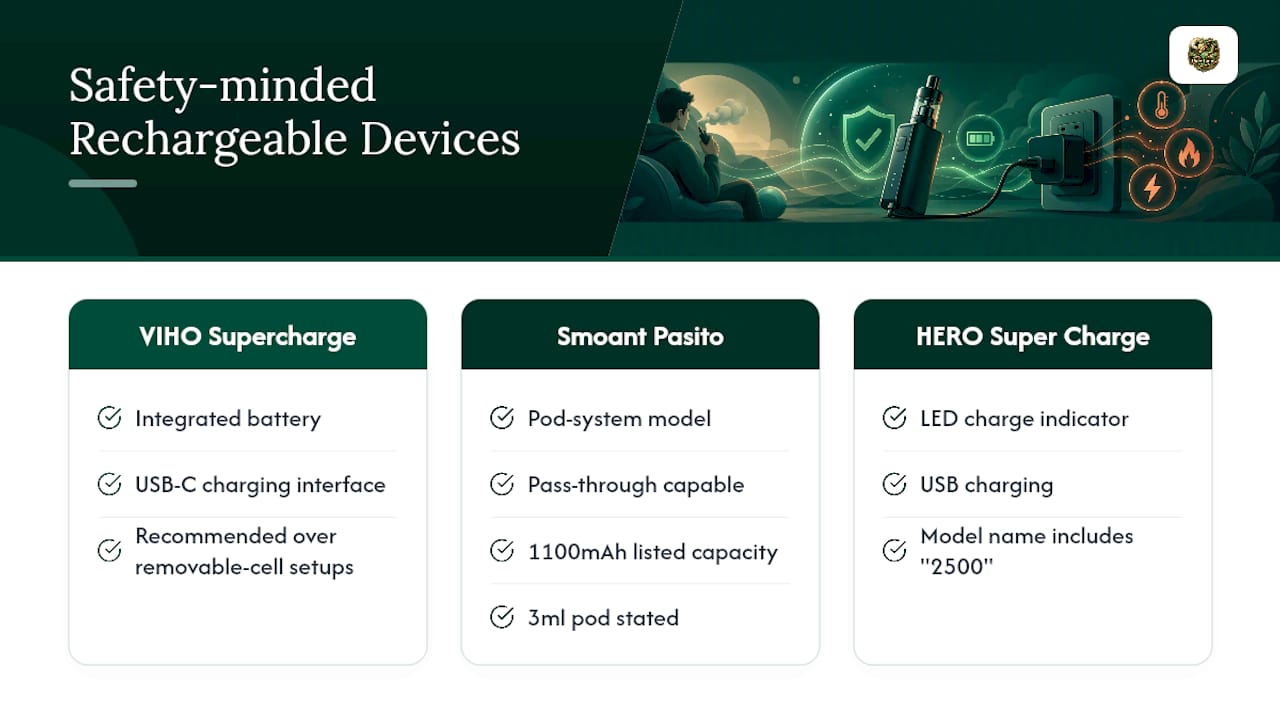
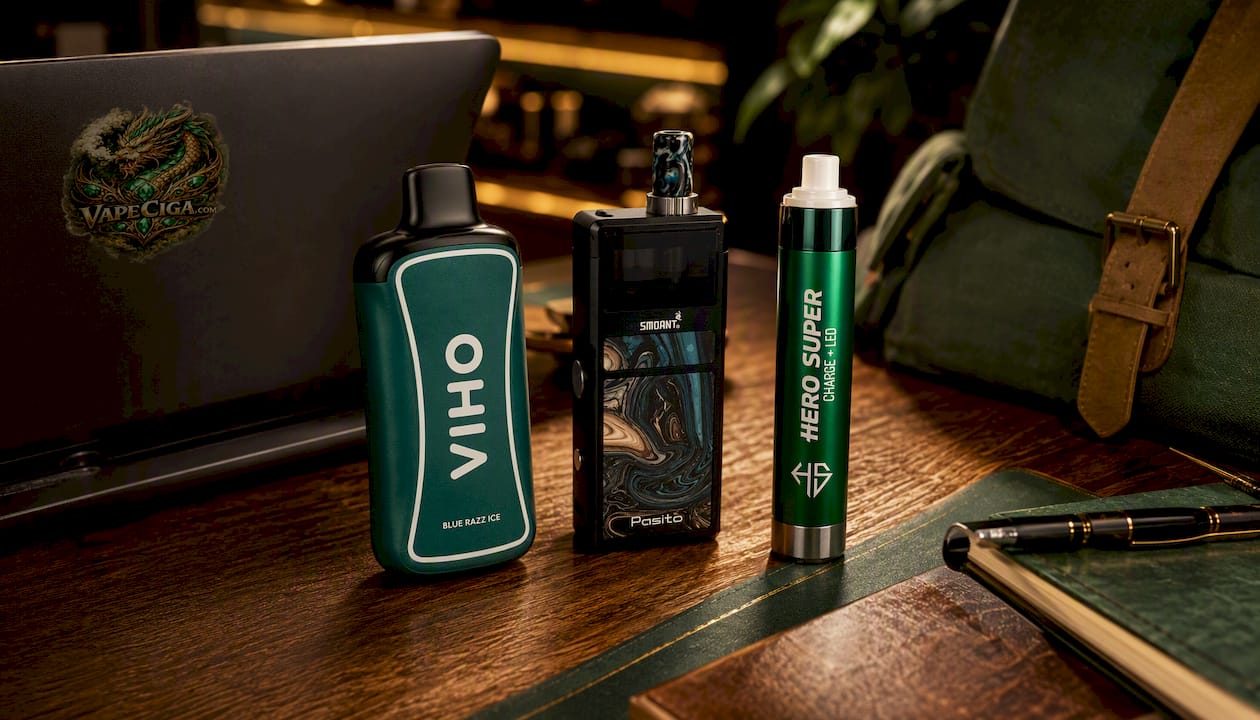
| VapeCiga stocks safety-forward rechargeables | The VIHO Supercharge 20K, Smoant Pasito, and HERO Super Charge + LED 2500 all pair integrated batteries with USB-C charging interfaces. |
Table of Contents
- Why Vaping While Charging Puts Extra Stress on Lithium-Ion Batteries
- Pass-Through Charging Explained: What It Protects Against and What It Doesn’t
- Integrated Batteries vs. Removable Cells: Different Rules Apply
- The Safe-Charging Checklist You Can Use Today
- When Vaping While Charging Becomes Especially Dangerous
- How VapeCiga Approaches Charging Safety in Its Product Guidance
- What Actually Matters Here, and What Doesn’t
- Rechargeable Devices Built With These Safety Standards in Mind
- Sources
- FAQ
Why Vaping While Charging Puts Extra Stress on Lithium-Ion Batteries
A lithium-ion cell generates heat just from charging. Add firing on top of that, and you’re asking the same battery to accept incoming current and discharge outgoing current at nearly the same moment. That tug-of-war raises the cell’s internal temperature beyond what either process would cause alone.
Every time you pull on your device while it charges, you create a tiny discharge event layered on top of the charge cycle. Battery engineers call this a micro cycle, and repeated micro cycling increases internal resistance over time. Higher internal resistance means the battery has to work harder to deliver the same power, which generates even more heat on future charges. It’s a feedback loop, and it’s the reason batteries that get vaped-on-while-charging regularly tend to degrade faster than ones that don’t.
The practical fallout shows up in two ways: shortened battery lifespan and a higher chance the cell overheats under stress it wasn’t originally rated for. Neither outcome is dramatic on its own, but they compound.
- Charging alone raises cell temperature.
- Firing alone raises cell temperature.
- Doing both simultaneously stacks the two effects.
- Repeated stacking increases internal resistance and reduces usable battery life.
There isn’t a large body of independent lab research specifically measuring vape battery degradation under simultaneous charge and discharge. What does exist is fire-safety documentation. The USFA/FEMA brief on electronic cigarettes catalogs real incidents connected to charging, which is the closest thing to hard evidence that charging-related stress on these batteries is a genuine fire-safety concern, not a theoretical one.
Pass-Through Charging Explained: What It Protects Against and What It Doesn’t
Pass-through charging routes incoming power straight through the device so you can fire it while the battery charges, instead of forcing you to wait until it’s full. The chipset inside manages this by prioritizing whichever demand is more urgent at that instant, either feeding the coil or feeding the battery.
That prioritization is smart engineering, but it’s not a safety guarantee. According to one industry explainer on pass-through charging, chipset protections cut down on many of the risks older devices had, but they can’t compensate for a battery that’s already damaged, counterfeit, or mismatched to the device’s specs. Protection circuits assume a healthy cell. Feed them a swollen or degraded one, and the safeguards have far less to work with.
You can typically tell if your device supports true pass-through by checking a few things:
- The user manual explicitly mentions “pass-through” or “charge while use.”
- The device has a dedicated charging port separate from any battery door.
- Firing while plugged in doesn’t cause the device to shut off entirely.
In real-world use, pass-through devices often behave in predictable ways: the charge light pauses or dims while you’re pulling on the device, and the overall time to reach a full charge stretches out compared to charging with no vaping at all. That’s the chipset doing its job, splitting attention between two demands instead of ignoring one.
Integrated Batteries vs. Removable Cells: Different Rules Apply
Not all vape batteries carry the same charging risk, and the type inside your device should change how you charge it.
Removable 18650 or 21700 cells are the higher-risk category for in-device charging. These cells were originally designed for external chargers with dedicated temperature and voltage monitoring built into the charger itself, not the device housing them. When you charge them inside a mod, you’re relying on the mod’s own circuitry to do a job an external charger is built specifically to handle. One technical guide on charging vape kits recommends pulling removable cells and charging them externally rather than in the device, and that advice holds regardless of how new the mod is.
Integrated batteries are a different story. Sealed, non-removable batteries paired with a manufacturer-approved charger are generally fine to charge in-device, since the manufacturer has already matched the battery, the charging circuit, and the housing to work together as one system.
A few rules to keep in mind:
- Use the charger and cable that came with your device, or a direct manufacturer replacement.
- Match charger output to what the device specifies. A higher-amp fast charger isn’t automatically better; it’s more current pushed through the same small cell, which means more heat.
- Inspect cables regularly. Fraying, exposed wire, or a loose connector are reasons to replace a cable, not tape it up.
- Avoid off-brand USB-C chargers pulled from unrelated electronics; output specs vary more than people expect.
Pro Tip: If your device supports USB-C fast charging, check the wattage rating in the manual before pairing it with a high-output wall adapter. Faster charging isn’t free. It trades speed for heat, and the battery absorbs that difference.
The Safe-Charging Checklist You Can Use Today
Run through this before you plug in, and again before you decide to hit it while it’s charging.
- Inspect the device and battery first. Look for swelling, dents, discoloration, or a battery door that no longer sits flush.
- Stop immediately if you spot damage. A compromised cell doesn’t get safer with one more charge cycle.
- Use the manufacturer’s charger and cable. Skip the generic charger in your kitchen drawer.
- Avoid overnight, unsupervised charging. Charge when you’re home and awake, not while you’re asleep or out of the house.
- Charge removable cells externally. Never vape while an 18650 or 21700 cell is charging outside the device either. Keep firing and charging fully separated for removable batteries.
- Set the device on a hard, non-flammable surface. A wood desk or metal tray beats a couch cushion or bedspread.
- Stop charging if the device feels unusually warm. Warm-to-the-touch during a charge cycle can be normal; hot enough that you want to put it down is not.
Quick recap of what to avoid entirely:
- Charging on soft furniture or bedding.
- Leaving a charging device unattended for hours.
- Mixing chargers between unrelated devices.
- Continuing to use a battery after you’ve noticed it’s swollen.
When Vaping While Charging Becomes Especially Dangerous
Some situations push the risk well past “generally not recommended” into “stop now.” A swollen, dented, or leaking cell is the clearest signal. Lithium-ion batteries swell when internal gas builds up from a breakdown in the cell’s chemistry, and that’s not a condition that improves with another charge cycle. Corrosion around battery contacts, an odd chemical smell, or visible scorching on the device housing all belong in the same category: stop using it and dispose of the battery properly.
Counterfeit or unbranded batteries deserve particular caution. A cell with mismatched specs, an unfamiliar label, or a suspiciously low price often lacks the protection circuitry a legitimate cell includes. Pair that battery with a high-amp adapter that pushes more current than the device was designed for, and you’ve stacked two risk factors that individually might be manageable and made them dangerous together.
- Swollen, dented, or leaking battery: stop and dispose of it safely.
- Corrosion on contacts or an unusual smell: stop using the device.
- Counterfeit or unlabeled cells: replace before your next charge.
- High-amp charger paired with a low-rated device: switch to a matched charger.
Pro Tip: If a device ever starts smoking or becomes hot enough to feel alarming, unplug it if you can safely reach the cord, move it to a non-flammable surface away from anything combustible, and do not inhale from it under any circumstances. The USFA fire-safety brief documents real incidents that started exactly this way.
How VapeCiga Approaches Charging Safety in Its Product Guidance
Battery and charging safety isn’t an afterthought bolted onto a product description. VapeCiga’s own Ohm’s Law safety article walks through the electrical basics that determine whether a given battery and coil combination is running within safe limits, the same math that underlies why charger mismatches and damaged cells matter.
Product listings matter here too. When a device page specifies a USB-C charging interface, lists chipset protections like overcharge cutoff, and states the battery type clearly, that’s information you can actually use to judge charging risk before you buy, not after.
James, who covers vaping hardware and safety for VapeCiga, cross-checks manufacturer spec sheets against charging behavior described in product manuals before recommending any device for pass-through use. That’s the same standard applied throughout this guide.
- VapeCiga’s Ohm’s Law article explains the electrical checks behind safe device operation.
- Product listings that specify USB-C interfaces and chipset protections give you a way to compare devices before purchase.
- Author review of device specs focuses on charging behavior, not just flavor or vapor output.
What Actually Matters Here, and What Doesn’t
Most advice on this topic gets stuck on a binary: charging while vaping is either fine or it’s a fire hazard waiting to happen. Neither framing holds up. The real variable is battery condition, and almost nobody talks about it in those terms.
A five-month-old device with a healthy integrated cell and its original charger carries a fraction of the risk of a two-year-old mod running a swapped-in 18650 nobody’s inspected since the day it was bought. Pass-through chipsets get credit for solving a problem they only partially solve. They manage power routing well. They cannot compensate for a cell that’s already degrading.
The public-health concern around pass-through is worth taking seriously too, and it’s not about fire risk at all. Removing the natural pause that came with a dead battery may quietly push people toward more continuous use than they’d otherwise choose. That’s a behavioral risk, separate from the electrical one, and it deserves its own attention.
If you take one thing from this: inspect your battery before you trust your charger to.
— James
Rechargeable Devices Built With These Safety Standards in Mind
Not every device on the market makes it easy to check the boxes covered above, but some do. The VIHO Supercharge 20K runs on an integrated battery paired with a USB-C charging interface, exactly the combination this guide recommends over removable-cell setups for everyday charging.
For pod-system users, the Smoant Pasito Vape Pod System 1100mAh 3ml is a pass-through-capable option with a clearly listed battery capacity, which lets you judge charge time and firing behavior against actual specs instead of guessing. And if you want a device that leans into charging transparency, the HERO Super Charge + LED 2500 includes an LED charge indicator alongside USB charging, giving you a visual cue for exactly the kind of supervision this guide recommends.
None of these devices make pass-through use risk-free. Follow the manufacturer’s charging instructions that ship with each one, and treat this guide’s checklist as the baseline, not the ceiling. Browse the full lineup of rechargeable devices at VapeCiga’s shop to find one that matches your charging habits before your next order.
Sources
The safety claims in this guide draw on fire-safety and public-health sources built specifically around e-cigarette battery behavior, not general consumer-electronics advice.
- Product Watch: The new trend is vaping while charging – UW–CTRI
- Electronic cigarettes (USFA/FEMA PDF)
- Can You Still Vape While Your Kit Is Charging? And Is It Safe? – Vapekit
This article is general information, not a substitute for advice from a qualified doctor. Consult a qualified healthcare professional about your own circumstances before acting on anything here.
FAQ
Can I hit my vape while it’s charging?
Only if your device explicitly supports pass-through charging, and even then it’s best kept brief and occasional rather than routine, since it still adds heat and electrical stress to the battery.
Can I hit my vape right after charging finishes?
Yes. Once charging stops, the battery isn’t experiencing the simultaneous charge-and-discharge stress that makes vaping during charging riskier, so normal use afterward is fine.
Can I leave my vape on the charger overnight?
Unsupervised overnight charging isn’t recommended. Fire-safety guidance from the USFA/FEMA e-cigarette brief points to real incidents tied to charging, which is why staying nearby and awake during a charge cycle matters.
Is 100 puffs of vape a day bad?
That’s a nicotine-consumption and health question separate from charging safety; for background on the broader health and behavioral picture, see this overview of vaping’s health and lifestyle facts.
Does pass-through charging shorten battery life?
Repeated micro cycling from firing during a charge does increase internal resistance over time, which tends to shorten usable battery lifespan compared to charging without simultaneous use.
Are removable batteries riskier to charge than integrated ones?
Yes. Removable 18650 or 21700 cells are generally safer charged in a dedicated external charger rather than inside the device, while sealed integrated batteries paired with an OEM charger are built to charge safely in-device.